... in terms of aerospace industry. I am on record: I do not pretend to be a commercial aircraft industry analyst, albeit for a number of years I was certainly an insider. Once in a while I do make some reviews of the state of commercial aircraft industry and since Russia is fully "isolated", it makes sense to again point out the real dynamics in Russian and... Chinese commercial aircraft industries. I stumbled on an interesting video about Chinese C-919 and Russian MC-21.
This review is very important against the background of an ongoing tectonic shift in global economy with combined West not only losing it positions but being forced by the US to commit suicide by means of de-industrialization. We all can understand basic ramifications of all that and the fact that the US cannot fight Russia directly inevitably pushes the US towards much more aggressive posture against China. And here is some info on COMAC C-919.
As you can see yourself this aircraft will never be allowed to appear on the global market because it will be immediately "sanctioned" by the United States which is a supplier of C-919's US-French CFM Leap power-plant and pretty much most of avionics and other systems. And here is this strategic difference between COMAC and MC-21. Despite non-stop sabotage and sanctions from the US, MC-21 is increasingly Russified aircraft--even ever confused Wiki gives a good account on the Russian systems in MC-21, as well as other Russian aircraft.
MC-21 already has critical components, from engine PD-14 to APU by Aerosila, to avionics (KRET), to composites, to landing gear, to on-board systems. All Russian-made, making MC-21 invulnerable to sanctions due to proprietary issues which will be and already are making, as an example, C-919 a subject of sanctions. In other words, if ever C-919 will try to compete with single isle mid-range aircraft globally, it can easily be removed from competition on the same grounds as was the case with both MC-21 and SSJ-100. Naturally, full Russification of both is on track and the impact of that is much greater than mere invulnerability to proprietary claims from the combined West. It is strategic in terms of national security across the board, with independence from the West being a big prize. While PD-14 is already in serial production, the other crucial piece is also in the game:
And acceleration it did. I am on record for years, ad nauseam--if you do not have your own engines, APU, avionics and other systems, you do not really have own commercial (or any other) aerospace industry, period. No matter how one tries to spin it but any aircraft is primarily a platform for the engines and everything related to them and that is the most complex and most advanced part.
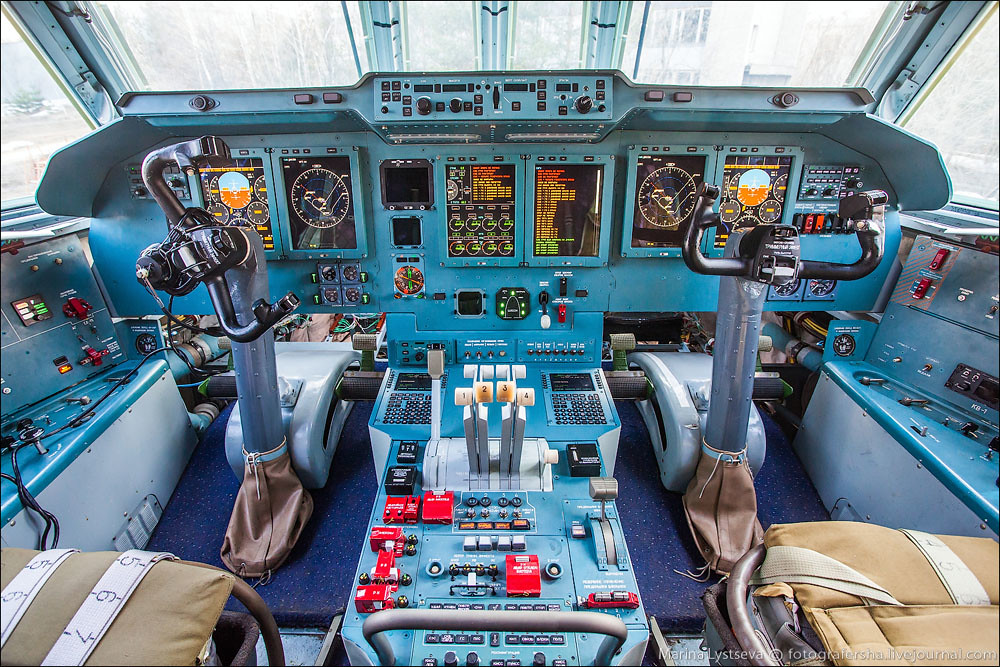
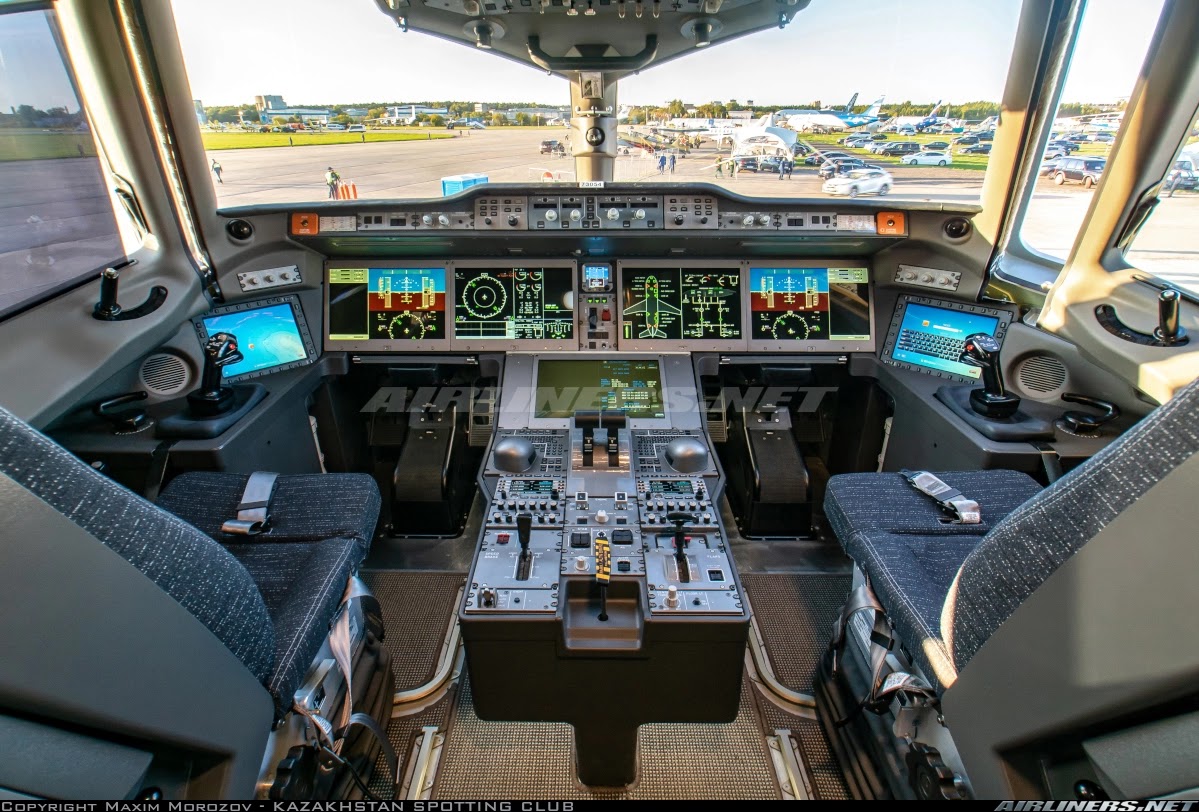
There are some variations of that for TU-214s and naturally MC-21 cockpit looks like that.
Generally, most commercial aircraft avionics suites look similar.
And that is why I am constantly on record, COMAC C-919 is not going to compete with A-320 newest iterations, because it is in effect a Chinese version of A-320. Russian aircraft are a completely different game and that is why from the inception, once it became clear that both SSJ-100 turned out to be a very competitive plane and MC-21 started to emerge as a viable competitor to both A-320 family, not to speak of a grossly damaged B-737 line, all hell broke loose and both aircraft have been sanctioned non-stop. Well, guess what, it made Russian commercial aerospace stronger. And that is a very bad news for both Airbus and Boeing. Not to mention the fact that they lost voluminous Russian market. Stupid is as stupid does(c), remember this?
For aerospace industry professionals this is without a doubt a historic (for some joyous, for others--sad) event with Russia's returning to the very exclusive, elite club of full cycle production of commercial aircraft with own world-class, high bypass engine PD-14 (and all derivatives which will follow). Huge event. Here is MC-21 with PD-14 on maiden flight.
I can not stress enough a significance of this event. You can count nations producing own top notch commercial jet engines on the fingers of one hand: United States, France, UK, Russia. The rest of the world--not even close.
Mark Chapman (The New Kremlin Stooge), thank you Mark, pointed out to this news which created a lot of consternation in Trump's Admin. As Russian daily Gazeta.Ru titled it: Nord Stream-2 Broke Through All Obstacles (in Russian). Denmark folded and the road to completion of this strategic pipe-line is open. Deutsche Welle reported on that. New sanctions from the US? You can bet your house and 401K, if your have any, on that. But the choice is Europe's (ahem, Germany's) if Germany still wants to preserve what's left of her industry, which, of course, is the matter of national survival. It is slightly more than mere bread and butter issue. Meanwhile Russians and Chinese begin to run the world in accordance to their own vision.
Russia and China have blocked a proposal
at the United Nations Security Council aimed at keeping open two border
crossings that channel aid into Syria’s opposition-held northwest from
Turkey. Russia, which backs Syrian President Bashar al-Assad in the conflict, previously made clear its intent to veto the proposal, despite last-minute hopes the Kremlin might abstain. According to Reuters, Russia and China want to approve only one aid crossing from Turkey for a period of six months.
Obviously, the UN definition of "opposition" is a complete baloney since involves a lot of jihadist element supported by the West and, before Western powers begin to shed crocodile tears about "humanitarian situation" in Syria, they, together with Turkey, better look in the mirror to see responsible for this catastrophe.
But if that wasn't bad enough for Western propensity to support all kinds of democratic jihadists, news from this Eurasian Front are getting even worse for the Empire which is the process of a complete implosion.
The author of this piece does provide a look at the rationale' for this new massive pipe-line for both sides. Of course, COVID-19 features prominently there and people from Moscow's Carnegie Center (why not then just go to CIA and ask directly) offer their views. China's rationale', however, is very clear: it is geopolitical and no amount of fluffy platitudes can obscure the unfolding of the conflict between the US and China and China's necessity to have energy supplies secured. No, of course, the author still tries to look academic and concludes:
Despite the favorable environment, it is yet to be seen whether a
deal can be struck. In the case of Power of Siberia-1, it took four
years to sign a contract from the moment terms and conditions were
agreed. Furthermore, construction took five years after the long-term
contract agreement was signed. Power of Siberia-2 could take a similar
amount of time meaning it could be operational around 2030. Gazprom’s
flexibility in considering the Mongolia route offers an additional
advantage. Russian gas could be supplied to the heavily polluted capital
city Ulan Bator which ranks among the most polluted cities in the
world. Poverty and a relatively small state budget rule out big energy
projects that would bring cleaner fuels to Mongolia's cities. The Power
of Siberia-2 pipeline, therefore, is a unique opportunity. However,
the biggest beneficiaries would be China and Russia because the
pipeline could further solidify the political and economic integration
of the world's second-biggest economy with the world's largest energy
producer.
My only question here is this--is this dude fvcking for real. Did I just read his rating China's monstrous economy as the "second-biggest" in the world? Well, there goes your Western expertise (or is it mental incapacity?) when economy which dwarfs that of the US (I assume, "number one") is called "second-biggest". You make your conclusions how much such an "analysis" is worth. As if the butt-hurt hasn't been evident through this piece of "analysis", Russia confirmed that:
I guess I don't need to elaborate on what I elaborated not for once that CR929is effectively a dam on the flow of the Western wide-body commercial aircraft to China, yes, that "second-biggest" economy's gigantic air-travel market. How large is this market. Let me give you some visual representation of the size of that market in one of the sectors which wasalways viewed as West's dominated--automobiles. You know, motor-vehicles.
Observe, in motion, how US "elites" sold out own country and its people, and continue to so as I type this, for a few dollars more. The faster they recognize (they will--this is not the issue, the issue is to keep them away from military) that it is over for them and that they are losers both externally and internally, the less pain will be inflicted on the majority of Americans and many people outside the US. In the end, combined West thought it had it all, whatever it was--it is not there anymore.
It is not true, actually, Russia and China need many of those. But Russia's MC-21 couldn't have come out at a better time. As couldn't new Russian Constitution. But that is the whole other story, a gigantic one.
My sentiment exactly. Has been such for many years. Boeing is more than just American company, for decades it was a symbol of great quality and great airliners. Yet, Bernhard is spot on when he writes:
Boeing had stopped the final assembly line of the 737 MAX because
there was no more room to store the more than 400 produced but grounded
new planes. It will take more than a year to clear that inventory. But
Calhoun now wants to restart production even before the MAX is allowed
back into the air. This is beyond silly:
He said Boeing plans to restart the 737 assembly lines in
Renton months before the Federal Aviation Administration (FAA) approves a
return to service to ensure that production can be restarted with
maximum efficiency.“We’ll start it slow so we can practice and practice. That’s a bit of a silver lining in the [production] pause.”
That is an insult to Boeing workers. They do know how to build
planes. They do not need more 'practice' but a management that is aware
that pressuring workers will not produce better planes. But Calhoun is not interested the gritty details of manufacturing
good airplanes. It is all about the shareholders, the only group that counts:
Calhoun said Boeing is not planning to cut or suspend the
dividend because Boeing has the “financial capacity and capability to do
the things we need to do.” Calhoun said he “will stay on that path
unless something dramatic changes.”
Get it? It is all about dividends. But then again, who IS Mr. Calhoun? There is precious little about his REAL background except that his education is in accounting. Why I am not surprised with Boeing's not only current pathetic state but also a very dangerous one? The guy who is a bookkeeper (and yes, spare me this BS general title of "businessman") running the place which requires an enormous amount of STEM education and expertise. What the fvck are they doing to more than just national treasure but to an international symbol of air travel? They are literally killing the company. Here is another note-worthy point:
It takes at least 7 years and some $10 to $15 billions to create and
certify an all new airplane. Airbus already has some 60% of the large
jet market share with Boeing having some 40%. Pushing back the launch of
the New Midsize Airplane (NMA) means that Boeing will have nothing new
to offer throughout the next ten years. Without a new plane Boeing's
market share will slip to 30% which is less than the minimum one third
it needs to survive in the duopoly.
The MAX, though, is here to stay. Calhoun said he expects it
to eventually reach parity with the Airbus A320neo. He dismissed a
suggestion that the MAX may never fly again, or will be renamed to
disguise its history, and said passengers’ confidence in the airplane
will be restored.“I believe in this airplane,” he said. “I’m all in on it and the company’s all in on it.”
Well, here are some news for him: it is not just Airbus which is laughing all the way to the bank, B-737Max is not a competitor to Russian MC-21, which will inevitably replace ALL B-737s flying inside Russia (which also explains Irkut planning ramped-up production) and already has many firm contracts from Aeroflot, Red Wings and others but, as news have it (for admirers of China's progress it will be a very cold shower), other things come into play here. As rumor has it, Chinese, who already pushed own certification of their COMAC-919 back to 2021, may, actually, face a cold hard reality that this aircraft may have bigger problems than delay of certification. As Aviation Expert reports:
Translation:Delays during creation of new samples of aviation technology are nothing new--it is a widespread phenomenon. Never in history new design ever achieved ideal from the first attempt, without necessity for improvements. However, inability to implement such improvements over such a long time--delivers a serious blow to China's reputation as a new player on the global market of commercial aircraft, especially after investing such a massive effort into its first attempt to be competitive with Boeing and Airbus.
Evidently some serious mistakes in calculations have been made, which affected data required to be sent to engine manufacturer CFM, plus, at this stage all COMAC 919 prototypes spent less than 20% of required 4, 200 hours in the air required for certification. As you may remember, I was skeptical about COMAC from the get go. COMAC's only competitive advantage is its allegedly lower cost, which, most likely, if this aircraft ever to enter large-scale production, will be "financed" by government. Meanwhile, Russia's MC-21 already has a preliminary certification from EASA and, what is very important, has a certified PD-14 own engine. So, you get my drift, do you? I'll give you a hint: SU-35, S-400 and now Russia helping China to develop Missile Attack Warning System. Well, after all, what is CR-929 with PD-35?
Now, ask yourself a question what Airbus and UAC (United Aircraft Corporation) think about not only Russian market, but gigantic Chinese one, especially with Boeing being taken down by its incompetent management in the most important and profitable segment of narrow-body middle-range aircraft? Russia, sure as hell, knows that she will have some, initially small, share at Middle Eastern market, larger, most likely, at African one and she has a shot at a good slice of Chinese one once MC-21 goes on-line in 2021. Boeing, I think, doesn't have those 7+ years to develop something completely new instead of good but dated B-737 design. So, make your own calculations, including an increase of sanctions on Russia in a desperate attempt to delay a full russification of SSJ-100 and the launch of MC-21 into full-scale production. Russians do not really care anymore, plus, unlike Boeing, UAC features not only competent management, but extremely competent engineering corps and it really caters mostly to Russia's State as the most important shareholder. UAC doesn't see itself as a direct competitor on a global market, after all, here is the UAC's forecast, but it was in 2017--things changed since then dramatically.
In 2017 nobody could have predicted, let's call it what it is, a catastrophe with Boeing which more and more looks to me as some deliberate attempts to sink a legendary and trusted aerospace giant. But then again, someone, it seems, wouldn't mind splitting the United States into few statelets. All this, as bizarre as it seems, feels like an invisible, behind the scenes, Liquidation Committee or is it just the logical conclusion to a short era of collapsing financial capitalism which cares only about "bottom line" and poor-poor fat cats shareholders who cannot afford another Ferrari (or Maserati) for their harem. I guess, we'll know the answer soon.
I write about them all the time. Why is the US a superpower in aerospace? Obvious--US can produce aircraft from literally a scratch. US can produce all required materials, all required parts, fuselage, avionics, engines, APU... Ah, yes, APUs--those proverbial Auxiliary Power Units which no modern aircraft can exist without today. Those units do it all while aircraft engines are silent--they keep engines warm, they run all on-board systems, from air conditioners to lights, in the end--they start main engines. APU is an extremely important, crucial aircraft system. Well, here is the news (in Russian), Russians certified own APU TA18-100 by EASA. EASA is European Aviation Safety Agency which issues certificates of type of aviation systems and grants permission to operate both aircraft and systems in EU.
This seemingly not important fact is actually huge because it clears road to Russian commercial aircraft such as MC-21 and SSJ-100 to a complete Russification. Yes, yes--that means removing many American parts and substituting them with Russian-made, thus opening the market not only for Europe, but to...Iran and whomever else the US will put under sanctions. And this is not all, apart from certification of excellent PD-14 which has ZERO foreign components. In related news, in Samara at Aviaagregat (in Russian) they already manufacturing all required pipes for SSJ-100s. Now wait what KRET will come up with in terms of avionics and voila', 90+% Russian-made MC-21 and SSJ-100s are ready to be delivered to anyone, US sanctions or no sanctions. Didn't I tell you (and not me alone) that sanctions are good for Russia? And here I have to recall recent talk by some of Russia's media figures who almost ranted (fully justifiably) about sanctions. I will add here my take too: in the beginning of sanctions and spreading of the myth of Russian "economy left in tatters", I recall many economic "experts" from all kinds of BS organizations and rags, such as WSJ, making smart faces on TV telling that Russia depends on Western extraction technology, aircraft technology, some other technology. I have one question for them: morons, do you understand that the country which builds Borey-class SSBNs or flies into space will have no fvcking difficulty creating some drilling pump or materials for drills or any other equipment. The only thing Russia needed was time. Here are the results.
Will Russian commercial aircraft be competitive on the international markets? Hell, yes, especially secondary markets such as Iran, Iraq, many African nations, Indonesia etc. Well, look for yourself what US sanctions here. All hi tech, especially many in aviation related fields (not only, of course). So, we may yet witness some amazing moves at commercial aircraft market and there will be a lot of sabotage, blackmailing and arms twisting, such as with Indonesia who wanted to buy SU-35s. Nothing personal--just business.
Let's continue a bit of rationalization and reasoning which we started in the previous post with the same title and get back to our global commercial airspace matters. Here is the MC-21 cockpit:
This is how MC-21 or, for that matter, any other commercial aircraft flies. Straight and slow.
For this kind of flying commercial aircraft need all kinds of computerized on-board systems which control all mechanics and engines, which also provide monitoring and representation of the state of on-board systems visually. They also require radar, collision avoidance system, altimeters, navigation (usually inertial navigational complex with various correction systems, GPS, GLONASS Et all) and the list goes on and on this is what Honeywell, plus some Israeli and French avionics companies pride themselves on doing it better than anyone in the world. When speaking about Russian commercial aircraft, however, one should be fully aware of the presence of Western avionics and some other systems not because Russians are so dumb and can not make their own, but primarily because having Western "partners" helps the process of certification and of reaching foreign markets. After all, there is also a reasonable want of many potential customers to deal with avionics, aggregates' and engine packages they got used to. But let us continue:
Here is a standard cockpit of SU-35:
here is more:
This, meanwhile, are SU-35 (and SU-30SM) engines, or rather engine exhausts:
And this is how this damn aircraft flies:
If you want to get the point without watching the whole thing, get to 6:30 mark and try not to drop your jaw to the floor. Avionics of SU-35 presented in the photos above is 100% Russian-made and overwhelmingly, including elemental base, including processors, Russian-designed and produced. So now, let's cut to the chase. Not only modern combat aircraft such as SU-35 can do any commercial aircraft type flying easily (well, without passengers, of course) but they fly in such a way and carry an astonishing array of cutting edge sensors and weapons, that any commercial aircraft avionics and what it can do compares to SU-35 avionics as a horse and buggy compares to the top of the line Ford truck. In other words, try to develop AI based software and then realize it in own produced hardware for all-aspect thrust-vectoring engines. I can tell you immediately, it is much harder than producing pretty much unified and fairly boring avionics package for commercial aircraft.
Here we are coming to this very important juncture at which we have to ask this straight-forward question: if KRET (part of Rostec mammoth corporation) is capable to make avionics which makes SU-35 fly like an alien spaceship while simultaneously using fully integrated sensor and weapons suite which commercial pilots (unless they are former military) have no grasp of, isn't it reasonable to assume that, say, KRET and UAC will have no serious problems removing US (or Western) made avionics from Russian made aircraft, together with 100% Russian designed and made engines, thus removing them from the sanctions which are coming? What sanctions you may ask? Well, the US has the right to prohibit any sales of aircraft to anywhere if they contain more than 10% of US-made parts. And this is the next step Trump Administration will take against Russian airspace.
Russian know it. But once you remove P&W engines and Western avionics and aggregates from MC-21 (and, accidentally, SSJ-100) you get almost fully Russian-made aircraft which will not be affected by sanctions, at least not this way. And here is the trick. Look at PD-14--not a single foreign piece in it. In fact, this engine pushes boundaries of what is possible and promises enormous savings for customers. Some say as high as 17% over any Western analogue. Well, even if it is 10%--it is gigantic in commercial aviation terms. US plane makers know it. Moreover, PD-14 already launched another mini-revolution of sorts in commercial engines design (is it possible that it is somehow connected to Russian combat aviation, wink-wink) and materials. So, make your own conclusion if the makers of avionics and aggregates for SU-35 or SU-57 will be able to replace western parts on commercial jets? I guess it is always harder coming up in complexity than down and that is your answer. But perspective is even more threatening for the end of the next decade once PD-35 and CR-929 go on-line.
If Russian commercial aviation market is large--its loss for Western commercial aircraft manufacturers is painful but survivable, the loss of Chinese market, on the other hand, talk about tectonic shift in commercial aviation and that is what CR-929 will do. Well, that plus I have some difficulty believing that all issues with COMAC 919 will be solved in timely manner (they will be solved eventually) but one way or another it is not real competitor to MC-21, A-320 Neo or B-373 Max 8. So, it's impact will be limited. The reason? China does not have modern engine, Russia does and, in fact, it is being certified as I type this. So, the trend is being set and, considering the fact that DJT doesn't control his own government, there is very little necessity of any kind of cooperation, especially with upcoming November sanctions and, I don't think, Putin really believes Trump anyway. But it was stated many times before--sanctions are good for Russia, well, except for the last vestiges of some so called liberal (in reality criminal) and so called "business" (mostly money making and laundering) circles of Russia who, as I said many times before, should worship Putin who is the only obstacle between this public and lamp posts on which they might be hanged the minute he steps down if they trespass. But that is a separate topic altogether.
I wanted to post it a week ago, when it just came out but I got overwhelmed with work. Now is as good of a time as any. Listen attentively to what Putin has to say at 5:55 at Russia's Energy Week summit. The whole piece is worthy of attention but what Putin says about sanctions is massively important in a grand-strategy framework:
Fact is, for a leader of a nation to state that it is preferable to be under the most severe simultaneous actions, since it unties the hands, is a wowser of a statement and it gives some insight into Russia's political and economic kitchen. Well, this plus Putin speaking in the beginning (from 2:00) about failing to comprehend why the United States destroys the US Dollar. I too, to be frank, fail to understand from a basic rational position why the US works so hard to finish off the last vestige of its power--the trust in US Dollar. But that is if one uses basic principles of rationality. But, of course, Putin does know why and I, at the risk of sounding as an arrogant a-hole, also have an idea. Obviously not as comprehensive of an idea as Putin has (after all--he has one of the best, if not the best, intelligence-analytical apparatuses in the world working for him), but an idea nonetheless.
Only sublime people (or morons) would deny that today we face a gigantic geopolitical shift and global turbulence--all that, the resulting effect of an implosion of a liberal capitalism (aka globalism) which has no national and cultural attachment other than to itself and to the process of making money, while increasingly failing to deliver an actual value. Indeed, consumerism ran into the most horrifying (for shareholders) financial wall--it reached consumer plateau. People, some people, either "overate" in developed countries or will never be able to afford standard of living so well "presented" in commercials--it does not work like this anymore and the American Dream is, frankly, dead. It was dead for sometime. I know, I remember America of 1990s and I can compare. The contrast is startling and not for good reasons. Fact is, I have all reasons to suspect that the situation is even grimmer than it is being reported.
So, is there any chance that America will improve? Some think so, by applying the very same methods that are in the foundation of collapse of liberalism. One of them is, in Russian-American case, the fight with competition for the markets by means of sanctions against Russia. This is not to mention a rabid Russophobia of Western elites, which helps them commit irrational and suicidal acts. One of those suicidal acts is precisely squandering of own reputation as business entity worthy of trust. All that is in the past for the US and the same is approaching US Dollar.
Consider $5.43 billion Russian-Indian contract for S-400s. Let us be frank here and I understand that it may sound harsh but in simple language the US has nothing comparable to S-400. Not even close. In other words--US wants India as US own market but has nothing competitive to offer. So, what does it do? US does "convincing" (well, blackmailing) of other nations to not buy Russian weapons. It is pretty much the same situation as to offer a car buyer with $40, 000 budget a brand new top of the line Toyota or used Tesla with broken batteries. It is kinda obvious what normal rational people would choose. The same goes for Russian-Indian other aerospace projects and technology transfers. Absolutely the same situation is with energy supply with US being in a constant bipolar state threatening and then recanting, then threatening again and recanting yet again, to impose sanctions on Nord Stream 2. Any companies which want to cooperate with Russia on extraction are under the threat of sanctions. Good for Russia, since she was able to substitute key imports in hi-tech extracting and gas liquefaction equipment with Russian-made equally good analogues.
So, not only Russia remains immensely competitive on gas market, she continues to supply the US with LNG. Thus the question: are they that dumb in D.C. that they do not understand that sanctioning half-of-the-world left and right they exhibit not US power but ultimate weakness to compete and doing so destroy reputation of US (well, it has been destroyed) as a reliable partner? With Russia in particular, the US is not competitive anymore across the whole spectrum of crucial military (and not only) technologies. In some, US simply has nothing, zero, to offer--such as non-nuclear submarines, cutting edge missile technologies and it increasingly falls behind in combat aviation. Now comes this MC-21 "thingy".
One of the massive fields in which the United States remains highly competitive and a global leader is commercial aviation. I do like Boeing commercial aircraft, I will be missing a beauty and a queen of the skies B-747 once it is removed from the passenger service, I recall warmly B-727 and I have no problems with taking ever-reliable B-777 over Atlantic. In other words, I am a fan and admirer of the American (primarily Boeing) commercial aviation. But the juiciest part of Boeing's commercial contracts is medium range B-737 and it is precisely this segment where main money to be made. Now get this: Boeing fights with Airbus (with its A-320 series) for this immense market. Russia is not Boeing's significant market but Russian carriers surely bought many B-737s. Enough to take a look at Aeroflot fleet--42 B-737s, fewer than A-320-1, but still. But the rightmost column of Aeroflot shows 50 of Sukhoi Super Jet 100s which increasingly begin to fly (there are other carriers operating them) routes which used to be serviced by Boeing and Airbus mid-range aircraft. Here is Russian carrier Azimuth flying its SSJ -100 from St. Petersburg to Krasnodar. So, the shorter mid-range routes in Russia already see SSJ-100s substituting Western mid-range aircraft (B-737, A-320+1). Now imagine what happens when MC-21, especially with Russian PD-14 engine makes it to market? Yes, the removal of B-737s and A-320s will start in earnest.
MC-21 is enormously competitive and it is significantly cheaper that either B-737 or A-320. So, the Russian state will have to do very little convincing of Russian carriers to buy MC-21. In fact, Russian commercial aviation is in full anticipation of this aircraft which was created specifically for this purpose--to compete with Western mid-range commercial aircraft and, eventually, come out on the global market.
This video gives a pretty good feel about advantages of MC-21 over its direct B-737 Max competitor. It is very clear that MC-21 will have home field advantage in Russia, but MC-21's potential global appeal where the real danger to Boeing and Airbus monopoly is. How? Very simple: start from Iran and then, even despite own COMAC-919 (very slow and troubled development) there will be takers (possibly) in China and even in Europe. After all, nobody took SSJ-100 seriously too, initially. Now this aircraft flies in Europe and Mexico and people love it.
MC-21 is a much more serious competitor for a much bigger market segment and latest sanctions on Russian companies involved in MC-21 program are just a first salvo. But at this point, one has to understand why Putin wishes all sanctions, all of them severe, now. Russia, it seems, has already found or is very close to an economic model which works and this one has nothing in common with liberal capitalism. This model has no title yet but it is clearly some kind of fusion between state capitalism, socialism and free enterprise and it will be very interesting to see how this model will evolve. But all seems to point to the fact that it is already largely in place. After all, Russia openly proclaimed she will become number one arms supplier in the world and this, ladies and gentlemen, is as high tech and cutting edge as it comes. Ah, yes--dedolarization is in full swing, while President Trump threatens (in Russian--fresh) India and Russia. Evidently they have no idea of effects of a quicksand in D.C. For some odd reason this comes to mind:
Theactual number (sum) of S-400 contract is quite a bit more (in Russian) but no matter--one way or another, the Russian Air Defense complex with the moniker "Triumph" is definitely triumphant both as a weapon system and as a hi tech commercial item. Of course, expect now all kinds of media military "experts" pretend that they know what it all means and how this means nothing but the truth is simple: Russia gets to keep her clients and she gets them all over Eurasia. Eight other major agreements, ranging from shipbuilding to space, have been signed between Russia and India and, something tells me (wink, wink) that the project for India's fifth generation fighter is far from dead. And, of course (rumors are already in the air) T-14 Armata is supposed to be also on a shopping list...somewhere. All in all, productive summit and, I am sure, new sanctions will follow if not now, then later. It is all about business, folks.
Now, one is forced to ask a question--what future holds for arms trade. I already know at least partial answer to this. Russians when promising to become number one in arms sales are not bluffing, nor US is slapping sanctions on Russia left and right non-stop just because US elites are viscerally Russo-phobic, which they are, but that is not the only factor. The competition in real hi-tech markets--aerospace, weapons, energy extraction, just to name a few--is heating up. And while Wall Street is busy pretending that Walgreen's or Amazon really matter, the actual and reliable indicator of economic development is good ol' military and actual capabilities it generates. This explains well why the US slapped recently sanctions on Russian companies which are involved in MC-21 manufacturing, such as AeroComposite. US will try to sabotage MC-21 getting anywhere near international market, especially with PD-14 engine. One of the ways to do so is to slap the breaks on, as one of the desperate measures, sale of MC-21 with Honeywell avionics. Sure. The problem, of course, in this approach (for Honeywell) is that the nation (Russia) which produces 100% domestic avionics for SU-35C or SU-57, which makes any commercial aircraft avionics look tame compared to military one, will have no (in fact it is NOT having) problems with fully domestic substitutes which are already available for MC-21. So, who loses? The answer is self-evident. But about this later.
About something peaceful, for a change. In the news which will never make front pages of any Western "business" media, Russian commercial carrier S7 Airlines just signed letter of intent for 75 brand new, shortened 75 seat version, of Sukhoi Superjet (in German). The deliveries for this new modification of Sukhoi passenger jets will start in 2022. For anyone who wonders why it is significant, one has to remember that 10 years ago Russian manufacturers had no competitive jets to offer for internal market, now two major niches of regional jet, such as Sukhoi, and most popular mid-range jet, such as MC-21, are being filled and they are being filled fast.
Considering the fact that Aeroflot (42 SSJs) and Azimuth also use SSJs extensively--the trend towards domestically made aircraft is now well pronounced and, considering Russia's massive market for air travel, one can fairly safely predict that in decade or two these Russian-designed and made commercial jets will begin to dominate domestic market. But that was the idea to start with. For a commercial jet, such as SSJ, for which all Western "analysts" predicted a very grim fate--it is not too shabby to perform as it is performing, with Iran also signing letter of intent for 40 SSJs just a week ago. The issue of Iranian commercial jet market is a whole other story in itself and it is driven, as it supposed to be, by geopolitical, not just business considerations. Iran must know who really is a guarantor of her safety today and that "small" consideration is what I called a geopolitical currency. After all, MC-21 is an outstanding aircraft, if you know what I mean.
This event, unlike the maiden flight of COMAC C919, is huge. MC-21 is a full and extremely competitive package. The first prototype was powered by Pratt And Whitney engines (presumably for prospective foreign customers), starting from the fourth prototype MC-21 will be powered by PD-14. Apart from being a state-of-the-art aircraft, MC-21 boasts, the only, in his class of mid-range commercial jets, vacuum infused carbon fiber (composite) wing. This makes this wing both extremely strong and light. At this stage there are 175 firm orders for this plane with more to follow, once one considers Russia's vast market for this type of aircraft, which for now is dominated by B737 and A320, many of them bought used (second-hand). In this case it is up to Irkut Corporation and UAC to provide appropriate financing and services to this plane.
UPDATE: I couldn't miss this, Yak-130 (light fighter/trainer) which escorted MC-21maiden flight, having some kind of aerial.... orgasm? ;)) Some really good flying in the end of the video.
This is a major development not only for Russia, with MC-21 already having 175 firm orders and 100 options from Russia's airlines, but also for global market. This jet is a direct and powerful competitor at the most voluminous market of mid-range aircraft with anything out there available today. In this roll out, MC-21, named after legendary Soviet/Russian aircraft designer Alexander Yakovlev (initially, the plane was known as Yak-242), is equipped with Pratt & Whitney engines--this configuration will be used for promotion in the international markets. Russian versions will be equipped with newest PD-14, which will be in series production by 2018.
MC-21 is a remarkably thoroughly Russian-made plane with a very high percentage of localization--from avionics to composites, which constitute 40% of aircraft air frame, including all-composite wings. A lot could be said about all that, but what must be said is that it is a milestone and a massive comeback of Russian civil (commercial) aviation which about 10 years ago was all but "buried" by all kinds of "experts".
This aircraft has a massive export potential but for now it must be oriented towards Russian market.
Now, onto flight tests and certification. This aircraft is badly needed in Russia. As they say--Godspeed.