Showing posts with label aircraft carriers. Show all posts

Wednesday, April 20, 2022

"We Bear Heat And Light"(c)

No, it is not Gazprom or Rosatom's motto in the headline. The motto in the headline, although a joke and a meme, is the motto of RVSN, aka Russian Strategic Missile Forces. Hey, it is a proper one, indeed a variety of missiles and MIRVs RVSN operates do, indeed, provide a lot of heat and light upon delivery. Behind the stream of news from 404 we all, understandably, forgot that life in Russia didn't stop. RVSN today launched, successfully, new ICBM RS-28 Sarmat, which is about to enter IOC

That thing can carry pretty much any munitions, including hyper-sonic Avangards, which brings us to other related news which may slip unnoticed in the informational bacchanalia in Western media. 

As TASS reports, Amur Shipyard already laid down first sections of the third serial production corvette of the Pr. 20385 (in Russian). Four of those 3M22 Zircon carriers are planned for the Pacific Fleet and are surely to change the whole concept of naval warfare in the Western Pacific. 
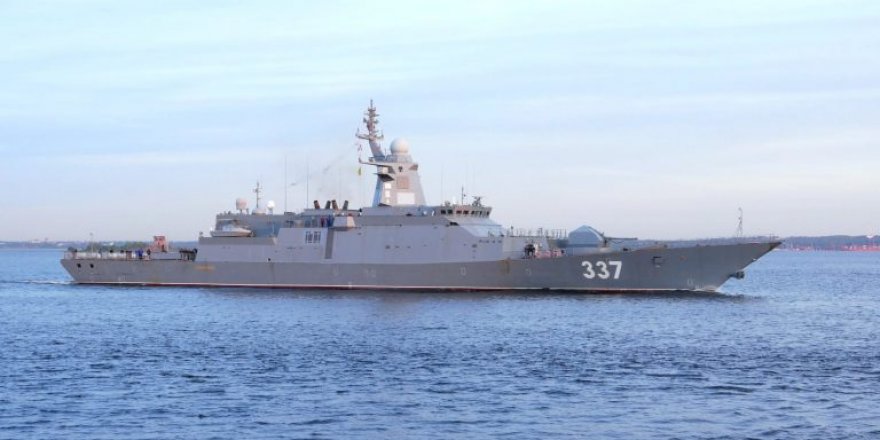
They are nice looking ships and now that we know the actual range of Zircons (1,500 kilometers), together with Gorshkov-class frigates (also Zircon carriers) it may explain why Borisov was stand-offish on carriers in his interview a couple of days ago.

Now that Shoigu confirmed yesterday a radical increase in the speed of targeting information exchange between ISR and high-precision weapons carriers, which include Zircon carriers (in Russian), the carriers issue for Russia really becomes a moot point, albeit it is clear that with the commissioning of large amphibious assault ships such as project 23900 Russia may (don't quote me on that) bring to the sea some version of STOVL aviation. In all, Russian Navy does not completely abandon carrier aviation plans but in real war the utility of modern CVNs is really questionable, especially for the astronomical expenditure and high psychological significance attached to these beautiful and mighty looking, but fast becoming obsolete, ships. 

So, Russia continues to build her weapons and, while Mikhail Mishustin admitted that Russian economy "sagged somewhat", that sagging was expected under well-known circumstances and the growth will return starting this year. But here is my beaten to death point: combined West grossly miscalculated in terms of the size of Russian economy. No, it is not just the matter of crucial Russian exports ranging from energy, to metals, to food, it is about the actual size of Russian economy. And by size I mean, of course, real, physical economy which produces real products. Just one look at Russia's aerospace industry, both commercial and military, should have given a hint to Western "economists" but they failed, naturally. 

In related news: Netflix is "valued" more than Gazprom. I mean "shares". That explains why Russia doesn't care anymore about all those BS "rating agencies" and IMF and World Bank "projections"--the idiots live in a virtual world of virtual money. The new Russia's strategy for participation in WTO in metallurgical sphere  should be ready by June 1st, and Vladimir Putin was very clear today that behavior of the West towards Russia will not change (in Russian). It will be very interesting to see this strategy and how defense of the domestic producers will be reflected in it. Expect new developments in the extraction sphere because Russia has ALL critical resources ranging from Uranium to Titanium to what have you in industrial volumes and the only reason that Russia was not developing those deposits was because it was somewhat cheaper to buy them from other countries.  Circumstances changed dramatically, and Russia has enough cash to do it all. 

In SMO news, Patrick Lancaster is finally getting the recognition he deserves, with  more than 400,000 subscribers. I believe it is two days old report.

The dude has the balls of steel and is a real war reporter, old-fashion, down and dirty but that what real war is. Patrick has to stay safe, together with his gutsy cameraman. There are some reports of VSU simply abandoning villages and towns and the stream of POWs continues. Many of them do not even look like military men anymore: completely warn down and broken down, many say that the stream of surrendering VSU would have been even larger if not for many trying to surrender being shot in the back by Nazis. Well, we knew that from the get go, didn't we? 

Sunday, August 16, 2020

That's Russia For Ya.

I always say that Russian military-industrial plans are to be taken with a grain of salt but not because Russians overstate, but for exactly opposite reasons. Recall initial officially disclosed parameters for 3M22 Zircon--something slightly above M=5 and 300-400 kilometer range. Well, we know now that it is Mach=9 capable weapon with the range in excess of 1000 kilometers. You also recall the ceremony of laying down two newest Amphibious Assault Ships of project 23900 held a month ago, right? Remember how those ships were described? 25,000 ton of standard displacement, 28,000 tons of full. Right. It is Russia, alright. Now TASS reports, in Russian, that the actual displacement of these ships will be way in excess of 30,000 tons

Not just that, but now, it is reported, they will carry recon and, what is most important, strike UAVs which, apart from impressive amphibious capability, makes these ships a rather interesting mix of LHD and, ahem, cough-cough, aircraft carrier. What kind of UAVs and with what capabilities will be based on these ships at this stage is a matter of pure speculation not to be taken seriously. But this news may hold some answers:
No-no, it absolutely doesn't mean that S-70 Okhotnik will be a part of their air wings--this UAV is too large and too heavy to be ship-based. The significance of this news is in the fact that Russia in a very short period of time went from importing UAVs (Israeli ones) 10 years ago into a development of the state-of-the-art UAV with outstanding, unmatched really, payload and combat network capability, which also implies extremely advanced electronic components and AI algorithms. So, it is totally logical, in fact, almost inevitable to assume that a smaller, ship-borne version of S-70 could be in works.  
Judging by today's Zvezda TV report of Sergei Shoigu's inspection of the Far Eastern shipyards, the shipbuilding program is being kicked in the high gear, as is production of combat aircraft being expanded. Substantially. In the end, do not be surprised if we will learn that full displacement of the project 23900 Amphibious Assault Ships will turn out to be around 35,000 tons, which is way above Izumo-class Japanese carriers capable of carrying more than 12 STOVL F-35B. Oh, boy, am I getting into the dangerous territory of STOVL and UAV carriers? 
Let us recall the event which took place exactly 2 years ago. Here it is (in Russian): Vice-premier Yuri Borisov: in accordance to the order of President of Russia a brand new STOVL combat aircraft is being developed in Russia. The length of design and putting aircraft into series production is between 7 and 10 years. The work on Russian STOVL started in 2017. Well, 2017+7=2024, 2017+10=2027, precisely the years when both ships of project 23900 will be commissioned. Well, give and take, of course. I am intrigued. 

Now, if anyone doubts that, apart from extremely capable strike UAVs, Russia will be able to develop a state-of-the-art STOVL aircraft, think again and recall the story of Yak-141 (NATO: Freestyle) which really re-defined STOVL aircraft design. In fact, that aircraft was revolutionary and many ideas (and technologies) realized in it have been incorporated into F-35B. Russians are creating a completely new STOVL aircraft from scratch. This also explains the growth in displacement (and redesign) of the pr. 23900 LHDs, which, in the end, may become simply universal aircraft carriers capable to do it all. I wonder why Russia's MOD today proposed to limit propagation of the military-industrial information which does not constitute state secret, but is sensitive, to still be counted as "confidential" (in Russian). Something is certainly up and we all know that Russia's economy "is the size of Texas economy", wink-wink;))  

Wednesday, April 24, 2019

Jon Huntsman As A Symptom .

Jon Huntsman, a current US Ambassador to Russia still didn't get the message that it is good to learn the history of the country in which you are given the post and that degree in "International Relations" and being an Eagle Scout at a tender age in school are not exactly the set of skills when one talks about war. Yet, as it is the case with the so called US "diplomacy", Huntsman never gained even rudimentary awareness of the country he is currently in and decided to generally forego the craft of diplomacy.
The US ambassador to Russia, Jon Huntsman, says there is little need for his craft as “200,000 tons of diplomacy” are prowling the waters of the Mediterranean, unabashedly endorsing military show-offs as a political tool.“Each of the carriers operating in the Mediterranean at this time represent 100,000 tons of international diplomacy,” Huntsman said in a statement to the US Navy’s 6th Fleet.
I agree with Huntsman in one sense, two CBGs in Mediterranean is a fine tradition of US Navy's 6th Fleet which operates in Med for decades now but somebody has to tell esteemed Ambassador that Power Projection tools such as CBGs are good only for providing "100, 000 tons of diplomacy" for third world shitholes which have no operational air defense, navies or air forces. Once CBGs encounter a competent military force 100, 000 tons become a liability for both carrier and its air-wing. But, of course, Huntsman doesn't know this. Turkey, however does. And this is precisely the reason it contemplates finalization of her contract for S-400. 

Of course, we cannot see all hidden from public eye back-and-forth between the US and Turkey on this issue, but there is very little doubt that a lot of hand-twisting by US is going on behind the curtain. So, delivery of S-400s to Turkey is by no means a done deal and Turkey may yet fold. But  who, indeed, US needs those hundreds thousands tons of "diplomacy" against? You guessed it right. 
Judging by the degree with which Trump stuffed his admin with war-mongering psychopaths and the way he himself turned out to be leaning away from his Presbyterian roots towards Christian Zionism and towards Rupture psychobabble, one has to seriously start questioning rationality of US political, so called, "elite". Add complete military incompetence in the mix and you get, as Ambassador Huntsman so manifestly exhibits, a collection of lunatics and fanatics who may, indeed, think that they are working for the End Times moment. Well, I am cautiously avoiding speaking of Huntsman's system of beliefs. While at it, somebody has to explain Mr. Ambassador that the country of his current station has one gigantic and unsinkable, unlike it is the case with US Navy's 6th Fleet CBGs, aircraft carrier--it is called Crimean Peninsula and it allows to control the whole Black Sea and East Mediterranean Area. 
War-mongering rhetoric from the US only grows in intensity and those are unmistakable signs of a desperation of an Empire to, quoting Russia's metal stalwarts Aria, "break the clock to extend own life". So, we may see soon some demonstrations by Russia of some of the actual capabilities in order to try to shut down the choir of the US war-mongers who still think that they have the power. Can we be nearing a Cuban Missile Crisis moment? I can only say that this is not out of realm of possibilities. As per US "diplomacy", as I continue to state it for years now--it doesn't exist as such for a long time.       

Wednesday, January 23, 2019

After Media Amateurs Had Their Time, Some Insiders Begin To Talk.

Despite being very busy, I couldn't miss this one, since Dr. Mark Schneider is a Pentagon and State Department insider and he presented his views through US Naval Institute Proceedings, one of few remaining more or less competent forums on some key defense issues. He writes on the issue of venerable TU-22M3 upgrade to TU-22M3M version which, for all intents and purposes, is a completely new aircraft within old fuselage. Schneider starts with sacramental phrase. 
He proceeds to assess new TU-22M3M capabilities:
The Backfire weapon upgrade is quite impressive, enhancing the bomber’s capabilities against both land targets and surface ships. In addition to the new land-attack missiles (the Kh-101 and Kh-555, according to Russian press), there reportedly will be at least two long-range ultrahigh-speed dual-capable (nuclear and conventional) missiles with land-attack and antiship capability. This is important because the Department of Defense has said the United States currently has no defense against hypersonic missiles. Backfire’s manufacturer, Tupolev, claims the improved Backfire bomber will be operational in 2021. 
But while admitting a current vulnerable state of US Navy's surface fleet, he, predictably, settles back into the good ol' tactical and operational ambiguity of aircraft carriers: 
The Kh-32 makes it more difficult to intercept the Backfire before weapons-release range. The Soviet-era Kh-22 (still reportedly operational) has half the range of the new weapon. While post–Cold War U.S. Navy fighters have much better radars and avionics than the F-14, they lack its long-range (and even the F-14 range would not be adequate against a Kh-32-armed aircraft). The longer range of the Tu-22M3M complicates a carrier strike group’s ability to set up a barrier defense. The extreme speed of the missile reduces flight time by a factor of four compared to a subsonic antiship missile, reducing the defensive value of locational uncertainty between launch and impact time. 
It really is fascinating how outdated concepts and technologies continue to dominate thinking since:

1. Issue of locational uncertainty is resolved by number of means such as configuration of salvo, ability for refined (finishing) search (Dorazvedka) by active warheads of modern highly evolved anti-shipping missiles (ASMs), plus other tactical and technological means which make modern ASMs fully shoot-and-forget weapons, which are often launched not at fixed position of target but at an area accounting for the rate of obsolescence of the intelligence (last datum) on target's position. In this case, as I stated before, it is a salvo at the area with the radius R= Vcarrier*tfrom detection to impact.

2. By far the most terrifying weapon in TU22M3M is not even X-32, however deadly, it is fully hyper-sonic Kinzhal, which makes any defensive solution useless on arrival for a simple reason--modern Russian ASMs have ranges greater than ranges of carrier aviation and their air-to-air weapons. But there are other, no less complex, issues with the intercept of very to hyper high speed maneuvering missiles which cannot be resolved by creating another, intercepting missiles--solutions to that lie in a completely different field and physics.

3. Appearance of 3M22 Zircon on submarines, especially SSGNs, will make not only near-littoral operations of CBGs, which are already, impossible--it may complicate greatly even blue-water, that is ocean deployments of any assets. And that brings this ever sensitive issue of CBGs forth. 

I repeat myself, US Navy's super-carriers are magnificent ships but they are way pass their prime as US Navy's main striking force. Against peer they are not only a secondary, if not tertiary, asset, they are, in actuality, a liability--one has to ask Elmo Zumwalt's question time and again: what happens, God forbid, with escalation if the United States loses one of its CBGs during conflict, what will be the psychological impact of such a massive loss? The era of magnificent American CVNs as strike and deterrent force against even near peer, forget peer, is over. In fact, in the same issue of Proceedings, Captain Barber calls on:
Is such a redesign even possible? I don't know--institutional inertia, Status Quo culture, as called by Roger Thompson, and, in the end, colossal expenditures required for such a gigantic overhaul, may doom US Navy to a status of still beautiful visually but hollow force good only for demonstration of the flag and serving as high value prestigious targets in what shapes to be global very high threat environment. Again, don't tell me that I didn't warn:  
My next book is exactly a deliberation on these ramifications which are, indeed, historic. The signs of this understanding dawning on American professionals are unmistakable and these are good signs...for peace.   
He foresaw it all in 1970s

Thursday, July 26, 2018

Carriers, Again.


Again!?
 

The reason of my frustration is not this never-ending aircraft carrier saga of Russian Navy. Economy, sanctions et al considered. It is obvious that it is better to have carriers than not having them. But as I wrote for years—Russian Navy has issues not with technology, after all, if it puts its mind to it, Russia will build 3-4 of those ships eventually. No, in the end—the problem is mental, it is the issue of operational concept for these ships and forces required to form Carrier Battle Group(s). 

Such statements from the above are not the first time representatives of Krylov State Research Center throw into the Russian media. Enough to take a look at the promotion of this:

The Krylov State Research Centre has developed and presented to the public at large the conceptual design of an aircraft carrier for foreign customers, which was earlier offered for the domestic fleet as well. The Project 23000 was called Shtorm (Storm). The conceptual design envisages the aircraft carrier to displace 80,000-90,000 tonnes and feature a combined powerplant (a nuclear reactor and a gas turbine engine). The ship’s air group should comprise up to 60 aircraft.

"Sublime" isn't it?

But if you get my drift, here IS the real problem with this representative Polovinkin's statement:

 Speaking about the US Navy, which currently operates 11 aircraft carriers, the expert noted that the United States had an excessive number of carrier-led groups but the availability of only one aircraft carrier was a "deadlocked situation."

The issue is not a deadlocked situation with Russia's sole and barely (sometimes) operational carrier Kuznetsov—in this I agree with Polovinkin. My issue is in constant invoking of US Navy's experience with carriers. This is wrong, since the only REAL interest this experience should invoke is purely organizational and operational, not the force structure whenever the talk is about one existing and, possibly, future Russian Navy's carriers. And here is a single example of WHY realistically Russia needs carriers as a NICHE system-- specifically in Mediterranean, apart from Northern and Pacific Fleets. For starters, Polovinkin should learn the latest news that the ranges of modern anti-shipping missiles are either equal or greater than ranges modern carrier-based strike aircraft provide. The dynamics of missile development today testifies to the fact that in the nearest future (10-15 years) those missile ranges will only grow. Hell, they are growing already. This moves carriers into the niche of what US Navy was doing since 1950s—projecting carrier power against third-rate powers with barely any, using modern parlance, A2/AD, forget full blown Sea Denial capabilities. 

But here is the news: since 2011 due to Obama's criminal actions (and inaction)—the whole of Maghreb and Middle East got destabilized through the so called Arab Spring, and, as events in Syria show, it requires a serious military (combined with other means) effort to stabilize the situation and preserve political forces capable to run a country and fight off armies of Jihadists (supported by the US, Europe and Gulf satrapies) which now operate in every single country on the Southern coast of Mediterranean, from Algeria, to Tunisia, to Syria. So, the question is—granted that Europe is realistically militarily impotent and culturally (and gender-wise) confused, at best, in reality suicidal—why not to have a "fire crew" in Med in case one needs to prop up any political regime against terrorist Jihad forces? This is precisely the case for having those pesky MiG-29Ks and Ka-52s on station for immediate reaction to any Jihadis' advances. Hmm, what does this remind me? Ah, yes—Fifth Operational Squadron of the Soviet Navy of 1970-1980s. Are those disturbing events coming in Maghreb? Hell, they are already happening. So, it is "power projection" after all. In the end, Kuznetsov's deployment to Syria was ordered by Putin personally.

I omit here any discussion on the possible Northern and Pacific Fleets' carriers—this is not the point—Russia's A2/AD and Sea Denial clout at those theaters of operations grew exponentially since 2017 and, ironically, put the issue of carriers on the back-burner. But Mediterranean and what is coming there—a reality obvious to anyone with even rudimentary forecasting apparatus—does, indeed, bring the issue of future Russian aircraft carriers to the fore. As Libya and Syria, and, in the end, Yugoslavia in 1999, with NATO gang-raping Serbia for the benefit of Kosovo Jihadists and organized crime, showed it will be wise for Russia to have full blown Mediterranean Operational Squadron back to the full strength and that automatically means at least two aircraft carriers. And while Mr. Polovinkin is very busy trying to promote Krylov Center's "perspective" carrier, he should recall a simple military truism that the best ship is the one you have now, as opposed to sometime in the future. That brings up the most important issue in all of this: what will be that sensible compromise which will allow both to develop and built those ships when needed (soon), with effective technology, on a sensible budget within a sensible operational concept. What they will be: CATOBAR, STOVL or whatever else is not for me to suggest. At least MiG-29K is a very decent aircraft and it does exist and it is a good place to start from.   

On Kuznetsov's Deck
As for the rest, Polovinkin may consider a simple fact that a squadron of MiG-31Ks with Kinzhals at Khmeimim Air Base covers practically whole Mediterranean up to Mallorca against any combination of threats (targets). Just saying. In the end, Russia is NOT an Imperial power nor should she be a global policeman, but it becomes increasingly clear that Russia's main geopolitical export today is political stability and this product is in demand and the rate is going up daily.   

Wednesday, November 29, 2017

My New Article At The Saker's Blog.

Here is my latest piece on a travails of Russian Navy. The Saker asked me to share my thoughts on the issue--I gladly obliged. 

The Russian Navy at the crossroads: paradoxes and choices

Those who are interested in Russian naval strategic thought may find this further development and elaboration on my publications in US Naval Institute Proceeding and Blog to be of some value.  


Tuesday, July 18, 2017

Damned If You Don't!

If true, this could be vindication of some of my personal (admittedly not always correct) views on naval warfare in general and naval aviation in particular. I always loved STOVL, that is why, with all my criticism of F-35 program (and it is rather embarrassing program), I still follow F-35B STOVL development fairly close because it is the concept that is sound. In the end, some of the technical solutions in F-35B were... Soviet/Russian, borrowed from what promised then, in the end of 1980s, to be a revolution in carrier aviation--Yak-141 Freestyle

Now, Russia's Deputy Defense Minister Yuri Borisov drops a bomb today when revealed (in Russian) that discussion on development and production of a brand new Yakovlev STOVL (based on the ideas of Yak-141) aircraft is in a full swing and that this new aircraft must enter series production in 2025. Oh boy! This is sensational and without going too deep at this stage into the details of why these are exciting news, I will present here a single (there are many more, of course) pro argument:

Modern naval combat is already deep into the missile paradigm in which any aircraft carrier, including classic American CATOBAR mastodons, are not immune from hyper-sonic weapons. But here is the thing, especially for those who intent on fighting Sea Control/Sea Denial battles--the essence of any aircraft carrier is its flight deck and all infrastructure immediately underneath it which make it so vulnerable--catapults, arresters etc. Once one of those elements is gone, and the probability of a deck suffering a major damage in real modern combat is very high, CATOBAR carrier becomes merely a huge pile of steel incapable to launch or receive its air wing. Well, this issue is mitigated on STOVL carriers--their decks are simply more "survivable": 


Now, considering a level of modern aerospace technologies where it is possible to make parameters of STOVL aircraft comparable to their CATOBAR colleagues, it becomes only natural to explore the venue of much less expensive than CATOBAR, STOVL carriers which in Russia's case would fit really well into her strategic and operational requirements. Knowing what Russians do with aircraft, it could be really fascinating to see what could be accomplished in this field. After all, Yak-141 was so ahead of its time and that is why Gorbachev rushed to close this program. Now, it seems, it is being reincarnated on a completely new technological foundation. We'll see, but this is exciting, after all, US Navy is flying F-35B, despite all of its failures. 

Wednesday, March 1, 2017

Lieutenant X On (The Fate Of) Aircraft Carriers-II

Back to our incognito US naval officer. LT X points out what seems to be an axiom, that is a statement which requires no proof:  


Well, this argument shouldn't be limited to US naval aviation only. Last time United States faced half-decent adversary capable of a full spectrum warfare, that is ranging from guerilla to full blown combined arms operations.... I would say Korea, and even this is a stretch. Now comes the issue of naval aviation as a "decisive" force in power projection. One of the first US military professionals who questioned the status quo, based on what LT X characterizes as a combat history "polluted by naval aviation", was Colonel Douglas McGregor who in his seminal Breaking The Phalanx pointed out what many knew all along--air forces are simply more "productive" when "projecting power" from their land bases. 


FWEs (Fighter Wing Equivalents) numbers speak volumes. But that is, of course, when one considers an enemy such as Iraq, which neither wanted nor realistically could attack staging areas and airfields of anti-Saddam coalition. But in any case, mathematics (arithmetic) is simply not there when it comes to naval air power "projecting power", especially if this projecting to be done against competent and more-or-less equipped enemy. But that is an arithmetic approach, pure quantitative, comparison of forces; algebra, let alone calculus of such a "projection" will reveal a much grimmer reality for a "projector". I already addressed partially this issue before, here and there, among many other places. It is still arithmetic approach of a linear comparison of forces, the profile of modern battle against developed A2/AD will be extremely complex and against peers, who can deploy, apart from state-of-the-art air defense, capable air forces, it will be a death knell for carrier aviation. 

As Admiral Kuznetsov's latest deployment to the shores of Syria demonstrated fully--the ratios which McGregor refers to (EAW) generally hold. Combat "input" of Kuznetsov's air wing was  marginal at best when viewed against the background of operational tempo of Russia's Air Space Forces there, including, at some point, of some SU-33s being based directly to the Khmeimim airfield due to Kuznetzov's arresters malfunction. Of course, proponents of carrier aviation will make an argument that Kuznetsov is an old carrier and its air wing was not large at all. Against 87 aircraft which Russia's AF had at Khmeimim by November 2015, Kuznetsov carried 14 fixed wing aircraft and 18 helicopters. Out of those only 4 MiG 29Ks and 4 KA-52K were dedicated ground attack aircraft, with SU-33s being equipped with Gefest SVP-24 which gave them a robust ground attack capability. Yet, roughly 4 times larger Air Force (Air Space Forces) contingent from Khmeimim (80+ aircraft of all types against Kuznetsov's ground-attack 18) flew on the order of magnitude more sorties and, it could be stated, played a decisive role in achieving a strategic reversal of the situation in Syria. But Syria was in many respects a repetition of what US combat aviation encountered in its operations against Iraq or Afghanistan--an opponent with no viable air defense and air force. In the peer-to-peer scenario things change dramatically because:

1. Carrier aviation will face real air forces at the enemy's "shore" or even at their carrier stations. As Roger Thompson writes in his important bookThe Israeli Air Force, also one of the most professional in the world, has outshined the U.S. Navy, and they have done so even with less capable aircraft. A joint U.S.N.-I.A.F. air combat exercise in 1999 underlines and highlights the thesis that the U.S. Navy is overrated. On September 14, 1999, The Jerusalem Post announced that the Israelis soundly dispatched the air wing from the U.S.S. Theodore Roosevelt (which, incidentally, was the same carrier the Dutch destroyed in 1999). Israeli F-16s squared off against American F-14s and F-18s, both of which are said to be more capable than the F-16. The final results were astonishing. The Israelis shot down a whopping 220 U.S. aircraft while losing only 20 themselves. The 10:1 kill ratio was so embarrassing that the results were not “officially published ‘to save the reputations of the U.S. Navy pilots.’” The magazine article on which the article was based, however, reported the kill ratio to be about 20:1. Some dispute these figures, and claim that the Israelis had an “unfair advantage,” and did not include American victories from “stand-off missile hits.” But, as The Washington Times reported on September 15, 2000, an official investigation by Vice Admiral Lee F. Gunn, U.S.N., confirmed “Navy pilots were thoroughly beaten in an exercise against Israeli fliers. ‘An air wing commander was proud the Israelis only achieved a 6-to-1 kill ratio during simulated air-to-air combat maneuvers against a carrier air wing during a recent exercise, instead of the 20-to-1 kill ratio initially claimed.’”  

It is a tactical axiom that land based aviation, its pilots, dedicate more time to actual combat training than their deck based colleagues, who must train constantly in carrier deck landing and take offs--a very complex skill but which doesn't add much to combat efficiency in the real battle but surely works well as an "argument" in the penis measuring contests between naval and air force aviators. Carrier aviation, however, will face forces who do not care much about deck cycle and have no problems with taking off and landing in any conditions. This is not to say that there are no excellent pilots in carrier aviation, far from it--many superb pilots fly from carrier decks but in case of "power projection" against "peer" they must expect facing jets and pilots who are at least equal and often superior to them and the times of carriers being relatively safe on their stations are coming to an end. Peers and near peers are not only getting excellent jets and training, they also develop "pushing out to sea" methods to protect their own shores and inland

2. Missile-carrying submarines, both SSGNs and SSKs. A two-layer (double-range) barrier which starts at a remote sea or ocean zones--this is where modern SSGNs deploy. They will carry extremely potent anti-shipping missiles, many of them. Project 949A (Oscar II) SSGNs are being modernized to carry 72 anti-shipping missiles and not just some missiles--capabilities of something like P-800 Onyx, especially in salvo of 4-6 or 8 missiles. Deployment of even a single such sub creates an extremely serious containment factor, especially if the deployment is "supported" with heterogeneous forces capable to prevent or extremely impede operations of enemy's ASW (Patrol) Aviation in remote sea or ocean zones. Conditions for such a force I will review later in this series of posts. This is the first edge (rubezh) of the defense (or deterrence), the second one being in own littoral with missile-carrying SSKs which will be reliably covered by own air force, ASW-Patrol Aviation and will have an advantage operating against enemy's SSNs. 

The factors, most important of them--missiles, which will, and already influence modern carriers' operations are in play and will only increase their role. Modern missile weapons and platforms which carry them have matured. This is a deadly technological and tactical-operational mix which leaves for CBGs only open oceans to sail in relative safety, far from the littorals of "peers". The coming of 3M22 Zircon (and more tamed Russian-Indian Brahmos-II) will make combat operations of CBGs impossible since there will be no defense against such menace, even if one considers all those promises of laser weapons which exist mostly on paper and in labs and will not become usable weapons for a long time. In the end, even a laser beam must be pointed at the target, that is have all angles (bearing or azimuth and elevation) in order to have a chance at one missile, facing 8 simultaneously? 20? 32? Paradoxically, it is in the open oceans where these magnificent beasts such as US Navy's CVNs will find their end because they will be useless there providing barely a cent of a bang for a ten billion plus of a buck. But here we inevitably get from technological and operational level to a doctrinal one and a nation's views on the armed forces' creation, maintenance and use.  Paradigm shifted and if carriers do not want to disappear completely they will have to change, and they will.  How? That is a billion dollar question. Aviation still has and will have a use over oceans and the first thing which comes to mind is ASW. Remember this...
     
Zumwalt's Idea.
Or this?


There is a reason why I follow closely the fate of F-35B  
 

 To Be Continued....