Rosoboronexport signed the first contract--the country is not disclosed yet--for newest Pantsir S1M (in Russian), which is a further development of now legendary S1s and this one has an increased range or targets' "intercept" of 30 kilometers and elevation of 18. But among news pouring in about Russia producing nothing (wink, wink), this one stands apart--the signing of contract for the new batch of S-400s between Russia and Turkey is expected by the end of this year (in Russian). If that wasn't enough, Russia offered Turkey help in developing the fifth generation fighter. I don't need to elaborate on geopolitical significance of this news, since Turkey, being a NATO member, looks increasingly interested in military cooperation with Russia for obvious reasons. Same as Egypt, whose political "top" was "impressed" by the fate of Libya and, obviously, doesn't want to repeat the fate of her Arab neighbor.
Two days ago, Vladimir Putin gave a start for the construction of six new ships for Russia's Navy, among them two newest Borey A SSBNs, two latest Project 636 SSKs and two corvettes, one of project 20380, another of the ocean-going variety of project 20385, capable of carrying 3M22 Zircon. All that bounty is for Russia's Pacific Fleet with the exception of the Boreys, because it is unclear if both of them will join Pacific Fleet or only one. But here is one ship which caught my attention:
This is the newest project 15310 cable-laying ship Volga, which, without much fanfare, was launched at Kerch shipyard Zaliv few days ago. It is a beautiful, 10,000 ton of displacement, modern vessel (the second one of the class is also nearing the completion at the same shipyard) which is yet another proof of a major boost in Russia's shipbuilding industry which many Western "experts" buried just few years ago. These two particular auxiliaries will operate as Russian Navy's ships and the next big thing from Kerch are, of course, those two amphibious assault ships, which will be four times heavier and larger than Volga and her sister-ship Vyatka. And I am not even talking about SSK Zvezda at Far East which is extremely busy building giant Aframax class vessels and this:
Russia builds those ice-breakers (their different iterations) like there is no tomorrow and most of it is related to the obvious economic dynamics of the emerging Eurasian market, which will need a lot of energy, the type of energy EU wants to forbid to use and thus complete its descent into the economic and geopolitical obscurity.
Depends, of course, for who this commissioning is ominous. Today, Russian Navy received yet another ship. The flag was raised on Project 20385 Corvette Gremyaschiy (Thunderous) and this is not an ordinary delivery. Not to speak of this ship joining fast modernizing Russia's Pacific Fleet.
These are very different from now popular and versatile corvettes of the Project 20380. The differences between the two brotherly classes are, actually, dramatic. Not only new corvettes are larger, they are armed differently and this difference is not only in the main strike weaponry--20385 are carriers of Kalibr family, P-800Oniks and 3M22 Zircon. They also have a new AESA radar Zaslon, whose capabilities are well represented in this Russian-language video.
This is a considerable upgrade over run-of-the-mill (by Russian standards) traditional for pr. 20380 Furke. Whatever else is packed inside the integrated mast of these ships--we can only guess. Obviously something for specifically surface search and targeting, including over-the-horizon. It goes without saying that satellite communications and data-links allow receiving and providing targeting within combat network from and to multiple sources, so, all things considered, the use of the main missile systems to the maximum range is assured. Judging by the open info Zaslon and Redut air defense complexes are fully integrated and the whole thing looks absolutely intimidating for the fraction of a price of project 22350 Gorshkov-class frigates. It is certainly more expensive than relatively austere 20380 but 20385 dwarfs its strike capability. All 6 project 20385 corvettes with the strike fire power of a destroyer are bound for Pacific Fleet, which is being modernized and expanded dramatically. There is a reason for it.
Obviously project 20385 are designed for A2/AD primarily but the funniest thing about this A2/AD "thingy" is that with new missile complexes such as 3M14M and 3M22 even couple of such ships can completely control all of Japan and Okinawa and can strike from Bering Sea anywhere in Alaska, Northern Canada and parts of the US Pacific Northwest. But here is the main point--for anyone who didn't spend last 10 years under the stone--it will come as no surprise at all that the shipbuilding program for the Russian Navy accelerates, especially after Russia removing her dependency on Ukraine in power plant. Next 7 years will see 70 new major combatants (I exclude here Russia's Coast Guard which is being thoroughly modernized) ranging from brand new SSGNs of Project 885M (Severodvinsk-class), SSBNs, large amphibious assault ships and newest frigates and corvettes. In her combat shipbuilding today Russia lags only behind China and the US. But don't be surprised seeing Russian Navy hitting number two spot in the next few years. But, in the end, these are not just platforms and their numbers which, of course, matter--these are weapon systems and sensor suites which make all the difference. Project 20385 embodies this philosophy--a lone ship of this class can destroy anything with a single salvo at the ranges which seemed inconceivable even 10 years ago. All that--in about 2500 tons of a displacement. But then again, take a look at the Karakurt-class to get the idea. Ah, yes, Russia is a shipbuilding yard, masquerading as a country. She is also an aircraft and space ship station masquerading as a country. So, you get my drift.
In related news, 10,000 tons of high-tech self-propelled polar institute has been floated 10 days ago. LSP North Pole is Russia's major return to Arctic research.
The form of the vessel is specifically designed to freeze into the ice but not be crushed by it. This institute is capable to conduct geological, acoustic, geophysical, meteorological, you name it, research. Ah yes, Russia is a scientific station, masquerading as a country. As Patrick Armstrong recently concluded:
In a humiliating insult to Canadian pride, rumor has it, Russians are toying with the idea of a Russian Zamboni production. This is an atrocity, really, but that is just a rumor. Hopefully Russia will abandon this reckless idea in order to save Russian-Canadian relations at some point in the distant future.
I always say that Russian military-industrial plans are to be taken with a grain of salt but not because Russians overstate, but for exactly opposite reasons. Recall initial officially disclosed parameters for 3M22 Zircon--something slightly above M=5 and 300-400 kilometer range. Well, we know now that it is Mach=9 capable weapon with the range in excess of 1000 kilometers. You also recall the ceremony of laying down two newest Amphibious Assault Ships of project 23900 held a month ago, right? Remember how those ships were described? 25,000 ton of standard displacement, 28,000 tons of full. Right. It is Russia, alright. Now TASS reports, in Russian, that the actual displacement of these ships will be way in excess of 30,000 tons.
Not just that, but now, it is reported, they will carry recon and, what is most important, strike UAVs which, apart from impressive amphibious capability, makes these ships a rather interesting mix of LHD and, ahem, cough-cough, aircraft carrier. What kind of UAVs and with what capabilities will be based on these ships at this stage is a matter of pure speculation not to be taken seriously. But this news may hold some answers:
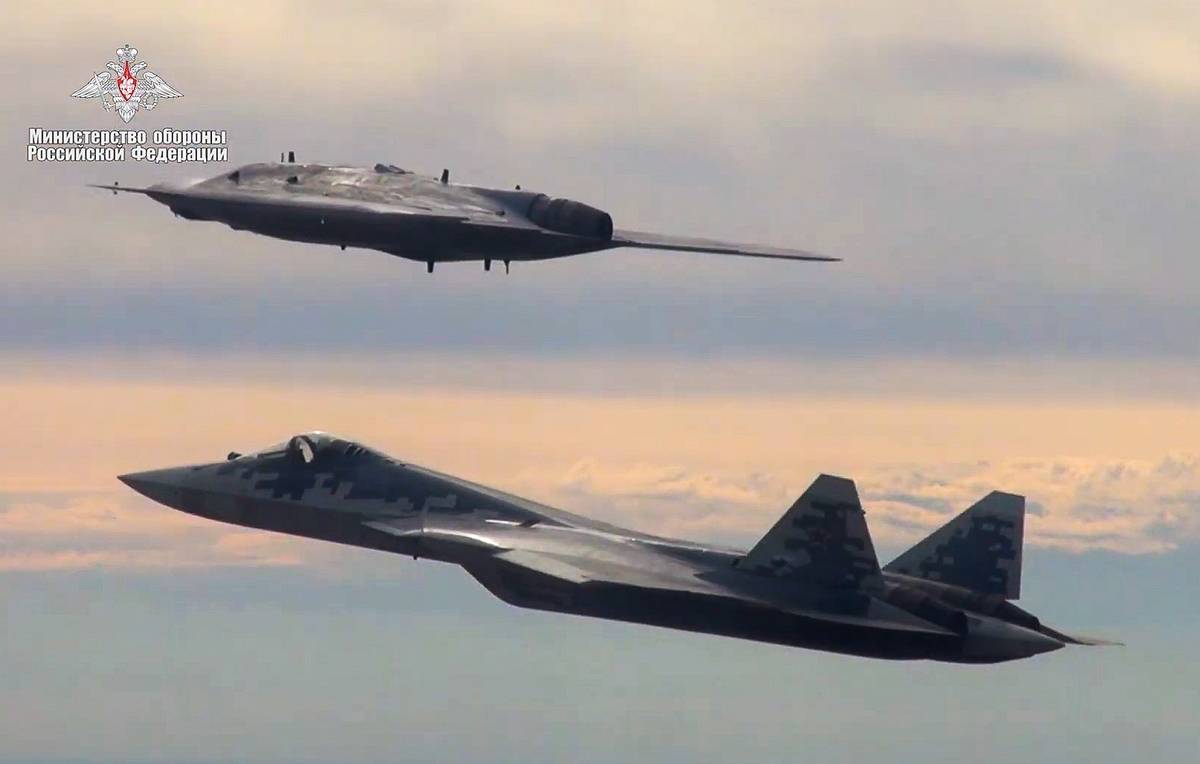
No-no, it absolutely doesn't mean that S-70 Okhotnik will be a part of their air wings--this UAV is too large and too heavy to be ship-based. The significance of this news is in the fact that Russia in a very short period of time went from importing UAVs (Israeli ones) 10 years ago into a development of the state-of-the-art UAV with outstanding, unmatched really, payload and combat network capability, which also implies extremely advanced electronic components and AI algorithms. So, it is totally logical, in fact, almost inevitable to assume that a smaller, ship-borne version of S-70 could be in works.
Judging by today's Zvezda TV report of Sergei Shoigu's inspection of the Far Eastern shipyards, the shipbuilding program is being kicked in the high gear, as is production of combat aircraft being expanded. Substantially. In the end, do not be surprised if we will learn that full displacement of the project 23900 Amphibious Assault Ships will turn out to be around 35,000 tons, which is way above Izumo-class Japanese carriers capable of carrying more than 12 STOVL F-35B. Oh, boy, am I getting into the dangerous territory of STOVL and UAV carriers?
Now, if anyone doubts that, apart from extremely capable strike UAVs, Russia will be able to develop a state-of-the-art STOVL aircraft, think again and recall the story of Yak-141 (NATO: Freestyle) which really re-defined STOVL aircraft design. In fact, that aircraft was revolutionary and many ideas (and technologies) realized in it have been incorporated into F-35B. Russians are creating a completely new STOVL aircraft from scratch. This also explains the growth in displacement (and redesign) of the pr. 23900 LHDs, which, in the end, may become simply universal aircraft carriers capable to do it all. I wonder why Russia's MOD today proposed to limit propagation of the military-industrial information which does not constitute state secret, but is sensitive, to still be counted as "confidential" (in Russian). Something is certainly up and we all know that Russia's economy "is the size of Texas economy", wink-wink;))