Showing posts with label doctrine. Show all posts

Sunday, December 29, 2024

RT Continues on Course ...

China has shown some technology demonstrators which most military porn masturbators called "6th generation" whatever. Those are not 6th generation anything, nor are they fifth generation, whatever they are--for that one must have 5th generation (forget about sixth generation) engine to start with. China doesn't have one. But guess what, RT invited an "expert" to comment on this. 

The images of China’s brand new warplanes, which appeared online this week, is a bold “invitation” to an arms race for a next-generation fighter, Dmitry Stefanovich,  a military researcher at the Institute of World Economy and International Relations of the Russian Academy of Sciences, has told RT.  

The whole assertion here about "invitation to an arms race" which HAS never stopped and in which (as far as the combat air is concerned) China lags doesn't bother either RT crew or Stefanovich who is pivotal for the whole drivel in article about "arms race" in RT. But guess what, if that hasn't been enough, Stefanovich produces a wowser of a statement in the end: 

Beijing will have to compete with American next-generation fighter programs, Stefanovich said. “While there are no game-changers on the horizon, China is explicitly inviting to participate in an arms race, at least in terms of quality,” he said. “We should not forget, however, that the US is the only country with an advanced-stage program for a new strategic bomber – the B-21 – which can be adapted for some of what we would call sixth-generation capabilities. The Chinese and Russian planes of comparable type have not taken off the ground yet,” Stefanovich said.  

So, who is Mr. Stefanovich? I guess you already know where it all goes. Let's review the pedigree of this "military expert". 


But, of course, he is a good ol' boy from MGIMO with humanities degree and zero STEM and military background. He is a classic representative of an unemployable class of people who are not suited for any serious productive labor (per Schumpeter) be it physical or intellectual one. Yet, somehow, the guy who wouldn't understand the first thing about anything serious military goes to state that B-21 is a "new strategic bomber". Well, should Stefanovich or his employer Vatfor (a collection of journos and likes) have been around real military professionals, they would have learned that B-21 is something what real US naval aviators with immense carrier and aggressor squadron experience wrote about US naval (and in general) combat aviation 24 years ago:

"Money spent furthering manned aircraft technologies and programs—the CVNX (proposed Nimitz-class carrier replacement) being one of them—is like polishing cannonballs so they will fly a little farther."

It applies broadly to B-21 which may have one-two of the so-called "6th generation" features such as being capable of unmanned missions and allegedly "stealthier" than its parent B-2 while featuring ... 4th generation weapons which the US is simply incapable to develop and is stuck with legacy systems such as TLAM and, at best, 1,900 km range AGM-158 B2 JASSM-ER. This is pathetic compared with 3rd-4th generation of Russian bomber platforms capable of carrying and launching Kh-101 with the range of 5,500 km and Kh-BD with 8,000 + km range. But here we ran immediately into operational matters which are not easily understood by people with zero military background and who, like Stefanovich, will not even understand what they are looking at right in a front of their faces. 

It is a bomber conundrum today, because of the immense range of stand-off weaponry those (only Russian) bombers carry, it seems that the priority is given to TU-160M which is supersonic, fully netcentric and has state-of-the-art avionics (navigation-targeting complex). Every one of these weapons can be launched without leaving the safety of Russia's air space and imposes a completely different technological requirements on Russian bomber force. In this case, B-21 actually looks like an anachronism birthed within the obsolete US combat air doctrine which no insanely expensive and dubiously effective bomber such as B-21 can save. In the end, this "6th generation" weaponry and systems have seen a real combat already in SMO, including the use of drones (one of the S-70 Okhotniks malfunctioned and was shot down by the Su-57 pilot), including swarms (Su-35S has similar netcentric and swarm control capabilities as Su-57 and now latest Su-30SM2s). And we know that Tu-160Ms have full similar capability. 

Per "new strategic bomber"--it seems like it is almost impossible to explain to pseudo-experts that in the end it is a COMPLEX, or weapon SYSTEM, which consists of a platform and weapons it carries--one doesn't exist without another. The United States has lost missile arms race (well, the arms race, period) by a knockout and we may only guess what a truly new strategic bomber Russia works on currently will be and what weapons it will carry. One can extrapolate the strike capability which will include new generation of hypersonic weapons with enormous range, as well as other stand-off weapons which will have a truly global reach. As per "game-changers", Stefanovich needs to try harder, because hypersonic weapons and weapons such as R-37 AAM and Russian AD changed the air war completely, they didn't just change the game, they created a completely new one, making the whole USAF obsolete. But Stefanovich wouldn't know that--one must be a professional and even that is not a guarantee against continuing playing a Hollywoodesque shell game by believing military porn. But then again ... unemployable. 


When even these morons started to suspect something ... 

Saturday, January 13, 2024

Not Possible.

John Mearsheimer doesn't understand the problem. 

It is not just about manufacturing capacity--in theory the US may build, in the next 10+ years, some facilities to increase production of 155-mm shells or drones. But it will not be able to match industrial capacity of Russia in this respect, even with theoretical addition of future, if any, European capacity. The issue here is not just quantity--the target impossible to reach due to utter destruction of US manufacturing base and an extremely complex supply chains for military production. This all is just the tip of the iceberg. The main body of the iceberg is a complete catastrophe that the US military doctrinal and, as a result, procurement development is. 

I spoke about it for years--some gaps, such as in air defense or missilery the US will not be able to close, because as I type this, this gap continues to grow. It is measured not in years but in generations. This is, as an example, the result of misguided and illiterate approach to air defense based on... air power. You have to literally undo the whole thing, and this requires not just building some facilities, but a complete rethinking of America's defense or, rather, "offense" philosophy which doesn't work. It never did. This is impossible in the present state of the American geopolitical thought without rethinking the United States as it perceived itself in the last hundred years. The US has no courage, intellect and will to do so because it leads to a destruction of America's mythology. 

So, the US is stuck. So, it is good that John Mearsheimer understands parts of it, but he doesn't understand the heart of the matter. After the US strategically and operationally "planned" VSU's "counteroffensive", the question of the competence of the US military establishment arose and was answered--it is incompetent! It will take a generation or two to even teach those who are currently in the plebe years in US service academies to think properly and within the framework of America's REAL military and industrial capability. This REAL capability has nothing in common with the US halcyon years of WW II and after and it is not coming back. Russia will not allow the US to unleash the war in Europe while thinking that the US can sit this one out again behind the ocean. Doesn't work like this anymore, especially with the construction tempo of Russia Navy's subs such as 3M22 Zircon carriers Yasen-class subs and frigates which already have Zircons deployed. These are technologies the US simply doesn't have and are nowhere near of getting them. China can rely on them, and much more from Russia in case of the US deciding to commit suicide, the US cannot. 

It is grim picture of corruption, financial and, most importantly, intellectual within the US military and foreign policy establishment, and what John Mearsheimer fails to understand--these are not just some pieces of hardware whose utility the US suddenly recognized. Nope, the REAL experience of SMO is way more than technological, it is above all operational and strategic, which made Russia's General Staff a well-oiled machine which merely uses 404 as a trap and a junkyard for NATO's military capacity, because Russia fights not Ukraine, she fights NATO, and NATO, and the US, are in panic. In the end, Washington cannot do strategy, it has no real strategists--only whiteboard doctrine mongers, who will fail again to learn proper lessons, because one has to have a proper tool kit. The US doesn't have one. Good luck "containing" China. 

P.S. I'll probably do podcast with my friend Colonel Vladimir Trukhan, and possibly with my other friend Colonel Oleg Shalandin fairly soon. I may also twist hands of some of my classmates--they are very humble people--to drag some of them to the podcast too. That depends, though. 

Tuesday, September 7, 2021

Euros (Dollars) and Sense.

Some interesting statistics from three consecutive Russia's  Air, Navy and Army exhibitions in 2021. 

Translation: MOSCOW, September 7. / TASS /. Rosoboronexport (part of the Rostec state corporation) signed contracts for the supply of weapons worth € 3 billion (more than $3.5 billion) during the International Maritime Defense Show (IMDS-2021), the MAKS-2021 air show and the Army-2021 international forum held in the summer. This was reported to journalists on Tuesday in the press service of the company.

In general, Rosoboronexport's contract portfolio today is around $52 billion and it is a whopping sum, considering non-stop sabotage and sanctions from the United States and her lap-dogs. Yet, even NATO is not impervious to those pesky Russian weapon systems. 

Turkey will continue to receive deliveries of the Russian S-400 anti-aircraft missile system, and there is nothing the US can do about it, despite Washington constantly threatening sanctions and other possible consequences. That’s according to Turkish Foreign Minister Mevlüt Çavuşoğlu, who told the NTV channel on Tuesday that the purchase had already been completed. “The US should accept that this is a closed subject,” Çavuşoğlu said, according to Russia’s TASS news agency.
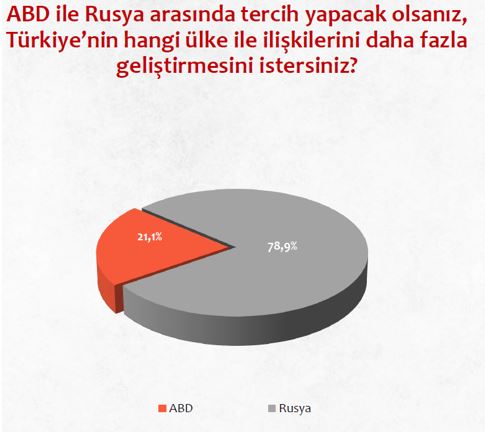
We may continue with trying to explain fully Turkey's increasing military cooperation with Russia until hell freezes over, but the simple truth is that it is all about the bottom line. Does Erdogan (and Turkey) buy S-400s because they want to increase leverage on NATO? Absolutely! Does Turkey buy S-400 as a demonstration of her independence from anyone? You can bet your ass on it. But in the end, the bottom line is this: you want to survive in the modern world--you need those Russian systems which constantly, not-stop, perform in real combat and perform well. Of course in Turkish case we have what nobody could even conceive 10 years ago: overwhelming number of Turks not only want closer relations with Russia, but consider Russia a strategic ally. Remember this? 
I wrote about it before. In the end, grossly oversold Turkish-made Bayraktars turned out to be not exactly fully Turkish-made and once Canada and other Western contractors who provided guidance and targeting systems for those UAVs refused to supply them, Turkey started to experience difficulties with production. Russians, though, say that they will help Turkey with her own indigenous 5th generation fighter and Russia has no problems with allowing Turkey to produce SU-35s. Russians will stick to contractual obligations and short of war, will continue with them politics notwithstanding.  
 
Saudis got the message, when signed last week military cooperation agreement with Russia. This is not to mention the fact that Houthis do not allow Saudis to rest. 

Authorities in Saudi Arabia say they have intercepted three ballistic missiles targeting the country’s oil-rich eastern region as well as the cities of Najran and Jazan in the south. There was no immediate claim of responsibility for Saturday’s attacks, but the Saudi-led coalition fighting the Houthis in Yemen blamed the Iran-aligned rebel group. There were no reports of casualties. A source familiar with the matter told the Reuters news agency that the missile aimed at the eastern region was intercepted over the city of Dammam. Shrapnel from the missile scattered over the Dammam Suburb neighborhood, injuring two Saudi children, while 14 homes suffered light damages, the official SPA news agency said, citing a statement by the defense ministry.

Obviously, the United States is very unhappy, because for many years after the collapse of the Soviet Union the United States considered arms trade and domination of the lucrative global arms markets its forte'. But things change, as does technology, tactics, operational art and strategy. It is about adapting, it always was and today the United States is not competitive across several important segments of weapons' market among which air-defense, armor and missile strike systems are most noticeable. It is not just technology issue--it is a doctrinal one. Afghanistan factor, moreover, will continue to impede American military-technological competitiveness on the international arms market, no matter how all kinds of "arms trade" observers, such as SIPRI, among many, will play (or falsify) statistics. There is very little doubt that Afghanistan was merely a visual representation for laymen of the process which started immediately after the Gulf War and which exercised a baneful influence on "American Way of War". Arms trade merely reflects a long-time trend in warfare which experienced a truly revolutionary development starting from early 2000s, the same way as era of sail yielded to the steam-driven and armored ships... times ten.  Expect a lot of butt-hurt in Western media.

Tuesday, June 26, 2018

Why Mathematical Models Break Down. And Why Our Life Depends On That-3


Continuation, first two parts are HERE and HERE.

When speaking about some kind of financial "adjuster" in this particular formula we, of course, may say that there should be a way of bypassing the tedious task of finding such an adjuster and go with nominal military expenditures figures while paying attention to what is inside the bracket—that is what theoretically should account for military potential thus providing the number for this proverbial bang for a buck. But this method has its own serious drawback. No matter how we play with numbers any kind of quantifiable comparison will not convey a crucial factor of geopolitical posture and doctrines which are derived from this.

Surely, there is always a way to "compare". Consider, for example, this famous dyadic technological relation of forces. 

Don't be intimidated with those Sigma notations—they merely stand for sums of products of the year of introduction of technology (types of aircraft, tanks, ships, subs etc.) and of the number of those types. Let's give an example: we start with a very simplified example of the United States Air Force and Tank forces—we take numbers from open sources and "trim" them to avoid a tedious calculation for a huge range of years and types—remember, we do it merely for demonstration. So, we go HERE and choose the number of combat aircraft in the USAF "inventory". Let's limit ourselves to strictly fighter and attack aircraft. This will give us roughly:

235 F-15 Eagles, 220 F-15E Strike Eagles, 570 F-16 Fighting Falcons, 195 F-22 Raptors and 287 of good ol' A-10s Thunderbolts. So, now to demonstrate what it gives us in terms of first ratio inside the bracket we assume, in order to avoid this tedious calculations for each batch of the same type of aircraft, that:


1. Out of 235 F-15 Eagles 35 was manufactured in 1980, 100 was manufactured in 1990 and the last 100 was manufactured in 2005. So, that gives us first term for the type (F-15) of aircraft: 


              =69,300 + 199,000 + 200,500 = 468,800.

Now we can divide this number by total number of F-15 Eagles and we get:

                             468,800/235=1,994.9 


This number is our "weighted" (sort of) technological (which translates into combat) "value" of F-15s.


2. Now we do similar operation with F-15s Strike Eagles and for simplicity of experiment we say that 110 of them were manufactured, say, in 2000 and another 110 in 2005. Thus our Sigma for F-15Es will be: 


             110*2000 + 110*2005= 220,000+220,550=440,550


Now we divide by the number of F-15Es and get:


                         440,550/220=2002.5  


By now you should get a simple idea behind these calculations, so I will omit further calculations for each type of aircraft and will merely state the numbers based on UNIFORM or averaged year of manufacturing for the rest of aircraft. Of course, this is not the case in real life, but:


3. For F-16s we choose uniform (or average) year of manufacturing, say, 2004, this gives us 570*2004/570=2004.


4. For A-10s we get the year of 1989, so their value is 1989;


5. For F-22 Raptor we get the (average) year of manufacturing of 2005, so their value is 2005.


Now what is left for us is to add all this together to get the value of the USAF combat aircraft:   


      1,994.9 + 2002.5 + 2004 + 1989 + 2005=9,995.4


This is roughly what the value of USAF is in our example.


Absolutely the same method is used for US Army's tanks, if we to assume the number of about 6,000 of all types of M-1s being "in inventory", how many of actually combat ready tanks is out there remains really a secret—this number will be much smaller than "inventory" or "storage" but since we are at it, we may as well count ALL of them, including in storage and that number is about 6,000 American Main battle Tanks which is all iterations of M-1 Abrams. As the formula goes, once technological value of tanks is calculated, you add them to the value of aircraft and then divide this sum by 2 (or multiply by 0.5) we supposedly should get the T, that is technological value, which could be compared with the T of other nation and this is supposedly give us Dyadic Technological Advantage Delta T. For Russian AF and tank forces the information is readily available, so feel free to play with those numbers. 


 Obviously, any T in this formula is nothing more than weighted time of introduction of military technology into service and this DOES NOT represent a real technological advantage, or otherwise, since ignores completely a mode of employment of forces. Yes, the year of introduction matters but what about upgrades and modernization? As an example, an upgrade of Russia's venerable SU-27 fighter to SU-27SM produced a very capable 21st century combat aircraft capable of turning and burning with the best of them and here we are talking about airframes some of which are 20+ years old. Same goes for upgrades of F-16s which will get AESA radar among other things, thus making this old timer not only still one of the sexiest aircraft out there but make it deadlier.

Moreover, when calculating any technological advantages one must consider not just comparisons of the likes—aircraft to aircraft, tank to tank or ship to ship. It doesn't work like this and never did. Vietnam War—a bulk of massive USAF losses (around 10,000 aircraft) were due to AAA and SAMs. Since then, USAF never encountered Air Defense of such a capability it encountered in Vietnam. One then is forced to ask an inevitable question: what could be possible, however improbable, performance of USAF against air defense assets of Russia? I do not even want to go there because this could be one of the thresholds which will force the United States to escalate to nuclear option. One, again, must consider how opposing forces deploy and fight. 


So, no matter how we play with numbers and popular formulas, so far—they do not really represent a reliable picture of capability. Indeed, what is better to have and who comes out on top in the scenario of 4 F-22s against 6 Su-35s, how about 6 F-22s against 4 Su-35s and two S-400s? Are these legitimate questions to ponder? Of course they are. In the open ocean any, even modern state-of-the-art, SSK will become inevitably much more vulnerable against modern SSN, while in its own littoral and under the cover of own ASW patrol aviation, those SSKs become deadly hunters against any nuclear powered sub. 


So, how we are to approach those comparisons? Obviously, some people go for the jugular and create all kinds of Firepower Rankings. They name whole 55 factors which influence their "calculations" and that is fine and dandy but does it reflect properly the only ability which matters in this world—to fight and WIN the war. Does it answer the question of WHAT war? It doesn't, because Russia, as an example, is not intent nor is planning for fighting the war in Europe, unless attacked first, let alone she is not intent nor is preparing for fighting a war inside the United States. The United States, however, is intent on fighting war both around and, in some mad scenarios, inside Russia. That brings us to inevitable conclusion that ANY comparison of military power outside the (respective) doctrinal frameworks is useless and is nothing more than mental acrobatics which, sadly, sometimes has a very serious and grim consequences for those who base their decisions primarily on those rankings and numerical "values".   

To Be Continued....  

Wednesday, March 1, 2017

Lieutenant X On (The Fate Of) Aircraft Carriers-II

Back to our incognito US naval officer. LT X points out what seems to be an axiom, that is a statement which requires no proof:  


Well, this argument shouldn't be limited to US naval aviation only. Last time United States faced half-decent adversary capable of a full spectrum warfare, that is ranging from guerilla to full blown combined arms operations.... I would say Korea, and even this is a stretch. Now comes the issue of naval aviation as a "decisive" force in power projection. One of the first US military professionals who questioned the status quo, based on what LT X characterizes as a combat history "polluted by naval aviation", was Colonel Douglas McGregor who in his seminal Breaking The Phalanx pointed out what many knew all along--air forces are simply more "productive" when "projecting power" from their land bases. 


FWEs (Fighter Wing Equivalents) numbers speak volumes. But that is, of course, when one considers an enemy such as Iraq, which neither wanted nor realistically could attack staging areas and airfields of anti-Saddam coalition. But in any case, mathematics (arithmetic) is simply not there when it comes to naval air power "projecting power", especially if this projecting to be done against competent and more-or-less equipped enemy. But that is an arithmetic approach, pure quantitative, comparison of forces; algebra, let alone calculus of such a "projection" will reveal a much grimmer reality for a "projector". I already addressed partially this issue before, here and there, among many other places. It is still arithmetic approach of a linear comparison of forces, the profile of modern battle against developed A2/AD will be extremely complex and against peers, who can deploy, apart from state-of-the-art air defense, capable air forces, it will be a death knell for carrier aviation. 

As Admiral Kuznetsov's latest deployment to the shores of Syria demonstrated fully--the ratios which McGregor refers to (EAW) generally hold. Combat "input" of Kuznetsov's air wing was  marginal at best when viewed against the background of operational tempo of Russia's Air Space Forces there, including, at some point, of some SU-33s being based directly to the Khmeimim airfield due to Kuznetzov's arresters malfunction. Of course, proponents of carrier aviation will make an argument that Kuznetsov is an old carrier and its air wing was not large at all. Against 87 aircraft which Russia's AF had at Khmeimim by November 2015, Kuznetsov carried 14 fixed wing aircraft and 18 helicopters. Out of those only 4 MiG 29Ks and 4 KA-52K were dedicated ground attack aircraft, with SU-33s being equipped with Gefest SVP-24 which gave them a robust ground attack capability. Yet, roughly 4 times larger Air Force (Air Space Forces) contingent from Khmeimim (80+ aircraft of all types against Kuznetsov's ground-attack 18) flew on the order of magnitude more sorties and, it could be stated, played a decisive role in achieving a strategic reversal of the situation in Syria. But Syria was in many respects a repetition of what US combat aviation encountered in its operations against Iraq or Afghanistan--an opponent with no viable air defense and air force. In the peer-to-peer scenario things change dramatically because:

1. Carrier aviation will face real air forces at the enemy's "shore" or even at their carrier stations. As Roger Thompson writes in his important bookThe Israeli Air Force, also one of the most professional in the world, has outshined the U.S. Navy, and they have done so even with less capable aircraft. A joint U.S.N.-I.A.F. air combat exercise in 1999 underlines and highlights the thesis that the U.S. Navy is overrated. On September 14, 1999, The Jerusalem Post announced that the Israelis soundly dispatched the air wing from the U.S.S. Theodore Roosevelt (which, incidentally, was the same carrier the Dutch destroyed in 1999). Israeli F-16s squared off against American F-14s and F-18s, both of which are said to be more capable than the F-16. The final results were astonishing. The Israelis shot down a whopping 220 U.S. aircraft while losing only 20 themselves. The 10:1 kill ratio was so embarrassing that the results were not “officially published ‘to save the reputations of the U.S. Navy pilots.’” The magazine article on which the article was based, however, reported the kill ratio to be about 20:1. Some dispute these figures, and claim that the Israelis had an “unfair advantage,” and did not include American victories from “stand-off missile hits.” But, as The Washington Times reported on September 15, 2000, an official investigation by Vice Admiral Lee F. Gunn, U.S.N., confirmed “Navy pilots were thoroughly beaten in an exercise against Israeli fliers. ‘An air wing commander was proud the Israelis only achieved a 6-to-1 kill ratio during simulated air-to-air combat maneuvers against a carrier air wing during a recent exercise, instead of the 20-to-1 kill ratio initially claimed.’”  

It is a tactical axiom that land based aviation, its pilots, dedicate more time to actual combat training than their deck based colleagues, who must train constantly in carrier deck landing and take offs--a very complex skill but which doesn't add much to combat efficiency in the real battle but surely works well as an "argument" in the penis measuring contests between naval and air force aviators. Carrier aviation, however, will face forces who do not care much about deck cycle and have no problems with taking off and landing in any conditions. This is not to say that there are no excellent pilots in carrier aviation, far from it--many superb pilots fly from carrier decks but in case of "power projection" against "peer" they must expect facing jets and pilots who are at least equal and often superior to them and the times of carriers being relatively safe on their stations are coming to an end. Peers and near peers are not only getting excellent jets and training, they also develop "pushing out to sea" methods to protect their own shores and inland

2. Missile-carrying submarines, both SSGNs and SSKs. A two-layer (double-range) barrier which starts at a remote sea or ocean zones--this is where modern SSGNs deploy. They will carry extremely potent anti-shipping missiles, many of them. Project 949A (Oscar II) SSGNs are being modernized to carry 72 anti-shipping missiles and not just some missiles--capabilities of something like P-800 Onyx, especially in salvo of 4-6 or 8 missiles. Deployment of even a single such sub creates an extremely serious containment factor, especially if the deployment is "supported" with heterogeneous forces capable to prevent or extremely impede operations of enemy's ASW (Patrol) Aviation in remote sea or ocean zones. Conditions for such a force I will review later in this series of posts. This is the first edge (rubezh) of the defense (or deterrence), the second one being in own littoral with missile-carrying SSKs which will be reliably covered by own air force, ASW-Patrol Aviation and will have an advantage operating against enemy's SSNs. 

The factors, most important of them--missiles, which will, and already influence modern carriers' operations are in play and will only increase their role. Modern missile weapons and platforms which carry them have matured. This is a deadly technological and tactical-operational mix which leaves for CBGs only open oceans to sail in relative safety, far from the littorals of "peers". The coming of 3M22 Zircon (and more tamed Russian-Indian Brahmos-II) will make combat operations of CBGs impossible since there will be no defense against such menace, even if one considers all those promises of laser weapons which exist mostly on paper and in labs and will not become usable weapons for a long time. In the end, even a laser beam must be pointed at the target, that is have all angles (bearing or azimuth and elevation) in order to have a chance at one missile, facing 8 simultaneously? 20? 32? Paradoxically, it is in the open oceans where these magnificent beasts such as US Navy's CVNs will find their end because they will be useless there providing barely a cent of a bang for a ten billion plus of a buck. But here we inevitably get from technological and operational level to a doctrinal one and a nation's views on the armed forces' creation, maintenance and use.  Paradigm shifted and if carriers do not want to disappear completely they will have to change, and they will.  How? That is a billion dollar question. Aviation still has and will have a use over oceans and the first thing which comes to mind is ASW. Remember this...
     
Zumwalt's Idea.
Or this?


There is a reason why I follow closely the fate of F-35B  
 

 To Be Continued....