Showing posts with label RS-28 Sarmat. Show all posts

Monday, May 18, 2026

The Best Version Of ...

 ... Erika, with a major purely instrumental segment. I mean it. It is great march and this version is the best. 


Now that I have your attention with this tender sentimental German music piece about the girl, flowers and bees--introduction to FOBS. That is Fractional Orbital Bombardment System. As you might expect, Russians had something to do with it, like in inventing it. Here is some historic background: 

Soviet interest in global or orbital attack options appeared early in the space age. The same rocket progress that made human spaceflight possible also made military planners think about routes that bypassed existing warning networks. By the early 1960s, Soviet design bureaus were studying systems that could exploit orbital mechanics for nuclear delivery. Sergei Korolev pursued the GR-1 concept, while other design teams advanced rival ideas. The system that moved toward deployment came from Mikhail Yangel ’s design bureau as the R-36O, also known by its GRAU designation 8K69. American intelligence tracked these efforts with rising concern. Declassified intelligence estimates from the 1960s tied Soviet tests to either a fractional orbital bombardment system, a depressed-trajectory ICBM, or both. Those estimates reflect a period when the United States still faced real uncertainty about Soviet technical direction. That uncertainty mattered in itself. A weapon that complicates warning can alter decisions even before it reaches maturity, because military planning has to account for possibility as well as established fact. 

So, I merely use available (and good) information here and here is a very decent explanation of what FOBS is. 

A useful definition has to separate FOBS from three related categories that are often mixed togetherThe first is the ordinary ICBM. An ICBM does not go into orbit. It climbs, coasts on a ballistic trajectory through space, then reenters. The second is a true orbital bombardment system, which would place a nuclear weapon into full orbit and potentially keep it there until commanded to attack. The third is the modern pairing of an orbital or near-orbital booster with a hypersonic glide vehicle . That pairing can look FOBS-like from the outside, yet the operational logic is not identical. The Soviet system sat between the first two categories. It used orbital flight as a partial path, but not a standing bomb-in-orbit posture.

Correct for highlighted in yellow. I also omit here any legal points because the US abrogated pretty much every single arms control treaty, so it is irrelevant for the Russian (and ONLY in the world) variant of FOBS. Enter RS-28 Sarmat, it is a 200 ton monster with a payload of 10 tons with Power-to-equipment ratio (энерговооруженность), aka PUE (Power Usage Effectiveness) without rivals in nuclear delivery systems. 

In missile engineering, the power-to-equipment ratio refers to the relationship between the available propulsion power (thrust, specific impulse, or energy output) and the total mass of the missile’s propulsion system and other equipment. It is a key performance metric that influences range, speed, payload capacity, and overall mission effectiveness. 

There is no contest, Sarmat is a FOBS system and it can deliver the payload to ranges unheard of before--35,000 + kilometers. Here is illustration from WiKi:


It launches in any direction it wants and inserts up to ten Yu-71(74) Avangards into suborbital path, after that you know the story. Mach=27, violent maneuvers et al. And it is always cute how Early Warning Systems (radar and sats) are presented in graphics as if somehow they make a difference--they don't, because there is nothing out there capable of real intercepts of hypersonic systems of any kind anywhere in the West. In other words, FOBS doesn't even need to fly around the world and attack from the "behind" of early warning installation most of which are directed at the North Pole. It can fly towards them and they literally are useless in any role other than the tripwire. Kinetically the US, let alone Europe, are simply defenseless. No professional will take mentioning of GBI (Ground Based Interceptors) in such conversation seriously. They also are useless. Hey, don't blame Russians--they wanted to preserve ABM Treaty, but some neocons with degrees in political "science" thought that Russia is backward. Well ... 

As you might expect, there is a whole lotta coping going on in the Western media. Vladimir Putin was dead wrong in 2018 when he stated that the West (well, US) is 5-7 years behind Russia in hypersonic weapons and anti-hypersonic defense. Looks today more like 15-17 years, at best, in hypersonic weapons. In terms of something equaling S-500 (550), S-300V4 and A-325--maybe 20-25, if ever. After SMO and Iran, the US air and anti-missile defense cannot be taken seriously, especially in matters involving latest generations of intercontinental delivery systems with the US still deploying 1970s, granted updated, technology of Minuteman-III and 1980s technology of Trident II-D5. And that brings us to this:
What is Mozyr? Here:
Modern computational capabilities brought this system back and Sarmats' silos will be defended, apart from their hardened reinforced design, by this system starting this year. Mozyr creates an impenetrable projectile field at the elevation of the 6 kilometers which disables any MIRV. If MIRV detonates at this elevation it represents no danger to silos' functionality. Remember this BS about some super-duper "trigger" for MIRVs of Trident II D5? It was a desperate attempt to somehow detonate MIRVs at least closer to the target (silo) because of the low yield and very bad accuracy of Trident's MIRVs when launched on suppressed trajectories for faster delivery. Basic physics.


The CEP (Circular Error Probable) in this mode increases to many hundreds of meters as opposed claimed for Trident II D5 as 100 meters. FYI--Avangard's CEP is ... 10 meters. When I say that the United States lost the arms race--I mean it, it is not a hyperbole. Then, of course, consider the fact that the Avangard FOBS flies around the world at will, while the range of Trident II D5 is 11,500 km. 

Now, you may ask, especially after listening to fairy tales by some MIT professor, and how can Russians control Avangards during flight, especially when it flies around the world. Well, for those who still believe that Russian Early warning System is blind--a reminder. Russia operates a constellation (currently 6 satellites) of Kupol Early Warning System which flies at Tundra Orbits with a very long so called dwelling period. 
There are always multispectral satellites looking down at the Earth from the apogee of 36,000 kilometers. But those are not just Early Warning satellites for Russia's SPRN, Kupol controls Russia's nuclear forces providing constant communications for any element of Russia's strategic nuclear forces. As you may have already surmised, this also includes Avangards which are fully controlled no matter trajectory. In other words, this is the most advanced system of the strategic containment in history. Now back to my favorite version of Erika. 

Thursday, June 2, 2022

Wrong Emphasis.

Not that I disagree with Rogozin in principle when he stated today that: 

Translation: "The State Department said that the United States wants to maintain restrictions under START-3 after 2026, to achieve limits on "new types" of Russian nuclear weapons. Apparently, they are already dreaming of the Sarmat during the night sleep". 

There is very little doubt that RS-28 Sarmat, as a strategic weapon, is not only unrivaled but also, in a good sense, a complete overkill. But that is the issue, even without Sarmat, the US has zero capability to stop what is known head-on response (second strike capability) of Russia. US dabbling into the ABM technology for the last several decades produced, frankly, very little practical results and is no match for even very limited second strike. Once one considers such weapons as Avangard hyper-sonic gliders (already on combat duty in 13th Missile Red Banner Division in Orenburg) and fast growing gap between the US and Russia in terms of hyper-sonic weapons such as 3M22 Zircon, which turns any SSGN carrying those missiles and deployed at both Pacific and Atlantic into de facto strategic strike platforms, one begins to grasp a scale of the problem facing the US. 

In other word, the US neither has nor will have any time soon any capability to prevent a massive retaliation on own territory in case the US decides to do the unthinkable. I want to remind you, again, about admissions which do come out periodically about a complete vulnerability of the continental US to any modern cruise missile technology, let alone salvos of supersonic and hyper-sonic cruise missiles. It is a Congressional Budget Office report, no less. 

Yes, RS-28 Sarmat is a unique technological achievement, but it shouldn't "simplify" the complexity of the retaliation issue which the US faces and obscure a larger strategic framework in which the actual military capability of the US is nowhere near the image it tried to project in the last couple of decades and, in fact, it now acts as a fast declining power following rigid and unimaginative dogma of Thucydides Trap, because even ongoing SMO demonstrated huge limitations of the United States as self-proclaimed global military power. In the end, who can ignore such "lovely" systems as Poseidon.

Which brings us to the statement of a newly appointed US Ambassador to 404 Bridget A. Brink who stated that it is for VSU to decide at what distance shoot their weapons (in Russian). Brink, being a product of the US "diplomats" diploma mill, obviously, as is expected from the US "diplomats", has no clue what she is talking about, because the only subject which dominates US "diplomats" curriculum is a bombast. For all her credentials, she still doesn't recognize that she is not anymore an ambassador to small Slovakia but to a country which is de facto non-existent anymore and is next to the only country in the world which can wipe the US off the map in 30 minutes. But as I said, you cannot buy culture, let alone proper education, especially in the US foreign policy establishment known for its incompetence. 

There will be 4 HIMARS platforms with 80 kilometer range munitions delivered to Ukraine. Well, even from purely military POV those make no difference whatsoever, granted they even make it to the front line, most likely they will be destroyed before that. But the issue of HIMARS is a "hot button" issue and is primarily PR spun to give Biden Administration precious little to grab onto when facing a complete annihilation with it best ever proxy and facing mid-terms against the background of disastrous approval rating and actual economic calamity unfolding in the United States. I did a fast search (using GEICO's app for cheapest gas) and got a  lovely spread of low grade gas from $5 a gallon in Boston, to $6.50 in L.A. And I started to wonder, for how much longer will this charade continue, because, obviously, the country is ungovernable at this stage and PR procedures do no have a desired effect anymore. I know, one has to conduct actual governance, not running constant election cycle routines and that they don't teach in the US universities. 

Wednesday, April 20, 2022

"We Bear Heat And Light"(c)

No, it is not Gazprom or Rosatom's motto in the headline. The motto in the headline, although a joke and a meme, is the motto of RVSN, aka Russian Strategic Missile Forces. Hey, it is a proper one, indeed a variety of missiles and MIRVs RVSN operates do, indeed, provide a lot of heat and light upon delivery. Behind the stream of news from 404 we all, understandably, forgot that life in Russia didn't stop. RVSN today launched, successfully, new ICBM RS-28 Sarmat, which is about to enter IOC

That thing can carry pretty much any munitions, including hyper-sonic Avangards, which brings us to other related news which may slip unnoticed in the informational bacchanalia in Western media. 

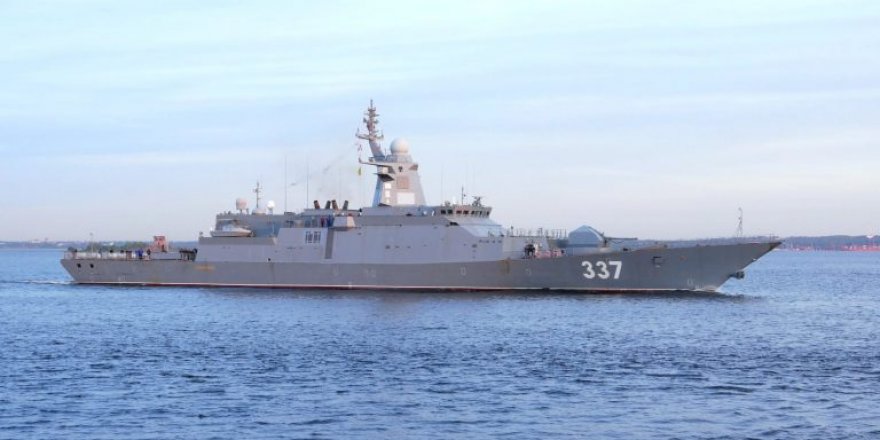
As TASS reports, Amur Shipyard already laid down first sections of the third serial production corvette of the Pr. 20385 (in Russian). Four of those 3M22 Zircon carriers are planned for the Pacific Fleet and are surely to change the whole concept of naval warfare in the Western Pacific. 

They are nice looking ships and now that we know the actual range of Zircons (1,500 kilometers), together with Gorshkov-class frigates (also Zircon carriers) it may explain why Borisov was stand-offish on carriers in his interview a couple of days ago.

Now that Shoigu confirmed yesterday a radical increase in the speed of targeting information exchange between ISR and high-precision weapons carriers, which include Zircon carriers (in Russian), the carriers issue for Russia really becomes a moot point, albeit it is clear that with the commissioning of large amphibious assault ships such as project 23900 Russia may (don't quote me on that) bring to the sea some version of STOVL aviation. In all, Russian Navy does not completely abandon carrier aviation plans but in real war the utility of modern CVNs is really questionable, especially for the astronomical expenditure and high psychological significance attached to these beautiful and mighty looking, but fast becoming obsolete, ships. 

So, Russia continues to build her weapons and, while Mikhail Mishustin admitted that Russian economy "sagged somewhat", that sagging was expected under well-known circumstances and the growth will return starting this year. But here is my beaten to death point: combined West grossly miscalculated in terms of the size of Russian economy. No, it is not just the matter of crucial Russian exports ranging from energy, to metals, to food, it is about the actual size of Russian economy. And by size I mean, of course, real, physical economy which produces real products. Just one look at Russia's aerospace industry, both commercial and military, should have given a hint to Western "economists" but they failed, naturally. 

In related news: Netflix is "valued" more than Gazprom. I mean "shares". That explains why Russia doesn't care anymore about all those BS "rating agencies" and IMF and World Bank "projections"--the idiots live in a virtual world of virtual money. The new Russia's strategy for participation in WTO in metallurgical sphere  should be ready by June 1st, and Vladimir Putin was very clear today that behavior of the West towards Russia will not change (in Russian). It will be very interesting to see this strategy and how defense of the domestic producers will be reflected in it. Expect new developments in the extraction sphere because Russia has ALL critical resources ranging from Uranium to Titanium to what have you in industrial volumes and the only reason that Russia was not developing those deposits was because it was somewhat cheaper to buy them from other countries.  Circumstances changed dramatically, and Russia has enough cash to do it all. 

In SMO news, Patrick Lancaster is finally getting the recognition he deserves, with  more than 400,000 subscribers. I believe it is two days old report.

The dude has the balls of steel and is a real war reporter, old-fashion, down and dirty but that what real war is. Patrick has to stay safe, together with his gutsy cameraman. There are some reports of VSU simply abandoning villages and towns and the stream of POWs continues. Many of them do not even look like military men anymore: completely warn down and broken down, many say that the stream of surrendering VSU would have been even larger if not for many trying to surrender being shot in the back by Nazis. Well, we knew that from the get go, didn't we? 

Friday, August 6, 2021

This Is THE Mother Of All ICBMs.

RS-28 Sarmat is coming on-line in 2022, while good ol' Topol is being retired and is being substituted with RS-24 Yars ICBMs. But again, all of them pale in comparison to RS-28. 

Russia is poised to begin test flights of a new liquid-fueled, super-heavy intercontinental ballistic missile (ICBM), Defense Minister Sergey Shoigu has confirmed. The missiles are expected to enter service in 2022. “Flight tests [will begin] this year and should be completed in 2022. In 2022, the first batch should enter service with the strategic missile forces,” Shoigu said on Friday while visiting Krasmash, a machine-building plant in Krasnoyarsk, Siberia.The new RS-28 Sarmat ICBM is capable of carrying 16 warheads. The advanced silo-based system features a heavy liquid-propellant intercontinental ballistic missile, and is to replace the R-36M/R-36M2 Voevoda ICBM. The new missile will be capable of hitting targets using either the North Pole or South Pole route, effectively bypassing any defense system employed by a potential enemy.
The United States also works on some form of its strategic missile forces upgrade but the cost of upgrading US strategic missile forces is astronomical. This is how Congressional Budget Office sees it.

But the general consensus is that the whole thing will exceed $1.2 trillion. Another interesting issue if Ukraine, where previous generation of the Soviet ICBMs, such as RS-36 Voevoda, lovingly called by Pentagon Satan, were produced, leaked information on Satan to the United States. I am sure a lot of info on that missile has been "exported" to the United States, so Russia needed super-heavy ICBM one way or another and Sarmat got the green light, and boy, if RS-36 was called Satan, how do you call Sarmat? The Evil, the Beelzebub, the Most Evilest Satan of Them All? Hey, as long as it works, who cares how it is called. After all, recall that these magnificent C3 ships of the Soviet Navy:
Project 1941 Titan were named by NATO...Cabbage. Well, if Su-57 was given a handle of Felon by NATO, boy, I feel a lot of butt-hurt on NATO's part in failing to find an appropriate (F--fighter planes' names start with this letter) handle for Su-57. How about Falcon, ahh, wait. OK, how about Fury, or Fuse or something, hey, even Flying Fuck will do. But Felon? Russians resolved that issue for themselves in the most practical way possible--they call NATO's equipment as it is called by NATO itself. The only item which ever got its own handle (unofficial) which stuck for it forever in USSR and Russia are Los Angeles class SSNs know all over Russian Navy as Moose (Лоси).  So, it is going to be very interesting to observe what final handle will be given to RS-28 Sarmat and I hope it is not a Thug or Gangsta, let alone Cabbage or Shiitake. On the other hand, that last one...