... the history of WW II Eastern Front in the West. Judging by the utter a-historic trash which still circulates among many US military professionals as a genuine history, you know some of those names, it is not surprising that they still cannot understand what hit them. When your world view is formed by fairy tales about WW II written by what amounts to Wehrmacht and SS "sources" and how NKVD "executed" 1 million Red Army soldiers--what do you expect? Here is a good tearing apart of a Hollywood BS whose scenario was "written" by the same people (or rather their ideas) who only read Solzhenitsyn and Soviet dissidents and believe that it was the US which defeated Hitler and that the Red Army was nothing but kettle prodded into the battle by evil commissars and NKVD. Luckily, there are still some diligent people out there who cannot tolerate BS and do something about it.
Friday, December 27, 2024
This Is How They Teach ...

Thursday, August 4, 2022
Where, Let Me Ask, Where...
... do they take their numbers from? It is no wonder that US and UK run VSU "operations" are not only defeated, but expose a complete professional inadequacy of US and UK military operational planning. It is bad and unprofessional which calls in question military professionalism of those who "plan" them. Evidently, issues of awareness and knowing "thy enemy" are not taught in Anglo-American military educational facilities anymore. No wonder. Daniel Davies writes a fantastical piece in which he concludes:
I am not going to talk here about absolutely bizarre "interpretation" of Red Army's Kursk Strategic Defensive Operation July 5-23, 1943, how it was known in USSR and was in response to Wehrmacht's Operation Zitadelle (Citadel) and which saw human, armor and air carnage of unimaginable proportions, which resulted in final strategic shift of the WW II in Europe after which the Blitzkrieg met its match. But the issue, apart from Davies' obvious sheer fantasy about Kherson, is the fact of this, I quote it again:
In the Battle of Kursk, for example, the USSR was willing to throw over two million men into the meat grinder against the German Wehrmaht in a massive tank battle. The Soviet Union sacrificed 800,000 troops lost, but inflicted upwards of 200,000 casualties on the Germans in the process.
Davies references the US History Channel, evidently not understanding, that most of the Anglo-American WW II historiography of the Eastern Front is based on... right, German sources, much of which are self-serving in trying to "explain" how, after what amounts in German "sources" of Eastern Front, Red Army was losing 1,000 soldiers for 10 of Wehrmacht's, of 100 combat aircraft for 1 lost Luftwaffe fighter, or 100 T-34s for 2 or 3 Tigers, those incompetent Russkies, somehow crushed unified forces of Europe, from Finland to Germany, to Italy, to Hungary, Romania and other armies and somehow, obviously because of "bloody Stalin" ended up in Berlin and hoisted the Red Flag over Reichstag in May of 1945.
Well, we will start with this, and this is old, from 1996 by Glantz, who later, together with House elevated even more the Wehrmacht's "historical" perceptions' influences on the American view of the Eastern Front:
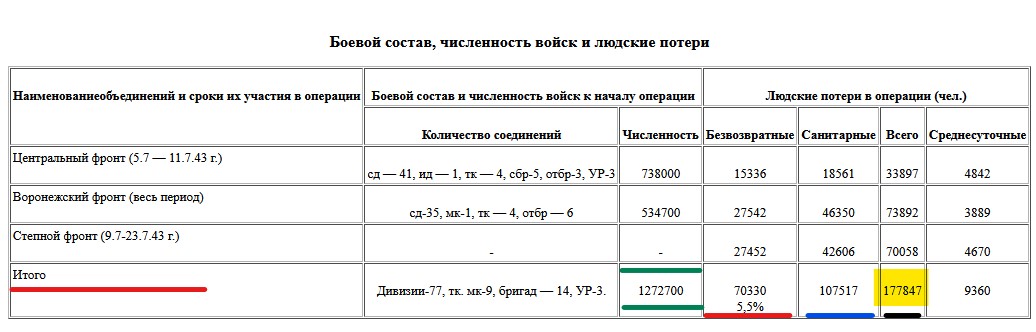
But let's address the issue of Red Army's "sacrificed 800,000 troops". We will open the most authoritative source of Red Army's losses and this is, of course, Krivosheev's publications meticulously derived from all available Russian Defense Ministry WW II archives. Let's take a look at the "spread" so to speak of Kursk Strategic Defensive Operation, which could be counted as "Counter-Citadel." Here is the table from Krivosheev's 2001 Rossiya i SSSR v voynah XX veka: poteri vooruzhyonnyh sil. Statisticheskoe issledovanie (in Russian). Moscow: OLMA-Press. ISBN 5-224-01515-4.

Monday, January 18, 2021
Yet Another Dud?
Here is the biography of the author, who is praised in The American Conservative for his new book Last Stands: Why Men Fight When All is Lost. Here it is:
In other words, he is a man who knows about military and warfare primarily from the books and movies. Fine. There is a cultural aspect to the warfare and last stands when everything is lost often are connected to the sense of brotherhood in arms with buddies in the unit and of the esprit de corps, and of simple masculine doggedness, which often manifests itself in extreme circumstances such as war, where defiance in a face of death is well documented. But that is all well-known and books on the warfare and acts of defiance and heroism are plentiful. But Walsh decides to concentrate on such acts, in the words of the reviewer, for:
Here is where the whole thing goes haywire immediately, while Bradley Anderson who wrote the review continues:
The qualities of which Walsh writes are real, and they are every bit as vital to a civilization as he says. They are, however, virtues that can be cynically exploited by those who have little interest in the defense of the United States against the kinds of existential threats that would inspire American men to take up arms and go willingly to their deaths if need be.
Yep, this thingy, which usually comes from primarily sense of duty and love for the nation, country, when they are in the grave danger. And here is a thingy, of which I speak ad nauseam--the United States lacks this "thingy", since no American soldier ever fought under the circumstances (not since 1814) of the United States proper being under any danger which comes with enemy's victory and him occupying the country. This distinction is crucial in psychological terms and it was and is being demonstrated since Korean War, because unlike most occasions which Walsh chose to describe, the United States remains impervious to any invasion and a nightmare which follows and can afford to lose interest in wars, which in the American case are all, without exception in the XX Century, were wars of aggression and conquest.
But then again, Walsh is a... music critic by occupation and expecting prudent and precise view on the history of wars and human condition in them from such a "historian" is an exercise in futility, and Walsh aptly proves it. He decides to review a famous Pavlov's House defense during the Battle of Stalingrad, whose description is drowned in ideological noise, and then Walsh blows in a spectacular manner:

Moreover, last stands while having not just your buddies, but your home, your families, you loved ones, your culture is what drives men to perform acts of self-sacrifice in those proverbial last stands when everything seems to be lost. This is not the experience the United States military can relate to, despite having its own share of heroism and sacrifice, but in the end, as, I believe, Chesterton stated--the soldier must not so much hate what is in a front of him, as love what is behind his back. This is precisely why the United States couldn't win in Korea, lost in Vietnam, lost Iraq and lost in Afghanistan, because as this insignificant combat officer noted:
"But all the general and soldiers of [Napoleon’s] army…experienced a similar feeling of terror before an enemy who, after losing half his men, stood as threateningly at the end as at the beginning of the battle. The moral force of the attacking French army was exhausted. Not that sort of victory which is defined by the capture of pieces of material fastened to sticks, called standards, and of the ground on which the troops had stood and were standing, but a moral victory that convinces the enemy of the moral superiority of his opponent and of his own impotence was gained by the Russians at Borodino…The direct consequence of the battle of Borodino was Napoleon’s senseless flight from Moscow… and the downfall of Napoleonic France, on which at Borodino for the first time the hand of an opponent of stronger spirit had been laid"
But what does he really know, this loser Tolstoy, he didn't have Hollywood to refer to, because we all know, Hollywood can always "vividly illustrate" just about any bullshit it wants to. That's the entertainment.
Friday, December 14, 2018
Facepalm Of The Week.
What lessons can be drawn from this history? As much as anything else, the rise and fall of major powers determines the viability of the prevailing order, since changes in economic strength, political cohesion, and military power shape what states can and are willing to do beyond their borders.
Although Russia has avoided any direct military challenge to NATO, it has nonetheless shown a growing willingness to disrupt the status quo: through its use of force in Georgia in 2008 and Ukraine since 2014, its often indiscriminate military intervention in Syria, and its aggressive use of cyberwarfare to attempt to affect political outcomes in the United States and Europe.
In general, there is nothing scholarly in this continuous, often murky, stream of recent American "thinkers" theses, ranging from magazine articles to books, since in their continuous lament about collapse of Pax Americana, or "global order", or "liberal order", whatever the moniker they want to slap on the global chaos the US is trying to perpetuate in an attempt to save its hegemony, they continuously forget to mention one simple military fact. This fact is the loss of American insulation from conventional warfare (who wants to fight a nuclear war, no, really?) she enjoyed since WW II and facing a very grim reality of getting conventional strikes on US Command and Control and military industrial infrastructure in case of igniting conventional conflict with, say, Russia. It is this massive change in military-strategic paradigm, driven this time by a very real, not contrived, Revolution in Military Affairs (RMA) which the US appeared to be not ready for. This is what drives this mass hysteria among those who want to blame their own lack of knowledge, education, foresight and of this proverbial statecraft on everyone else but themselves. Indeed, with "scholars" and "thinkers" like Haas (or Fukuyama, or Allison, or.....theirs is the army) there is very little surprise that the United States finds itself where it is. In other words, those "scholars" should have known better but they haven't and for that they have only themselves to blame, even if hiding behind pseudo-scientific rhetoric about "global order", because in the end one reaps what one sows.