Showing posts with label Hubris. Show all posts

Saturday, May 8, 2021

Preaching To A Choir?

The world is a strange place and I am a pretty strange man in this world, all things considered, since I have a luxury (not afforded to many) to experience, as it turned out today, twice, two opposing sides in a huge geopolitical spectacle of the 20th and 21st centuries. Once one considers my background, this experience, or rather experiences, do look like a good place from which to start writing an interesting story. I am totally aware of this place and that is what I was doing since 2014 openly in public. For anyone who read my Runglish throughout the years they should (if they don't--then I failed them) get the whiff of my profound hatred for war and rejection of the military porn. I could write a good military porn fiction but I abhor the every minute of this writing, in fact, I abhor the very thought of me writing some military porn with fictional wars and all those big words such as "pincer movement", "armored columns", "close air support", "engagement envelope" and, God forbids, "attrition rates" or "fractional exchange rates". 

I, however, wrote two years ago this book in which I explained why I am scared shitless by America's military hubris and incompetence of her political elites, because they may get us all killed because they have no fvcking clue about modern war and how it is fought. So, I had to suffer through simplification of math for people to understand that the math for the US is simply not there anymore and the US cannot win the conventional conflict with such powers as Russia or China and as a result will sustain conventional defeat and will escalate towards nuclear threshold. Remember?

Allow me to quote myself from page 22 of this book of mine:

Such avoidance starts with understanding the nature of military power and of its application. This becomes absolutely crucial in such cases as the demolition of Saddam Hussein’s Army by a coalition led by the U.S. Armed Forces in 1991. If whatever lessons of the Battle of Lepanto in the tactical and operational senses are inapplicable for the Battle of Midway or the Falkland War due to a massive technological gap, the same could be stated about the “lessons” of the First Gulf War which, generally, devolved into a turkey shoot of the vast undertrained Iraqi Army, which enjoyed no operational Air Force nor even a remotely capable Air Defense to speak of. In fact, any lessons from that war could and, in fact, did provide a baneful influence on the state of mind of many Western civilian and military leaders. Hubris and gross misinterpretation of the results occurred despite many professionals describing in depth the Iraqi Army’s dramatic lack of capability, ranging from low quality of leaders and personnel, over-centralization of command, lack of ability for strategic assessment, lack of modern battle management means, not to mention gross technological inferiority.
Any of you who read this book should remember this. You see, I used the word "hubris" eight times throughout the book, on other occasions in the same book I wanted to use words such as "utter bullshit", "pulling fingers" and "dumbfuckery" but was forced to use more civilized and appropriate terms such as  "propaganda" (22 times), operational art (4 times) and operations (47 times) plus this horrible unholy profanity known as "Strategy". I used this whole book, and parts of previous one, and parts of  the new one to explain that one doesn't go into Russia's sphere of interests, create mess the scale of a Ukrainian one and expects that it will not get punished by Russia which has an overwhelming escalation dominance in Europe. 

As the latest events in Ukraine have shown the main danger for the United States could be America's desperate desire to get what it wanted since 2014. Namely seeing Russia getting involved in Ukraine openly big time. Always think twice what you wish for, especially for operatives in US State Department and organizations such as CIA, who only know how to handle a small fish and even that they cannot do right, those wishes may come true. As Russia has demonstrated it in April this year, if the US really wants Russia to get "involved" in Ukraine, she can have equivalent of two combined arms armies, two fleets and couple of VKS "fleets" ready to take on Ukraine within couple of weeks. While annihilating Ukrainian Armed Forces, together with neo-Nazi Kiev regime, Russia would do the unthinkable--she would parade both the United States and NATO as militarily impotent paper-tigers because they would be able to do exactly nothing to "help" Ukraine because everyone wants to live. This is precisely the reason Anthony Blinken visited Kiev this week and told Kiev behind the scene to "dial it down", amidst the fluffy tropes about US concern for Ukraine's "soverinity" and "security". As I say all the time since 2014 in this blog, math is not there for the US and NATO. It wasn't there in 2014, now it is not even close. 

Enter Scott Ritter with his piece today in RT. I hate military porn, Scott managed to read it three times. He is certainly much tougher than me to endure this and not to get aneurysm. I would:

An American war hero teamed up with a former NATO commander to write a novel about the final days of US global hegemony. The result is a plea for a common-sense policy that seeks to avoid an end game as tragic as it is inevitable.This is a review of a novel. I feel that I need to make this point up front, lest people read too much into what I have to say about it. It is a work of fiction – and an admirable one at that, extremely readable and possessing a narrative that grips you from the start and holds you until the end. It is also highly believable, even when one factors in the need for elements of fantasy in order to keep the plot streamlined and the length reasonable. Reality can be complicated and messy. ‘2034’ is a novel. It is not real.

Scott writes about this book. It came out in March this year. 

As I said, I cannot stand military fiction, but according to Ritter this book does indeed contain some ideas which are extremely important. 

‘2034’, by Elliot Ackerman and Admiral James Stavridis, takes us to a world that is but 13 years removed from ours. It is one where the United States no longer possesses military supremacy but continues to act like it does. Where China’s economic and technological strengths have been used to craft a military capable of strategic power projection. Where Iran has emerged as a major regional power, and India is positioning itself for a global leadership role. None of the underpinning conditions that make ‘2034’ work as a novel exist today. But when examined in terms of historical continuity, using 2008 as a starting point, continuing through today, and then projecting into the future, every scenario painted in ‘2034’ is not only plausible, but probable. ‘2034’ depicts a world gripped by a multi-polar reality, where an America still operating on unipolar assumptions struggles to find its feet. Two terms appear often in the novel: ‘hubris’ and ‘overreach’. Everything that happens in ‘2034’ is borne of those twin concepts, where a former unilateral superpower finds itself challenged by regional powers no longer willing to accept American hegemony, and the overreaction to this challenge results in global catastrophe.

As you all may know, and I am on record for years, the United States is (always was) nuclear-biased country. It is the only country which used nuclear weapons, and it is the only country which came close to serious consideration of a use of such weapons in conventional conflict. Recall that Truman authorized moving nuclear weapons (without triggers, though) to Guam in 1950. "Just in case". So, it is totally conceivable for the US to go nuclear in case of sustaining serious losses in a conventional conflict even in a war with a nominally inferior conventional power.  With global power? Russia doesn't need to "project" her power against US, she can defeat any conventional force in Eastern Europe purely conventionally and, God forbids, destroy human civilization with her nuclear arsenal. Ritter notes this:

None of the adversaries depicted in ‘2034’ had the ability to project military power globally like the United States. But then again, none needed to. All they needed to focus on was being able to project superior military power into a defined region. In short, a multi-polar world is beyond the ability of the United States to dominate militarily, and any continued effort by the United States to do so can only lead to conflicts which the United States is no longer guaranteed to win.

Well, today the "ability to project military power globally" against the background of the ongoing real revolution in military affairs means merely exposing your forces even in staging areas and rear to serious attrition. Here is how Iran did this. 

As you may expect, even a single tactical nuke in the vicinity of a 0.5-2.0 kilotons yield would have rendered such bases completely inoperable. I know Vicki Nuland doesn't know this but Stavridis does. The United States hasn't been in a classic concentration of force paradigm in decades, and every single US military base today is a fat and easily acquired target. That is why he and his co-author wrote this book. Things changed. Stone-rearranging business advanced tremendously in the last decade, with it came a threat of a huge conventional miscalculation on the American part. And the only thing I disagree with Scott Ritter is the fact that America's unipolar world end is not in the nearest future, but it became a fait accompli  in 2014, and since then we only observe the bubbles and whirlpools a huge sinking ship leaves on the surface after she is completely consumed by the water. Remember? Math is not there, neither is technology on the American side and it is NOW not in 2034. If, as Ritter states,  Stavridis and Ackerman wrote this book as a warning, then it makes it an important book and we can only applaud approvingly the effort by these two authors. 

Ritter concludes:

Thirteen years goes by in a blink of an eye. ‘2034’, the novel, explores a plausible outcome should the United States continue to incorporate hubris and overreach as the driving force behind its relationship with the world. It is not an outcome any American should endorse, but it is an outcome that is inevitable should America’s relationship with the world not change.

If that is the point of the book, it is all for the better. I still will not read it, but I am grateful that Scott Ritter did it (three times) and the fact that this book is based around the same set of strategic ideas I write about for many years, makes me feel not so much vindicated as hopeful that people of such a rank try to be realistic and militarily reasonable and only add to the choir of voices which calls on the US to face a reality and adjust its behavior accordingly. In fact, it may even work for the US benefit. Obviously, the US State Department and US utterly incompetent think-tankdom never read Bismark about the art of possible and have no concept that real international relations are not always a zero-sum game. But who knows, maybe a sheer volume of voices will get through, especially when S-500, A-235 and 3M22 become fully operational, like this year. 

Wednesday, February 19, 2020

Being A Devil's Advocate. In Defense Of US Military.

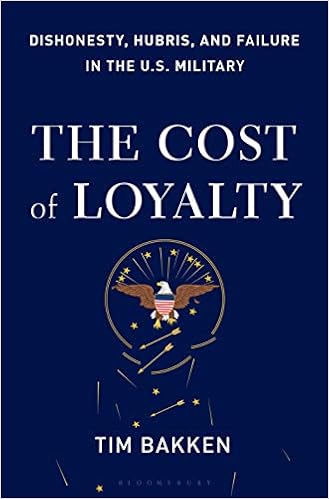
Yes, yes, you didn't misread that. As promised, I bought Kindle edition of Tim Bakken's much anticipated The Cost of Loyalty: Dishonesty, Hubris, and Failure in the U.S. Military and gave it a first "browsing" go. I immediately found myself in a "hot water" of sorts since, while very readable, the book completely blew my views out of the water--the book's major premise is that of a lack of civilian control over US Military and I couldn't agree with this at all, because it is simply not true. While being correct in many crucial details of US Military existence, Bakken, obviously, makes a very grave mistake when thinking that there is no "civilian control" over US Military. There is plenty of this "control" to go around, because American civilian political elites, with some minor exceptions, are the most militaristic, aggressive war-mongers in history and it is they NOT US Military who the "buck stops with", because US Military establishment, while undeniably having its own share of mindless, incompetent and even evil careerists, is not the one who makes final decisions on unleashing America's, one after another, disastrous wars. Those decisions are made in the civilian corridors of power. Let's recall where and how it all started in the immediate wake of WW II and continued in the post-Soviet collapse times of 1990s.
I guess, we shouldn't lose the sight of this simple fact that it is US Congress which the power to declare war lies with. And POTUS--if these purely civilian institutions cannot figure it out, granted often manipulated by the so called (lack of) intelligence and military community, what good they are for then? Most active and most enthusiastic addicts to American (often completely primitive and distasteful) military porn are precisely American civilian government officials overwhelming majority of who never served a day in the uniform, let alone in operational zones and are, in fact, major enablers of primitive American militarism, since lacking appropriate human (and real men) qualities, overcompensate by associating themselves with a military power, thus creating an echo chamber, or a feedback loop, if one wishes, to a non-stop US military pornography being re-amplified with each election cycle. So, I emphatically disagree with Bakken on this particular issue--US Military carries out the orders which civilian US men (and women) in suites from political parties, to media (propaganda, that is) to corporations issue to it. 

It does not absolve US military from atrocities it commits in its wars, but those who give (or help to push for) those orders are the most culpable in this unmitigated disaster which US failed wars in the last 75 years are. Madeleine Albright, Hillary Clinton, John Bolton, Bill Clinton, Lindsey Graham, his late buddy John McCain (granted former officer), Robert Kagan, Paul Wolfowitz, Dick Cheney are just a few examples of war-mongers, if not outright sociopaths and war criminals, who played and continue to play a crucial role in spreading a bloodshed and misery around the globe and use US military as merely their own personal tool for promoting most delusional geopolitical agenda, which, in the end also destroys the United States from within.  I cannot accept, in this case, this Bakken's argument as valid. I quote myself (pardon me for this):
In March 2018 an influential American magazine, The Diplomat, published a short piece by Francis P. Sempa on the Thucydides Trap. In this piece Sempa, citing a collection of articles and essays by U.S. senior military officers titled Avoiding the Trap: U.S. Strategy and Policy for Competing in the Asia-Pacific Beyond the Rebalance, noted in amusement that:
The most remarkable aspect of this study is the lack of “hawkishness” among the contributors, most of whom are high-level military officers. Only one article asserts that China intends to become the Asia-Pacific’s regional hegemon and is following a step-by-step expansionist strategy to displace the United States in the region. Two of the contributors emphasize the need to strengthen and improve U.S. defense ties to Japan and India in order to counterbalance China’s military growth.
It is, sadly, not surprising that Sempa, an attorney by education and a political “scientist” by occupation,  is surprised by the fact of military professionals being reluctant to take political science whiteboard theories to heart. But military professionals are absolutely correct in their reluctance and they have ample reasons to be suspicious of international relations concepts cooked up in the deep recesses of Western in general, and American in particular, political science kitchens populated by people who, for the most part, have zero military backgrounds and experiences. 
Far from exhibiting military "corporatism" I merely point out the fact that these are primarily American civilian institutions which allowed and, in fact, incited militarism which now reached grotesque forms and ignores completely the reality of the United States losing (or not winning) all her wars since the end of WW II. I have another major disagreement with Bakken in regards to military education and engineering courses modern officer should take, but that will require a separate post. I'll do it later, including some review of principles of Combat Training and military bureaucracy. Now, about what Bakken's gets with precision and does it well. 

Bakken goes for the jugular and, correctly, starts with deconstructing one of the darlings of American WW II military mythology General Douglas MacArthur whose myth of a great military leader was pretty much destroyed in Korea when MacArthur's arrogance and a complete detachment from military reality when grossly underestimating Chinese intentions and military capability did cost the US a war. Bakken is correct when starting from WW II and it seems I and he very much on the same page when stating the obvious fact that the US Military learned all the wrong lessons in WW II. In my case, I reviewed George Patton, whose actual military merits were exceeded by far by his ability for self-promotion and manipulating US press. As I wrote in my first book:
...there was a real downside to the famous 1970 Hollywood flick and genius acting of George C. Scott which contributed not only to the Patton myth but to an always foggy, very skewed American understanding of World War II and warfare. While the movie was a cinematographic triumph in the United States, those who knew war first hand—the Germans—had a different opinion. Ladislas Farago was blunt in stating the obvious:
German interest in Patton was still so spotty many years later that the famous motion picture with George C. Scott, a smash hit everywhere else, flopped dismally in Germany. After a week or two playing to empty houses, its showing had to be cancelled. Rommel, yes. Zhukov, surely.  Montgomery, maybe. But the vast majority of the Germans simply didn’t know why General Patton rated a film.
Nor did Russians, who, after the liberalization of the 1980s and the spread of VHS culture, were not amused by the movie which glorified, in Paul Fussell’s words about Patton, “a master of chickenshit”. For Russians, who had a pretty good idea of the scale of WWII and were used to its imagery, the film raised the inevitable question of why so much pathos would be generated about a general who commanded a single army at the Western Front in the last year of WWII
This could have been as well written not by me but Bakken himself, because, as I continue to state non-stop, problems with the US Military started with the failure to learn the actual history of WW II, which, through its "interpretations" in the US steadily removed the Red Army as the main contributor to a defeat of Nazi Germany and substituted it with a narrative of the United States, with some help from Great Britain and USSR securing European Continent for "democracy" and "liberty". There is no surprise that famous revisionist work of Earl Ziemke, in which he states that these were Anglo-American Allies who defeated Hitler and makes such a statement, is till being referred to:
This hardly qualifies as a real military history, yet, it is precisely what was laid in the foundation of the American view of WW II and lead to what Atkinson, when describing Patton, defined as: the creeping arrogance, the hubris, which would cost the American Army so dearly in Vietnam. It is of no surprise then, but sadly ironic, when former Soviet military professional (me, that is) is forced to explain to American posters on all kinds of forums, that Operation "Cobra", a breakout from Normandy, was a plan conceived and, essentially, executed by Omar Bradley, not Patton, that the victory in Ardennes was won well before Patton's 3rd Army ever got there and it was Hodges' 1st Army which stood firm against Dietrich on the Norther Face of the Bulge and that is what determined the outcome. That Patton, far from being the "genius for war" was just another army commander whose record is simply not that impressive and is inapplicable to even comparison with anything tank warfare wise on the Eastern Front.  Bakken is correct--arrogance, ignorance and, often, lack of professional military adequacy is what to a large degree defined US Military which was forced to believe in own invincibility against the background of overwhelming empirical evidence which testifies that self-proclaimed "finest fighting force in history" is not, actually, that good when facing an enemy which decides to fight for real, but about this later. This is just a warm-up, a primer of sorts, on Bakken's undeniably controversial but, in my mind, very important book which provides some very necessary insights into how the US Military views itself....

To Be Continued....