Showing posts with label steel. Show all posts

Monday, July 18, 2022

Why Russia Is Not Running Out Of Ammo.

The hint is in the latest statements by Vladimir Putin, Sergei Lavrov, Ushakov and many others. To put it in simple terms: Russia is NOT running out of ammo, high precision stand off weapons, tanks and aircraft because Russia was getting ready for the war with NATO (euphemism for combined West) in which even SMO is but one of many fronts and operations. Surely, RUSI's report on the "return" (I never heard of it ever going away) of "industrial warfare" may have come as a surprise to West's "elites", but the truth is--human civilization and its, sadly, major product--the warfare--always ran, runs and will continue to run on such things as steel, aluminum, oil, other sources of energy, other materials which are crucial in production of anything war related starting from fuel and artillery shells to finished and highly complex things such as satellites, submarines and combat aircraft. No steel, aluminum, composite materials or oil--no civilization and no modern warfare. 

So, the latest data on steel, which comes into... everything in human civilization, and especially into war effort, for 2021 looked like this:

As you can see yourself, Russia, who is now fighting a whole of combined West is doing fairly well in terms of production of the key war material, and even with the estimate (e) qualifier in a front of its data, which means no accurate data, often by design of western sources, is roughly at 90% of steel production by the United States. Not too shabby, once one considers the fact of Russian population being more than twice smaller. And as I said, steel translated into shells, tanks, submarines and other things of this nature. OK!

What's the deal with other crucial material from which most of combat aviation derives--aluminum.  

Oh boy, the only hope for the US in this crucial material is its northerly neighbor of Canada. Without Canada's aluminum the United States is not even a player at aluminum market against Russia and India. Forget about China. And if one subtracts a magnificent American infrastructure she inherited from Asministrations of FDR or Eisenhower, among a very few others, overall state of modern American infrastructure is not that great. And once one begins to view the energy production, look at the latest for 2021:

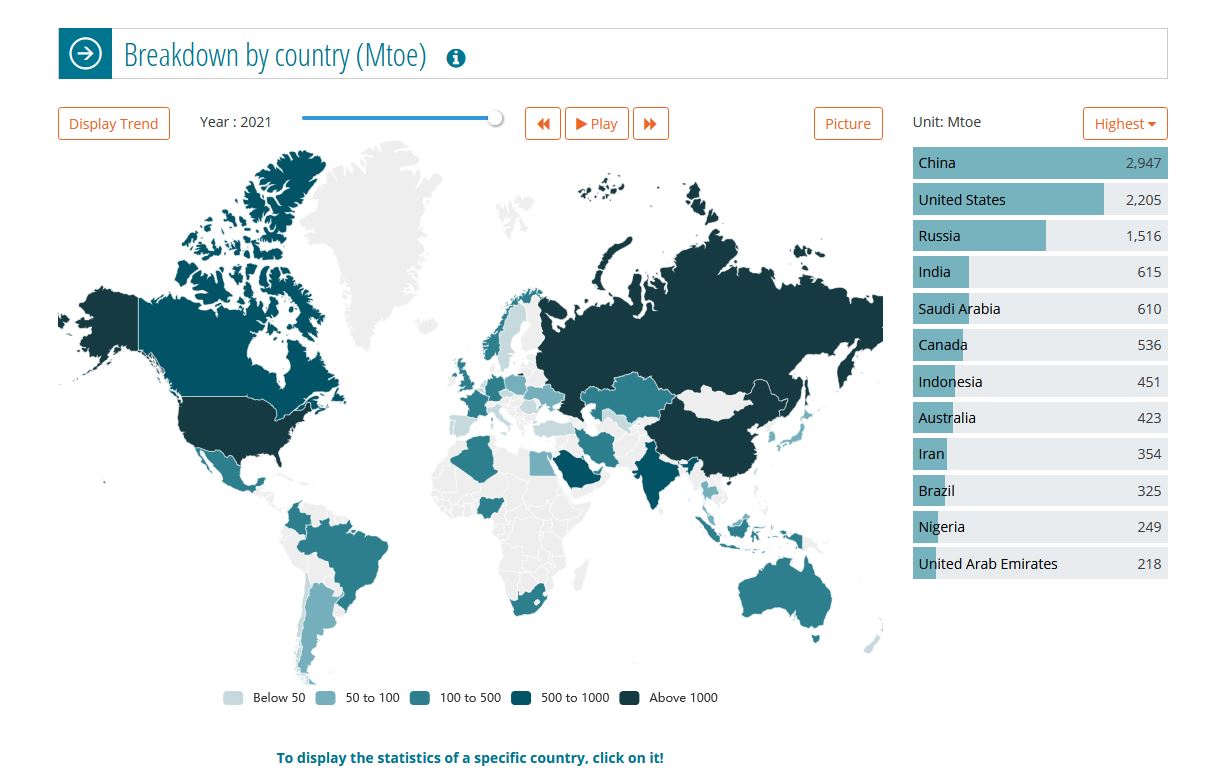
Think about it. Russia, being twice smaller in population than the United States, produces 69% of American production of energy and more than half that of China. To produce a variety of both civilian and military products you need energy, a lot of it. And this is precisely the reason Russia is not running out of ammo and high precision stand off weapons, because Russia IS prepared to take war to where combined West realistically cannot, without obliterating human civilization. 

And even in this horrifying, unthinkable, business there are many indicators that Russia may survive in one form or another, while combined West will cease to exist physically. It is a horrifying scenario to even contemplate, but it is clear that Russia already has in place a serious ABM program, which will only expand and may, in the future, mitigate US nuclear deterrent. In fact, all indicators of that are in place. But then again, I warned about it for years when was calling on the US (Europe is not a factor here) to engage Russia on a whole host of issues of mutual relations in order to find modus vivendi. It is late now, especially against the background of an economic catastrophe unfolding for the combined West and the issue is now existential and metaphysical, not just geopolitical one. And Russia is not running out of ammo.

Tuesday, May 26, 2020

Yet Another Victory... Not.

News pour in and people begin to feel nervous. How else can one describe this:
As Karen Shakhnazarov proposed yesterday (in Russian)--the whole oil war couldn't have been started by Saudis without US blessing, if not planning. I agree. As much as US depends on Saudis for a number of things, Saudis are what amounts to an American vassal. I don't think they planned it well, to start with--not surprising, once one notices a very weak grasp by planners in D.C. of causality and their inability to calculate consequences, which became a feature of US strategies in the last 20 or so years.  Russia, meanwhile, is what supports China in China's rear through the growing network of oil and gas pipelines and this strategy, if you will, is what matters above all for China which is beginning to be pulled into the war with the United States. So much so, that ideas like this are taking over discussion in the public (media) space.
For me personally it would have been an extremely interesting undertaking to discuss those ROE (rules of engagement) and how they are "written", especially against the background of the United States going out of its way to sabotage, as an example, Nord Stream-2, by means of putting Germany in her place as the US the doormat, but as the the author discusses and questions "kinetic" options, he arrives to this "conclusion": 
So where and how would kinetic operations begin? It seems clear that Beijing is reluctant to initiate military action, but is ready to engage once it has begun. Both the PRC and the US see advantages and disadvantages in delaying decisive tactical or theater action. The path to escalation to nuclear engagement is also far less clear — and deterrence far less sure — than during the NATO Warsaw Pact “mutually assured destruction” era. There seems a greater willingness by the PLA to engage in nuclear capabilities (ie: against military targets). Military action in the near-term could well consolidate the PRC position in its “near abroad”. It could even achieve de facto or de jure control of Taiwan, a critical legitimizing goal for the CPC, if the US did not rush in tripwire assets and support to show a preemptive tripwire to deter PRC escalation. But what after that?
He even goes as far as to refer readers to a peculiar document titled:
It is a "fun" paper (yet another one among many produced within "intellectual" kitchen of the Beltway thinktankdom stuffed with former military top brass and government bureaucrats), which through repeating  same ol' "we are about to die", a euphemism for "we need more money", provides for a full spectrum of all those good ol' cliches about "atrophy" of skills and, using Pentagonese, calls on:
To meet those intensifying military challenges, DOD will require rapid, substantial improvements to its capabilities built on a foundation of compelling, relevant operational concepts.
It is a dazzling, in its emptiness, linguistic miasma, which still doesn't answer the main question of what are "relevant operational concepts". OK, I get it, Gary Roughhead--one of the authors--is a an Admiral and he was in the position of CNO (Chief of Naval Operations) in 2000s for 4 years, so he must have a profound understanding of the subject matter and he should be able to answer the question on how he is intent to do this:
Protecting U.S. interests from China and Russia will require additional investment in the submarine fleet; intelligence, surveillance, and reconnaissance (ISR) assets; air defense; long-range strike plat-forms; and long-range ground-based fires. Deterring and, if necessary, defeating North Korea will demand additional air defense assets, as well as a sustained ground presence with the ability to quickly flow additional armored brigade combat teams (ABCTs), fires and combat engineer assets, and other capabilities into theater.  
In the end, what is "operational concept"? Operations (or operation) is defined by Russians (and they know a thing or two about subject matter) as such (in Russian):
A set of coordinated and interconnected in goals, objectives, place and time of combat engagements, battles, strikes and maneuvers of troops (forces), conducted simultaneously or sequentially according to a unified conception and plan for carrying out tasks at a theater (theaters) of military operations, strategic (operational) direction or in a certain vast district (zone) in a specified period of time;  form of military (combat) engagements: Operations are  distinguished by scale, type, and class of military engagements, time and sequence of carrying out. On the scale: Operations can be: strategic, that is operations by whole armed forces and a grouping of forces on a theater of operations; operational-strategic: army groups, fleets (flotillas) etc. 
In other words, the whole thing rests with one's ability, putting it in layman's lingo, to accumulate enough forces and materiel and engage them in such a way against the enemy that the enemy is crushed and all military and political objectives on the theater (of operations) are met. I, so far, know only one operational concept the United States provided in terms of modern warfare--it is throwing more money at the Military-Industrial Complex without any regard to economic and military-technological reality, which, inevitably, resulted in a dramatic, generational, lag in modern weapons and in de facto losing economic competition to China. Sure, the United States still can produce some magnificent things, such as microchips and some (cough-cough) commercial aircraft, but China's production of the main industrial "predictors" ranging from steel, iron, concrete to many machines dwarfs that of the United States. And I mean dwarfs. Just take a look at this picture:
I guess no comments are necessary here. And we all understand that such production of steel translates into such highly finished goods as ships, combat and commercial, structures, power plant, machines and... and weapons. As you may have guessed it already, US being outproduced in this field by China (and Russia) by almost twelve fold, has very little chance to win this kind of the competition. Of course, other crucial strategic metrics do not look that good either:
Of course, after Covid-19 demonstrated to the world US dependency on China even in such a crucial field as pharmaceuticals: 
China, the newsletter reported Tuesday, “accounted for 95% of U.S. imports of ibuprofen, 91% of U.S. imports of hydrocortisone, 70% of U.S. imports of acetaminophen, 40% to 45% of U.S. imports of penicillin and 40% of U.S. imports of heparin, according to Commerce Department data. In all, 80% of the US supply of antibiotics are made” in China.
This whole "operational concept" thingy begins to stink to heavens once one begins to look at and into tangibles, trying to assess how the United States is going to go to "war", especially a kinetic one since, after all is said and done, what is left are weapons and people which are in the foundation "operational concept" and weapons need to be produced, as in manufactured. Here the United States runs into problems immediately. Make no mistake, I will always bet on US Navy's submarine force against China, especially in the operations on Shipping Lanes of Communications--I am consistently on record regarding this fact--US submarine force, for all degradation of the US military, remains its crown jewel and it is, putting it bluntly, better equipped and trained than PLAN's submarine forces. It is simple as that, but I can now predict what any "future" relevant "operational concept" for the United States will look like when considering those kinetic options against China--it will be same ol' AirSea Battle, aka Joint Concept for Access and Maneuver in the Global Commons (JAM-GC), and it is a euphemism for the same ol' stand-off weapons being hurled at whatever the targets will be identified in mainland China and in her littoral from every platform the United States will be able to assemble away from zones of reliable detection and target acquisition by Chinese anti-ship missiles and combat aviation and that doesn't look good for the United States, to put it mildly, especially considering very serious difficulties of US air defense dealing with a number of the missile threats, especially, if to believe Chinese, their maneuvering ballistic missiles capable to hit US aircraft carriers. What is absolutely positive, is the fact of the Chinese missiles being able to hit Guam. 

The question, thus, is not about if the United States will be able to "update" itself for a real war with China--I doubt this will happen, but that's just me, I could be wrong--but the scale of losses, including extremely sensitive politically, the United States will be willing to take. It is one thing to start getting coffins arriving daily in large numbers (anyone really thinks the US is capable to fight China in China proper in a large protracted combined arms war?), totally another--starting losing ships, capital ones, as a result of such a kinetic option. Especially when the US will run out of stand-off weapons. Mind you, China is the size of US lower 48 and, unlike some "mighty" Arab militaries, actually has a fairly good Air Defense system which will be able to do a decent job in protecting those energy streams from Russia, while unleashing North Korea at South with a single purpose of making US forces there miserable. And then there is Russia... Russia, Russia, Russia. You can bet you ass on Russia not allowing China to collapse and Russia does have tools to do so. After all, Russians are royally pissed off at the United States and may (and most likely will) decide at some point that Noblesse Oblige doesn't apply anymore and, apart from making sure China has all necessary energy to sustain the fight against the US, she may exhibit a "strategic flexibility" and provide China not only with a world class intelligence and reliable targeting, but actually, recall Korea and Vietnam. In the end, China is an enormous and lucrative market not only for Russian energy but advanced technology too. Markets must be protected and Russian-Chinese trade is order of magnitude larger than Russian-American one. 

But speaking broadly,  the American political class' insanity, which resulted from losing US status as premier global industrial powerhouse and self-proclaimed "finest fighting force in history" is a first sign of the dawning if not of the realization then of the sense of a final departure which there are no peaceful and sensible solutions left to stop it, only desperate "kinetic" options which will result in US military defeat and collapse of the dollar-based international financial system. Or rather dramatic acceleration thereof. In this case no amount of strategizing and conceptualizing will help, because in the end it is the ability to produce tangibles, from steel and food with medicine, not credit ratings (fraudulent as they are) or virtual worthless money, which win those kinetic options and that ship for the United States sailed long ago. Remarkably, the sailing of this ship was hailed as yet another American "victory", which it was not.      

Wednesday, January 27, 2016

Military Power (Cont'd 5)

So, here we are, with economics or, rather, economy which is the foundation of it all. I, however, want to warn  those who still believe that Wall Street  or Goldman Sachs is real economy--you may really not like what you will be reading here. So, for those of you who believe in all this FIRE (Finances, Insurance, Real Estate) "economy", before reading this, you may want to conduct a mental forensic experiment. Imagine what will happen if money would disappear. Of course, there will be chaos, but here is the thing, of which Russians, and I mean modern day Russians, who lived through 1990s, like me, know well--eventually people will barter. As long as any manufacturing still exists, people, under the most difficult conditions, will barter. They will find the market place and they will go with their burlap sacks of potatoes or carrots and will barter them for tires, cigarettes or diesel generators. Eventually the chains of distributors will develop and money will re-appear. The cycle will re-start. 

Now, imagine what happens if the manufacturing is gone. Well, finances as we know them, will not exist, period. So, the issue of chicken and egg, that is what is a primer, is solved. After all, most economic schools agree on this fact--no production, no money. If Boeing goes down, the real impact of that is difficult to comprehend, but if tomorrow some shitty brokerage firm goes down, well..it may hurt a bit but life will go on. And it will also recover even if Wall Street goes down. In fact, the damage this condemned place, where crooks and the so called "economists" congregate, dealt and continues to deal to the world is so huge, that it is, in fact, desirable that this bastion of the corruption and selling of the air and phantoms, goes down at some point of time. Commodities exchanges can stay, though, and even then under some serious regulations.

So, now we can briefly, yet again, return to the expenditure. Let's draw a simple analogy: if I lived in the neighborhood where I had my house broken in constantly, including by armed robbers, under the condition that I cannot move away from this hood, guess, what I would do? Right, I would invest in weapons. I would buy several firearms, ranging from 9mm  hand guns to 12-gauge Mossberg, I would place them strategically (or, rather, tactically) inside my house and will hope that I will meet any son of a bitch trying to get into my house and harm my family with the barrel of my gun to his forehead, not the other way around. Here, I just described my personal military doctrine. Will this expenditure hurt finances of my household? Somewhat, but those expenses are all worth it, since they keep all kinds of scoundrels away from my home. What is most important here, with my very moderate income, just because I understand the value of a good round penetrating the knees or, in the worst case scenario, the forehead of some creep, my existence will be fairly safe, as opposed to some metro-sexual, and way more richer than me patsy, who can not stand small firearms or NRA. Will his money help him when he has armed robbers breaking into his house? Well, you all know the answer. All this analogies' drawing is very relevant to a discussion on the economic aspect of the war and military power. 

It matters most what nation produces, period. Sure, Steel/Iron Production and Energy Consumption are the backbone of it all, but so much more goes into that. Energy Consumption is a key in understanding how economy works. No doubt,  MBAs working in Goldman Sachs do consume a lot of energy: from using their computers and lights in the office to charging their Teslas overnight, plus a lot of energy is spent hauling those important asses all over the world in the private jets, mostly for golf courses and their wives (lov...I mean sluts) cosmopolitan shopping. But this consumption of energy by those, mostly self-centered, a-holes pales in comparison to what a single middle sized manufacturing company consumes. In fact, to maintain a steady stream of useless iPhones and other, superficially "needed", consumer goods, enormous number of British Thermal Units (Btus) (or Joules) is consumed. It is difficult to explain to some "programmer" (and I know way too many of those) that iPhones do not grow on the trees and that even this (as any other smart(dumb)-phone) requires metals, plastics, silicon and other huge nomenclature of elements to be produced. This is a colossal consumption of energy. But don't rush to the conclusion that the more the energy, the more is production. It doesn't work quite like that. Consider this, consumption is not enough to "measure" energy, it is production of energy which gives a better perspective. Here is some info on actual production of energy:

Top 3 producing countries by resource worldwide 

Why it is so important to emphasize production as opposed to mere consumption? Well, this is military-political blog and we are talking here about military power. Let us recall what father, or, rather, one of, of economic liberalism Herbert Spencer had to say about economy. In his The Military And The Industrial Society in 1896 he states: "Whence it follows that the desire "not to be dependent on foreigners" is one appropriate to the militant type of society. So long as there is constant danger that the supplies of needful things derived from other countries will be cut off by the breaking out of hostilities, it is imperative that there shall be maintained a power of producing these supplies at home and that to this end the required structure shall be maintained. Hence there is a manifest direct relation between militant activities and a protectionist policy..." Surely, Spenser, should he live today, would be eating his words in regards to "militant activities" and a "protectionist policy", but, in general, he correctly identified the approach. In modern history NO real military power emerged without a first most important condition--an industrial capacity. Energy Production, in this case, is a crucial parameter, especially when one considers that weapons' production consumes an enormous amount of energy. Electricity is a key. Here is the wiki's list of electricity generation by countries.


Here is per capita generation by the country. 


The first thing which jumps out immediately is the fact (remember, this is military blog?) of Russia generating net and per capita electricity which are the levels of a very developed industrial nations. Let's not stop here, let's review actually a Consumption as CINC model emphasizes. Yet again, Russia is in the top cluster of highly industrially developed nations.

List of countries by electricity consumption 

One may say that Qatar and Saudi Arabia consume per capita more than Russia, in fact they consume more than EU and even US. But the trick here is in the fact that their consumption is driven by....well, nothing but oil extraction and air conditioning of their malls and houses. Truth is, they produce nothing other than oil. Electricity generation/consumption, when considered together with other resources, gives us a good insight into the path to being a real military power. 

Steel/Iron Production? Absolutely, there are no weapons without it. Guns are made of it, tanks, ships and submarines. Shells and bullets, armor and...you name it--all this is steel and iron. But is it enough again? No. Same as electricity, iron and steel are produced, that is extracted, processed and produced, by many nations but even that is not enough to become a military power. Here is the list of steel production by nation in 2015.

List of countries by steel production

But here is the trick again. China produces almost 10 times the amount of steel USA produces, and almost 12 times the amount Russia produces. Yet, while being a world's largest economy, China, while, certainly emerging, is not yet a global military power. Will just steel/iron production metric define China's emergence as military superpower? No. Neither will the full list of CINC. CINC fails us completely here, since Brazil, which produces a respectable 40% of Russia's steel output is hardly a military power, let alone a global one. Not even close. As we can see, while CINC model gives us SOME important metrics which cannot be disregarded, it fails to answer to the question of what really constitutes a military power. But we already are creeping closer and closer to the answer. So, let's not procrastinate. CINC criteria are just a small part of the answer which is, following Herbert Spenser's logic, in the number of the enclosed technological (industrial) cycles nation possesses. It is quite obvious for any common sense and mildly educated person, with the exception of course of "liberal" so called economists and all other "expert" types who propagate their rubbish constantly in MSM. Yet, none other than late Samuel Huntington mentions what it takes. Remember?

Can US Still Save Itself? 

What defined "West's" domination was reduced to 14 points. West's domination (expiring as I am typing this) was achieved largely through military force. That's how it looks like.

1. Owns and operates the international banking system;

2. Controls all hard currencies;

3. Is the world's principal customer;

4. Provides the majority of the worlds finished goods;

5. Dominates international capital markets;

6. Exerts considerable moral leadership within many societies;

7. Is capable of massive military intervention;

8. Controls the sea lanes;

9. Conducts most advanced technical research and development;

10. Controls leading edge technical education;

11. Dominates access to space;

12. Dominates aerospace industry;

13. Dominates international communications;

14. Dominates the high-tech weapons industry. 

Out of those 14 points, highlighted 11, that is 78.6%, are directly connected to a very serious manufacturing or, in modern lingo, "real economy". If one throws away BS about "considerable moral leadership" (a delusion still propagated by Huntington's founded Foreign Policy magazine) and the point about control of all hard currencies, this share increases to 11 out of 12, that is roughly 92%.  It is also what makes one a military power. And even this list is still incomplete....

To Be Continued.....