Showing posts with label contracts. Show all posts

Wednesday, April 27, 2022

So, The Punishment Starts In Earnest.

You already read it, but let me reiterate: 

Oh my, so sanctions and stealing financial reserves are not "unjustified and unacceptable",  and so is arming Nazi regime in Kiev, but getting slapped into face for doing so is now bad? We all know what could be said here, but as I stated before Poland and Bulgaria will be made an example to show others that Europe did it to herself and if need be, Russia may stop practically all economic activity with Europe. But not everybody in brainwashed Europe wants to commit a suicide. Here is one, out of many, such an example.

Many other European companies already opened Ruble accounts and the "plan" (developed in kindergarten) is simple and transparent here--to buy additional volumes of gas and oil through Ruble account holders and then distribute those volumes inside EU, including to all those "proud" nations as Poland, Bulgaria and it seems Finland too. Sure. As I "warned", Hungary may become a very rich country soon. Even Austria may get on that lucrative scheme (in Russian), which, in the end, raises the question why Austrian Chancellor went to Moscow recently at all? He tried to threaten Putin and was shown to the door immediately. Putin is on record: the refusal to pay in Rubles is a breach of contract, period. 
 
I know how difficult it is for combined West to accept this reality, but resources-based Ruble is here now and not just de facto but de jure and is becoming a very hot commodity. As this, today's, exchange rate testifies to:
that there is a lot of butt-hurt and sore losing is going on in Western capitals and Yahoo News doesn't even bother anymore and simply places this kind of BS on  its front page:

Following the example of Dunkirk: the fighters of Mariupol ask for a procedure that even Hitler agreed to in 1940. 

Per military news, which, as we all know Russia is losing badly, and as UK toy soldiers inform us:

Ukraine retains control over the majority of its airspace, Britain’s defence ministry said, adding that Russia has failed to effectively destroy Ukraine’s air force or suppress its air defences.

I think Sandhurst has to be simply rebranded into the Circus Academy (there is a good one in Tucson, as an example) and just be done with all this military mambo-jumbo because the graduates of the Circus Academy (acrobatics department) can do as swell of a job discussing modern warfare as Britain's Defense Ministry. But then again, Pink Floyd should review and rewrite their  line from The Dark Side of The Moon's immortal track Time: "Hanging on in quiet desperation is the English Way". English way is not quiet, it is bombastic, into your face, loud stream of utter hysterical bullshit which comes as a surprise for fans (like me) of the old English culture of the stiff upper lip, delightful humor, acute sense of self-deprecating and great intellect all of which long ago left the shores of the Foggy Albion and gave us this:

Boy, how far has Great Britain fallen.
But then again, this is the choice British people made and that's the way the cookie crumbles. But if I would have been David Gilmour and Roger Waters I would have rewritten this line from Time. But that is just me, little insignificant me. Indeed, what do I know.  

Tuesday, September 7, 2021

Euros (Dollars) and Sense.

Some interesting statistics from three consecutive Russia's  Air, Navy and Army exhibitions in 2021. 

Translation: MOSCOW, September 7. / TASS /. Rosoboronexport (part of the Rostec state corporation) signed contracts for the supply of weapons worth € 3 billion (more than $3.5 billion) during the International Maritime Defense Show (IMDS-2021), the MAKS-2021 air show and the Army-2021 international forum held in the summer. This was reported to journalists on Tuesday in the press service of the company.

In general, Rosoboronexport's contract portfolio today is around $52 billion and it is a whopping sum, considering non-stop sabotage and sanctions from the United States and her lap-dogs. Yet, even NATO is not impervious to those pesky Russian weapon systems. 

Turkey will continue to receive deliveries of the Russian S-400 anti-aircraft missile system, and there is nothing the US can do about it, despite Washington constantly threatening sanctions and other possible consequences. That’s according to Turkish Foreign Minister Mevlüt Çavuşoğlu, who told the NTV channel on Tuesday that the purchase had already been completed. “The US should accept that this is a closed subject,” Çavuşoğlu said, according to Russia’s TASS news agency.
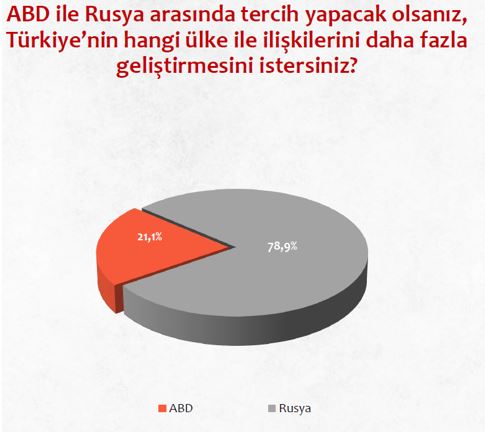
We may continue with trying to explain fully Turkey's increasing military cooperation with Russia until hell freezes over, but the simple truth is that it is all about the bottom line. Does Erdogan (and Turkey) buy S-400s because they want to increase leverage on NATO? Absolutely! Does Turkey buy S-400 as a demonstration of her independence from anyone? You can bet your ass on it. But in the end, the bottom line is this: you want to survive in the modern world--you need those Russian systems which constantly, not-stop, perform in real combat and perform well. Of course in Turkish case we have what nobody could even conceive 10 years ago: overwhelming number of Turks not only want closer relations with Russia, but consider Russia a strategic ally. Remember this? 
I wrote about it before. In the end, grossly oversold Turkish-made Bayraktars turned out to be not exactly fully Turkish-made and once Canada and other Western contractors who provided guidance and targeting systems for those UAVs refused to supply them, Turkey started to experience difficulties with production. Russians, though, say that they will help Turkey with her own indigenous 5th generation fighter and Russia has no problems with allowing Turkey to produce SU-35s. Russians will stick to contractual obligations and short of war, will continue with them politics notwithstanding.  
 
Saudis got the message, when signed last week military cooperation agreement with Russia. This is not to mention the fact that Houthis do not allow Saudis to rest. 

Authorities in Saudi Arabia say they have intercepted three ballistic missiles targeting the country’s oil-rich eastern region as well as the cities of Najran and Jazan in the south. There was no immediate claim of responsibility for Saturday’s attacks, but the Saudi-led coalition fighting the Houthis in Yemen blamed the Iran-aligned rebel group. There were no reports of casualties. A source familiar with the matter told the Reuters news agency that the missile aimed at the eastern region was intercepted over the city of Dammam. Shrapnel from the missile scattered over the Dammam Suburb neighborhood, injuring two Saudi children, while 14 homes suffered light damages, the official SPA news agency said, citing a statement by the defense ministry.

Obviously, the United States is very unhappy, because for many years after the collapse of the Soviet Union the United States considered arms trade and domination of the lucrative global arms markets its forte'. But things change, as does technology, tactics, operational art and strategy. It is about adapting, it always was and today the United States is not competitive across several important segments of weapons' market among which air-defense, armor and missile strike systems are most noticeable. It is not just technology issue--it is a doctrinal one. Afghanistan factor, moreover, will continue to impede American military-technological competitiveness on the international arms market, no matter how all kinds of "arms trade" observers, such as SIPRI, among many, will play (or falsify) statistics. There is very little doubt that Afghanistan was merely a visual representation for laymen of the process which started immediately after the Gulf War and which exercised a baneful influence on "American Way of War". Arms trade merely reflects a long-time trend in warfare which experienced a truly revolutionary development starting from early 2000s, the same way as era of sail yielded to the steam-driven and armored ships... times ten.  Expect a lot of butt-hurt in Western media.

Wednesday, August 25, 2021

Arms For Sale.

Rosoboronexport signed the first contract--the country is not disclosed yet--for newest Pantsir S1M (in Russian), which is a further development of now legendary S1s and this one has an increased range or targets' "intercept" of 30 kilometers and elevation of 18. But among news pouring in about Russia producing nothing (wink, wink), this one stands apart--the signing of contract for the new batch of S-400s between Russia and Turkey is expected by the end of this year (in Russian).  If that wasn't enough, Russia offered Turkey help in developing the fifth generation fighter. I don't need to elaborate on geopolitical significance of this news, since Turkey, being a NATO member, looks increasingly interested in military cooperation with Russia for obvious reasons. Same as Egypt, whose political "top" was "impressed" by the fate of Libya and, obviously, doesn't want to repeat the fate of her Arab neighbor. 

Two days ago, Vladimir Putin gave a start for the construction of six new ships for Russia's Navy, among them two newest Borey A SSBNs, two latest Project 636 SSKs and two corvettes, one of project 20380, another of the ocean-going variety of project 20385, capable of carrying 3M22 Zircon. All that bounty is for Russia's Pacific Fleet with the exception of the Boreys, because it is unclear if both of them will join Pacific Fleet or only one. But here is one ship which caught my attention: 

This is the newest project 15310 cable-laying ship Volga, which, without much fanfare, was launched at Kerch shipyard Zaliv few days ago. It is a beautiful, 10,000 ton of displacement, modern vessel (the second one of the class is also nearing the completion at the same shipyard) which is yet another proof of a major boost in Russia's shipbuilding industry which many Western "experts" buried just few years ago. These two particular auxiliaries will operate as Russian Navy's ships and the next big thing from Kerch are, of course, those two amphibious assault ships, which will be four times heavier and larger than Volga and her sister-ship Vyatka. And I am not even talking about SSK Zvezda at Far East which is extremely busy building giant Aframax class vessels and this:

Russia builds those ice-breakers (their different iterations) like there is no tomorrow and most of it is related to the obvious economic dynamics of the emerging Eurasian market, which will need a lot of energy, the type of energy EU wants to forbid to use and thus complete its descent into the economic and geopolitical obscurity.

Wednesday, September 4, 2019

$14.5 Billion Is A Large Chunk Of Money.

But this is precisely the sum India allotted for buying Russian-made weapons. It is a lot. As big defense sales (for Russia) honcho Dmitry Shugaev characterized  (in Russian) this portfolio: it is a breakthrough. As it is known well, India was under non-stop pressure by the United States trying to block India's purchase of S-400 systems. Something tells me, however, judging by the scale of this portfolio that new nuclear powered subs and, ahem, future 5th generation fighters are going to be the part of this whole deal. 

One has to keep in mind that India's contract for French Rafale attracted attention of some serious forces inside India. 
Rafale is an excellent fighter but the deal between France and India whose value is estimated at 7.8 billion Euros was for....36 fighters. This would make Rafale's cost, ahem, roughly 217 million euros a pop, or $240 million a plane. Of course, there were all kinds of caveats, including France investing 50%  of a contract into India's related sectors. The problem with all this is that even if to reduce Rafale's cost by 50%, one gets a price tag of $240/2=120 million a fighter. Rafale is a great aircraft, but it is not that great as to have a price tag of $120 millions. For "fly away cost" Rafale's in 2013 went for around 79 million Euros, or $87 million. Still very high but nowhere near $120 mils. Enter those nasty Russkies. 

Rumor has it that SU-35, which is a monster of a fighter-plane, goes on the market for roughly $65 millions as a base price. Russian-Chinese contract for the regiment (24 planes) of SU-35S is valued at $2 Billion, which makes the cost per single SU-35S (Russian, full capability, version) at around $83 million--still less than Rafale under the most favorable conditions. The math is really simple here. I am not going to go into fanboys' comparison of Rafale and SU-35S, both are superb fighter planes, with Sukhoi having one obvious edge over French fighter--super-maneuverability. But then again, it holds this edge over any aircraft in the world. And, of course, now a juicy SU-57 is towering behind SU-35S and India finds herself in a conundrum. Truth is, Indians love Russian-made weapons. They always did, since good ol' Soviet times and, facing now a true revolution in military affairs, (needless to say India knows this through Joint Russian-Indian Venture Brahmos really well), India wants those technologies. If Turkey can have them (some of them), India for sure, having a long record of friendly relations with USSR/Russia, have more than a fair shot at upgrading herself to cutting edge weapon systems. After all, India is a genuine candidate for crossing into the hypersonic paradigm, with her Brahmos, sometime next decade. 

What else was discussed with Indian side in terms of weapons I don't know and cannot know but the sum of announced portfolio is really gigantic and we all may state pretty confidently that India does it not just for obvious geopolitical considerations towards China and Pakistan, but also having some thoughts about the United States which becomes increasingly unpredictable and, certainly, views Indian Ocean SLOCs, or, rather, their interdiction, as crucial in curtailing China's BRI project. India, meanwhile, wants to view Indian Ocean as India's Lake and that requires even larger investment into the modern navy. Enter those damn Russkies again, wink, wink, who know that India needs ships and, most importantly, subs. And all that, as you may have guessed it already, requires all those enablers, those sensors, combat management systems and other pretty expensive things going under C4ISR moniker.  And then, of course, there are all kinds of joint ventures possible for joint manufacturing of... a lot. So, let's put it this way, Prime Minister Modi had a very fruitful visit to Moscow. 

Monday, November 5, 2018

There Is Always A Price To Be Paid.

We have been over this in this blog several times. It is good to repeat it yet again.
I don't know if Iranians learned their lesson, after all Russian proverb the orient is a very delicate business applies fully here, but it is about time they started making some proper decisions. Especially with this in mind:
Most modern commercial planes have more than 10 percent in U.S. parts, the threshold for needing U.S. Treasury approval. But Russian officials have been reported as saying Sukhoi is working on reducing the number of U.S. parts in the hopes of winning an Iranian order for up to 100 aircraft. 
Big power politics does not work on mere trade contracts, however important they are.
Bloomberg gives a decent representation of Iran's main export's (oil) distribution:
As you can see, if push comes to shove--new "instruments" or not, the United States can "kill off" Iran's deliveries to Europe and Asia easily. I do not have any faith with EU, which, I think, can be forced to do US bidding, especially when one talks about "defense" issue, which are important to Europeans (after all, aggressive Russkies are planning to harm Europe for...no apparent reason). This could be a disaster for Iran but... enter Russia. 

First, the reason Iran is still not bombed, as many in Tel Aviv (and D.C.) sleep and (wet) dream about, is because of, no, not China, but Russia. After all, even Iranian assets in Syria are breathing much easier as member of Knesset's Committee on Foreign Policy and Defense Xenia Svetlova (obviously of Russian Jewish descent) admitted today (in Russian). 
Since Russia supplied S-300s to Syria, Israel didn't fly a single mission into this country and this delivery changed the balance of power in region. 
Isn't it what I preach for years now? How many more empirical evidences are needed before people start to take in basic facts of great power behavior. Especially if this great power (or superpower) is Russia who loves peace and quiet. Iran, sure as hell, now better start thinking very clearly regarding her trade relations with Russia, because it is her who is selling this most important and desperately desirable product in the world--political stability. Hence the question: can Iran be slightly more patient for Russians finishing SSJ-100s to fully Russian specs, same goes to MC-21, which goes into series production next year, and so on? There is, after all, another dimension to this whole regional dynamics once one considers that almost 40% of Iranian population are ethnic Azerbaijanis and that brings into focus the issue of Caucasus and Turkey, which herself is somewhat in limbo right now, albeit I expect her to fall back into the NATO fold eventually. In the end, Iranian oil deliveries also rest on arrangements which Russia, who doesn't really gives a damn about sanctions, will make. 

So, no matter how important for Iran her regional ambitions are, she will have, at least for a little while, to dance a little bit to Russian tune, whose music sheet ranges from trade to military assistance to the alternative to SWIFT which eventually will be killed by the US, to...well, guarantees of Iran's safety which is a direct function of Russia's military might and geopolitical weight. It is what it is and for the time of this great turbulence, Iran will have to do a slight accommodation with Russia who is sincerely interested in keeping Iran stable, prosperous and peaceful. In the end, it was Iran who, once sanctions have been lifted, immediately signed contracts for 200 commercial aircraft NOT with Russia, who at that time hoped that Iran will consider Russia's support. But, as they say in Russia the orient is a very delicate business. It looks like Russians finally learned their lessons and that is what matters most at this point of time.