Showing posts with label Ike. Show all posts

Thursday, August 25, 2022

Speaking In Purely Military Terms...

... such a decision is reasonable. 

The US government intends to officially name its military mission to aid Kiev and appoint a general to command it, the Wall Street Journal reported, citing Biden administration officials. This would formalize the operation that predates the escalation of hostilities in Ukraine and allow the Pentagon to award ribbons, medals, and special pay to its participants. Giving the operation a name is “significant bureaucratically,” the Journal explained, as it “typically entails long-term, dedicated funding and the possibility of special pay, ribbons and awards for service members participating in the effort.” The US has previously named its operations in Afghanistan and Iraq. The original intervention in Afghanistan was dubbed “Enduring Freedom,” replaced by the nation-building “Freedom’s Sentinel” in 2015. The 2003 invasion of Iraq was called “Iraqi Freedom,” while the 2014 redeployment to Iraq and Syria to fight Islamic State (IS, formerly ISIS) terrorists was designated “Inherent Resolve.” A two-star or three-star general will be appointed to command the effort, in what the Journal described as “a shift from the largely ad hoc effort to to provide training and assistance to the Ukrainians for years.” 

But, of course, behind this military thingy there is a serious moral issue which sees the US supporting all kinds of genocidal maniacs throughout the world. ISIS and Al Qaeda connected terrorists being prepared at the US Al Tanf base in Syria are a good example, and, in this case, such operation should surely be named like... Ukraine's Freedom (To be Nazis), or Freedom (To Kill Russian Children), or Unflinching Liberty (To Support Terrorists), something like that. 

At issue, of course, is the fact that the US cannot support Ukraine for much longer because this romp of a country will continue to be reduced to primarily terrorist diversionary activity, such as killing civilians and trying to blow up infrastructure objects. That, the US (and UK) will support and, in fact, will be very proud of, because this is the only thing the US can do to harm Russia and Russians. Pentagon, it could be stated now very confidently, has no material, technological or operational (and intellectual) means to fight a real war and, mind you, Russia conducts SMO, not a war. War is a somewhat different thing and should that have been a full scale war in Ukraine, many of those awards for American servicemen involved with Ukraine would have been posthumous. It may yet come to this, Russia has excellent intel capabilities. 

Here is Ike and Petraeus. 

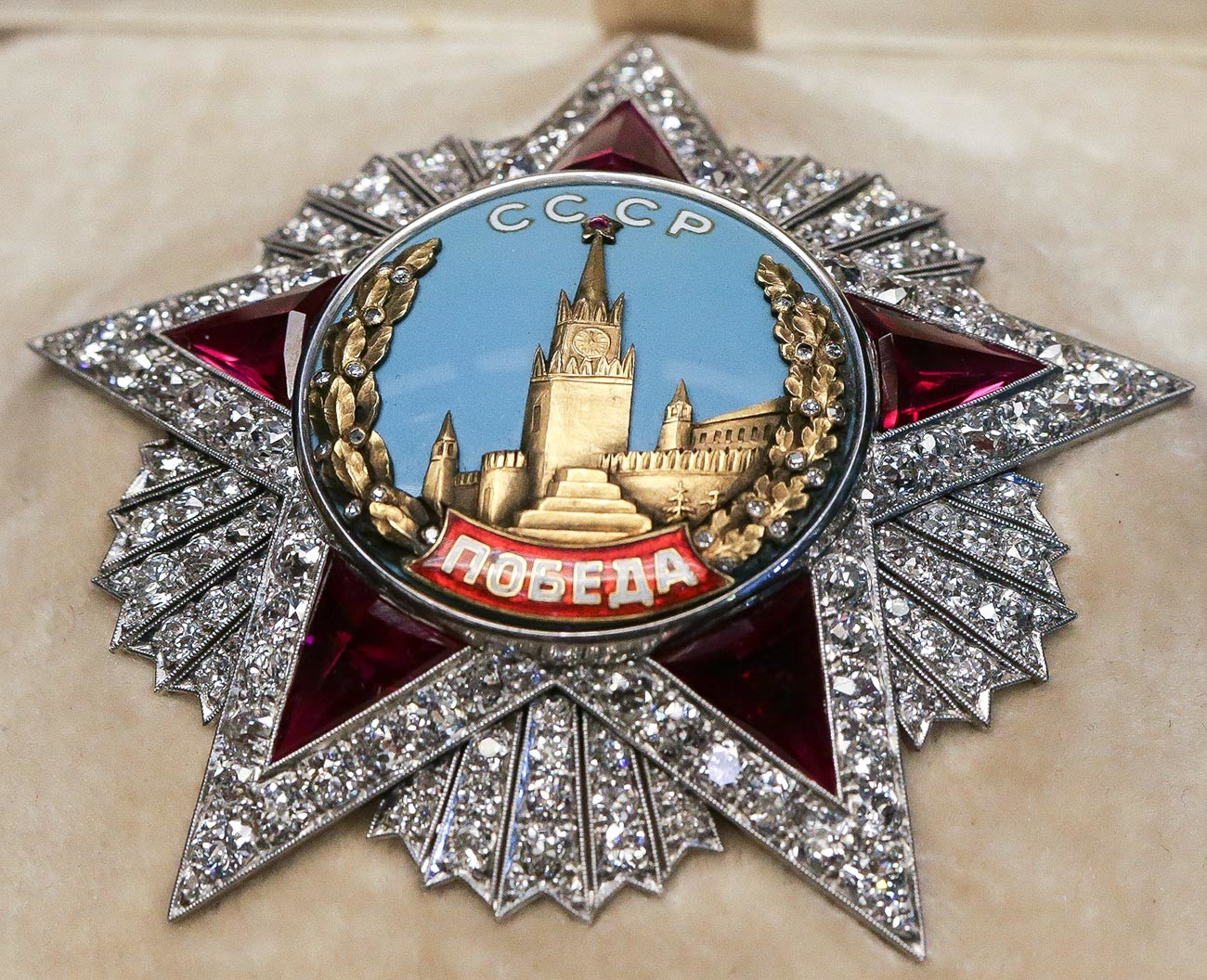
While fanboys still discuss how good or bad as a strategist Ike was, one cannot deny the fact that Ike was a very good military leader, all things considered. Not only he was a Supreme Allied Commander, he personally was awarded by Stalin with this:
 
Read attentively--it is the Order of VICTORY against mightiest military machine in history. Do you know how the status of this order is described? Here it is:

Орден “Победа” является высшимвоенным орденом. Им награждаются лица высшегокомандного состава Красной Армии за успешноепроведение таких боевых операций в масштабеодного или нескольких фронтов, в результатекоторых в корне меняется обстановка в пользуКрасной Армии. Для награжденных орденом “Победа”учреждается, в знак особого отличия,мемориальная доска, для внесения в нее именкавалеров ордена “Победа”. Мемориальная доскаустанавливается в Большом Кремлевском дворце.Награждение этим орденом производится толькоУказом Президиума Верховного Совета СССР.

Translation:  The Order of Victory is the highest military order. It is awarded to senior officers of the Red Army for the successful conduct of such combat operations on the scale of one or more fronts, as a result of which the situation is radically changing in favor of the Red Army. For those awarded with the Order of Victory, a memorial plaque is established, as a sign of special distinction, to include the names of holders of the Order of Victory on it. The memorial plaque is installed in the Grand Kremlin Palace. This order is awarded only by the Decree of the Presidium of the Supreme Soviet of the USSR. 

And here is this Plaque.  

Very few people on it. But I am sure Petraeus who lost everything there is to lose militarily, or any modern American general, can give a run to Ike, or even Zhukov, for all their awards. After all, those glorious "victories" in Vietnam, Iraq, Afghanistan, Syria and now in Ukraine have to be rewarded with something. Like the stunning military triumph in... Grenada, when the number of medals exceeded the number of troops involved by a healthy margin. So, I am sure the medals and ribbons for killing civilians in Donbass, supporting Nazi battalions, or torturing POWs is a logical conclusion to the American military history of the last 8+ years. I am not surprised anymore. And don't tell me that mediocrity is not rewarded in the West nowadays, in fact, it is the only thing which gets a reward.

Wednesday, April 4, 2018

Why I Still Like Ike.


Any American must remember Ike's greatest economic achievement as a President of the United States--Federal Aid Highway Act of 1956. Well, everyone knows, or at least should know, about Ike's great military leadership qualities. The man has many achievements to his record many of which eclipse the fact of Ike being merely a human, with many flaws which humans have, but apart from Ike's great military record, there is no denial of Dwight D. Eisenhower being America's 20th century not just POTUS, but a real statesman. In fact, Ike's scale as statesman of global standing is so huge, that it is simply tasteless to compare him with the crop of American political operatives, starting from LBJ, whose occupying position of POTUS must be viewed as examples of utter inadequacy of human and professional qualities to the highest government office in the US. Ike was more than adequate to this POTUS office. In fact, we all living in America today use and benefit greatly from Ike' vision. Just to illustrate outstanding human and American statesman qualities of Ike:


What is forgotten here is the fact that it was mandated by Eisenhower Administration that most of money provided and generated by this massive project should go back to the American industries—this is how industrial, manufacturing infrastructure grew, so grew well-paid employment. Gee-whiz, modern day liberals trumpet on every corner about Clinton's so called "economic expansion" forgetting, of course, that it was on his watch, granted with the service of Reagan economic ideologues (fraudsters), that American de-industrialization went into overdrive and the US today has become a full blown FIRE economy and is heading fast towards third world economic status. What a startling contrast between genuine American patriot and a collection of power-hungry corrupt politicians. In a sense, Ike is a man who created modern America.


Enter Vladimir Putin and his statement that:


Rings the bell? I will omit here going over Stalin's industrialization, not insignificant portion of it helped by American manufacturers, since some overly zealous "democrats" may have aneurysm reading about parallels, but there is no denial of a common economic and state (as in nation) principle of building an enclosed technological cycle or, rather, cycles which become national economic locomotives. As the news from Zvezda, which already cuts metal for, and other shipyards trickle in, and I quote:

In September 2017, in the presence of the president, four supply vessels of the ice class were laid here at once. “Catherine the Great,” “Holy Mary,” “Vladimir Monomakh,” and “Alexander Nevsky” will be launched in 2019. The entire portfolio of orders from Rosneft includes already 24 vessels. Including five Aframax type tankers – environmentally friendly, with gas fuel. Another 15 LNG tankers of the Arctic class are ordered by Novatek. However, in order to make “Zvezda” profitable in 17 years, a lot more has to be built.

Actually, I think, should Ike have been alive today he would have been ashamed to be called Republican when observing this cabal of free trade and monetarism fundamentalists who run GOP today and who, together with Democrats and sleazy corporate rats, are primarily responsible for American economic decline. Yet, Putin acts in case of a massive shipbuilding and energy projects (plus many others) very much as Ike did—the parallels are undeniable. Obviously, Putin, being Russian acts with consideration of Russia's unique economic factors but the common sense economic idea is universal—normal patriotic statesmen act in the interests of the whole nation, not some small and moneyed inner-circle of self-promoters and lobbyists. Ike, certainly, acted in the interest of the whole American nation and the monument to his economic success is America's wonderful interstate highway system and massive construction and heavy road equipment industries. Cannot ask for a better and more massive monument to one man. And that is why I still like Ike. 

A very small part of Zvezda shipyard with one of the pr. 949A Oscar-class SSGN being modernized with Kalibr missile complex.

Monday, June 12, 2017

Ike, Strategy Rant #1

Late Stephen Ambrose, who for a while was considered America's foremost scholar on Eisenhower, not for once commented to the effect that Ike was not necessarily that great of a strategist. These comments, evidently shared by some other American historians, good and bad, all derive from the Caesarist  (or Napoleonic, if one wishes) view of the warfare. American military bias to Napoleon and his campaigns is not surprising, Carl Sandburg in his Abraham Lincoln: The War Years (if my Alzheimer doesn't fail me. If mistaken I will correct the reference later)  wrote about frustration of US West Point-graduates with the fact that they, instead of studying Napoleon campaigns, were forced to study this Russian Suvara (Alexander Suvorov). Indeed, ideas of beautiful maneuvers, lightning strikes or strategies developed by a single brilliant military mind were all good for wars fought using linear tactics and cavalry, with set-piece battles. Yet, even those set piece battles culminated in a slaughter on unprecedented scale during the Battle Of Borodino and, in the end, tore away the mantle of pure strategic genius from Napoleon. Brilliant tactician certainly he was, a strategist? A strategy as a system of (military) measures designed to achieve  political objectives of a war (Clausewitz inspired definition, later adopted by Marxists) was something else completely and, when judged against the result achieved, tactical and operational brilliance means very little when the war is lost. 

By WW II, strategic thought became what we know it today--a function of military power, which, in its turn, encompassed a huge spectrum of national capabilities ranging from industries to public education and culture. Real strategists saw the world in a very different light than Napoleon saw it. Modern armies and navies required now immense industries, massive logistical chains, originating in national centers of industry and agriculture, new weapons such as radio, tanks and combat aviation changed the outlook of the war dramatically and changed the way armies were commanded and controlled. WW II was the first war with a full blown C3ISR complex becoming a decisive factor. To command a massive army group of 800 000 troops simultaneously required more than just ability to conduct brilliant maneuvers or inspire troops with pep-talks on the even of the battle, it required a profound understanding of the mechanisms of such a command and control and that, on a strategic level, that is level of large bodies of troops capable to influence the dynamics of a whole campaign, it meant the ability to harmonize a huge number of political, purely military, human and other factors. By 1939 to have such an ability one had to be extremely well educated not only as a good field officer, one had to have a serious both education and pedigree in (general) staff work. 

The fact that Ike graduated first out of 245 officers in Command And General Staff College at Fort Leavenworth, KS, in 1925 should be emphasized together with Ike's serious staff pedigree prior to WW II. Yet, the shtick of many in contemporary (since WW II) US historiography, let alone vast US military history amateur circles, is pointing out that prior to WW II Ike didn't (field) command anything larger than tank battalion. But that immediately raises a question, why then, a number of battalion commanders want to attend General Staff  academies in any serious Armed Forces? It is because they know that these are academies which open the door to the command of a much larger units. How being a superb and experienced staff officer is considered a disadvantage, while, if anything else, it is an imperative for anyone who is to be considered a serious military strategist. One of the examples of such General Staff leap into the cohort of outstanding military leaders is Marshal Vasilevsky, who, and you may have guessed it already, never commanded, before entering in 1938 the world of General Staff, anything larger than regiment. Yet, one of the most outstanding military leaders of WW II emerged back into the full field command during Red Army's operations in East Prussia. All that, after Vasilevsky planned and coordinated such battles as Moscow 1941 counteroffensive, Stalingrad, Kursk and Operation Bagration.  Not too shabby for a staff officer. 

How Eisenhower's staff pedigree could be a disadvantage, as many profess, in the war where strategic inception (Zamysel) required immense planning, hence large staffs, remains a complete mystery to me. How being a star graduate of what amounted to Russian (Soviet) equivalent of General Staff Academy is not a perfect pedigree for command of large complex forces and being a good level strategist is also a mystery to me, when speaking about Ike who has an overwhelming empirical evidence in his favor. Serious wars are not fought without serious plans and Eisenhower sure as hell was a good military planner with a good grasp of what was at stake in WW II. It couldn't have been otherwise, since in many important respects serving under George C. Marshall's command was more than ample evidence of Ike's talents. Illiterate references (in many US sources) to Ike's "administrative", a euphemism for staff officer, talents merely underscore a complete lack of understanding what is involved in serious operational and strategic planning and Ike sure has done more than his share of it. He ended up, finally, the greatest American practitioner of military strategy, which becomes even more evident against the background of many today's general officer mediocrities whose "planning" (in reality promoting their own careers) helped to squander American resources and embroil her in useless and unwinnable wars globally. 

Yet, Ike's first attempt on real strategic planning was both noble and professional. The first thing Ike understood--a fact which is largely downplayed or deliberately ignored in many American sources--was the fact that successful Allied strategy in Europe hinged on Red Army. Compare this view with the view of then Senator Harry Truman: "If we see that Germany is winning we ought to help Russia, and if Russia is winning we ought to help Germany, and that way let them kill as many as possible." The contrast in attitudes and the level of a strategic thinking couldn't be starker, when Ike wrote in his diary in July 1942, after the Second Washington Conference rejected his and Marshall's Operation Sledgehammer Plan, in favor of Torch.  Depressed and dejected Ike wrote that the prize "we seek is to keep 8 million Russian soldiers fighting Germany. Failing to provide help to Russia will constitute one of the gravest mistakes in history" (need precise quote, this one from memory, but almost exact). You can find this entry in same Stephen Ambrose's national bestseller "The Supreme Commander". Ike's prophesy will come true but Cold War ideological realities helped to not only obfuscate but essentially completely reverse the clock work of the early WW II to a such degree that, in the end, real events and strategic discussions between Allies in 1941-42 have been completely overtaken by Hollywood imagery and a mythology which only now, not least thanks to immense academic efforts of Colonel David Glantz and Lt.Colonel Jonathan House, is being penetrated with the actual facts "on the ground".  

To Be Continued...


Sunday, June 11, 2017

Ike-Intro.

This post or, rather, a series of posts was long in the making since required a significant thinking and re-thinking (and recalling) of many details of WW II and Western Allies approach to that war, and, I think, it is as good time as any to start writing about Dwight D. Eisenhower and his role both in WW II and, as a consequence, in what followed until his famous farewell speech on 17 January 1961 from the White House. I stated not for once, that we all still live in the world which was largely formed in the crucible of battles of WW II and it seems it is a good idea to revisit some very important (and crucial) events of that war. So here is a short intro:

--------------

It is  rather an arduous task to discuss WW II, namely European Theater of Operations, with many Americans who, as strange as it sounds, are more or less acquainted with the peculiarities of Allied operations after D-Day. The reason for this difficulty is simple--it is normal to be patriotic and have many biases associated with such a position. The amount of books in the US dedicated to European Theater is immense, so is the number of different TV shows and, of course, there is always Hollywood which is hugely responsible for developing of those American biases when dealing with WW II. Yet, it is, very often, precisely this gigantic number of "studies", narratives, stories and reflections on Allied operation in Europe which creates a problem--for an average American it simply becomes impossible to dig for the truth, especially for the one which requires at least basic understanding of issues of military strategy, operational art and, to a certain degree, tactics. Moreover, understanding of how those three interact and how they relate to a larger military-political picture is even more difficult task, since requires a good grasp on realities of a war, and especially the war as complex and brutal as WW II. Hence, Hollywood and pop-history. 

My personal experiences with these uniquely American attitudes and biases throughout the years ranged from being overwhelmed by militant ignorance on anything WW II related to me, a former Soviet military professional, explaining actual facts of US Army military planning and operations to a number of people who would pass, under normal conditions, for people "well-versed" in US WW II military history. The case in point is me, not for once, being forced, with quotes and even scans of documents, to debate many American WW II history buffs that Operation Cobra was a result of Omar Bradley's idea and planning and that General George Patton was merely an attribute to this operation. But it is almost impossible to break through American Patton's myth, which was enhanced immensely by the famous movie with George C. Scott's genius (and detached from actual war reality) performance, which won him an Oscar. As Ladislas Farago noted in his book, when the movie came out in West Germany early 1970s, Germans couldn't understand how" an obscured American general merited a movie", when there was not one made about Zhukov, Montgomery or even Rommel. But that is what constitutes the main problem--a Hollywood version of WW II and of Allied operations in Europe. Idealized view of the WW II, as merely a combination of artsy maneuvers conducted by military leaders who were modern reincarnations of Napoleon and who were ready to "breakthrough", "pursue", "envelop" or "annihilate", continues to persist in the US. Patton, who was just another Army Commander, and by far not the most remarkable one, among very many generals of anti-Hitler Coalition, merited two major Hollywood motion pictures, while Allied Supreme Commander Dwight D. Eisenhower got himself a 1979 TV mini-series and a rather obscured, yet again TV, 2004 movie with Tom Selleck as Ike--hardly an appropriate tribute to a man, who not only was a huge part in American push, together with incomparable George Marshall, for the Second Front but effectively stopped the war in Korea and went on to become a truly great American President, especially viewed from today's vantage point, against the background of a number of mediocrities who since occupied the White House. In US WWII mythology Ike was and is hardly a persona who fits into American perception of the war, which is not surprising--most Americans simply have no grasp of realities of the warfare in general and of WW II in particular and that is a travesty. 

While Hollywood portrayed Patton as a hand gun whipping, fearless "leader" ready to literally lead his Third Army to, well, even Moscow, Ike's balanced, no-nonsense approach to the realities of his high command, while being militarily admirable, made not a very good material for Hollywood. Yet, both Eisenhower and Patton represent an inherent and, probably, irresolvable contradiction of contemporary American military history, since are counter positioned a strategic and operational reality and a myth, and this brings to the fore the issue of scales and proportions, which is crucial when dealing with WW II. The question is then this: was Ike a great general? 

Here is the catch: real military leadership under conditions of WW II had absolutely nothing to do with the qualities exhibited (and greatly embellished later by his propagandists) by Patton. As studies of his campaigns, especially his debacle at Lorraine, pointed out (such as review by Dr. Christopher Gabel for Combat Studies Institute at US Army Command And General Staff College at Leavenworth, KS) Patton's exploits were "ruthless and reckless". The question is, then, why reckless. It will be answered later. To understand this issue one has to look at the realities of the Western Front's South by Fall of 1944. Realities were such that the Third Army faced "Few of the Germans defending Lorraine could be considered First-rate troops. Third Army encountered whole battalions made up of deaf men, others of cooks, and  others consisting entirely of soldiers with stomach ulcers. The G2 also identified a new series of German formations designated voIksrenadier divisions). These hastily constituted divisions numbered only 10,000." It is hardly a force to be compared to Wehrmacht circa 1941-43 but that is mainly the force on fighting which Patton's mythology is built in the US and the one which obscures serious strategic and operational choices Ike was facing since he, unlike Patton, had two large Army Groups under his direct command and was the one, who, among very few others, was responsible for finally turning Overlord into the actual operation--a command and leadership level of which Patton could only dream about and for which he was ultimately unqualified. But, if one discounts Patton's mythology, which is strictly a local American phenomenon and the one which complicates and, in fact, impedes understanding of WW II dynamics, was Ike, in the end, a good military leader? The answer to this question can be found in identifying qualities which realistically were required for the prosecution of such a war as WW II was. It is immediately possible to say that Ike was qualified to do so and the only debate which is possible here is the one of a style not of a substance of what Ike was doing, especially once one begins to go back to 1941-42 and see how Eisenhower, then assuming the position of the head of Marshall's OPD, viewed European Theater and that will require an excurse into the Sledgehammer ideas. It all comes down to this: 

  
To Be Continued.....