Showing posts with label aerospace industry. Show all posts

Friday, September 26, 2025

Yes, And?

It seems that Germany still cannot resign itself to the idea that it is not that important technologically. 


Yes, not only Russia can "track" satellites--all of them--she can destroy them from the ground up to 650 kilometers in space, or anywhere by the so called "inspector" satellite. The situation will get even worse by 2030 since Russia will be ready to start tests for its orbital and deep space nuclear tug Zevs (Zeus) which will be able to do just about anything. Yes, Germany still makes decent rolling stock and overpriced and overrated refrigerators, commercial and combat aerospace--that's a whole different level of scientific and industrial expertise. Do a forensic mental experiment--ask yourself a question if Germany can built and sustain completely out of her own resources a space station. Yes, it can--30+ years, soup kitchens and general collapse of economy. Then--maybe. That's your answer. 

This, as well as this--that's how superpowers look. Germany is not the one. 

The construction starts in 2027-28. While Russia continues to sustain ISS. That's called technological Bundesliga, its Bayern Munich. 

Tuesday, December 5, 2023

Two To Tango...

... or, two can play the game. Sanctioning Russia is akin to shooting oneself in the foot. And this is precisely what EU did. Note, the most important part of the modern jet engine are blades, not just fan blades, however important, or cold part blades (compressor), but the blades of the hot part of the engine, that is turbine.

Those are state of the art pieces of very advanced metallurgy. So, when Airbus and Boeing refused to service their aircraft flying in Russia, including engine manufacturers' maintenance  by such corporations as RR, GE or CFM, those nasty Russians did this:

НОВОСИБИРСК, 3 декабря. /ТАСС/. Специалисты Института теоретической и прикладной механики (ИТПМ) СО РАН в Новосибирске разработали технологию восстановления лопаток для двигателей самолетов Airbus и Boeing. Ее начнут применять на Бердском электромеханическом заводе (БЭМЗ) до конца 2024 года, рассказал ТАСС научный руководитель института академик Василий Фомин. По его словам, для решения этой задачи авиакомпания S7 менее, чем за год построила два завода и получила соответствующие разрешения. Между тем председатель СО РАН Валентин Пармон уточнял, что для этого был приобретен БЭМЗ, расположенный под Новосибирском. "Нашу технологию мы должны отдать [БЭМЗу]. <...> Я думаю, что он приступит к [ее использованию] в конце следующего года, если не в середине. <...> Мы уже разобрались, какой материал используется, уже подобрали близкий к этому материалу наш, и российский материал уже напыляем" - сказал Фомин в беседе с ТАСС, отметив, что опытные образцы уже готовы. Технология позволяет восстанавливать обгоревшие и потрескавшиеся лопатки для двигателей самолетов Airbus и Boeing. Это необходимо, так как из-за санкционного давления их обслуживание из-за рубежа затруднено. По словам Фомина, производство лопаток для двигателей в России не предназначено для этих воздушных судов, поэтому было необходимо уделить внимание их восстановлению.

Translation: NOVOSIBIRSK, December 3. /TASS/. Specialists from the Institute of Theoretical and Applied Mechanics (ITPM) SB RAS in Novosibirsk have developed a technology for restoring blades for Airbus and Boeing aircraft engines. It will begin to be used at the Berdsk Electromechanical Plant (BEMZ) before the end of 2024, the scientific director of the institute, academician Vasily Fomin, told TASS. According to him, to solve this problem, S7 airline built two factories in less than a year and received the appropriate permits. Meanwhile, Chairman of the SB RAS Valentin Parmon clarified that for this purpose the BEMZ, located near Novosibirsk, was acquired. “We must give our technology to [BEMZ]. <...> I think that he will start [using it] at the end of next year, if not in the middle. <...> We have already figured out what material is being used, already We have selected our material that is close to this, and we are already spraying Russian material,” Fomin said in an interview with TASS, noting that prototypes are already ready. The technology makes it possible to restore burnt and cracked blades for Airbus and Boeing aircraft engines. This is necessary because sanctions pressure makes it difficult to service them from abroad. According to Fomin, the production of engine blades in Russia is not intended for these aircraft, so it was necessary to pay attention to their restoration.

These guys, evidently, forgot who they were sanctioning. A simple logical, causality hint: nation which built half of the International Space Station, serially produces state-of-the-art PD-14 turbofans and flies Su-57s undoubtedly has the expertise and industrial capability to not only maintain critical parts (Tier One Flight Critical level) of foreign aircraft, but if need be reverse-engineer them, not that Russia needs to do that with MC-21 already flying. It is always the same shit with the West--US sabotages composites from MC-21 wing, Russia built a whole new composite industry. 

So, if Russia is evil in Western eyes, then she is extremely good at it.

Monday, July 30, 2018

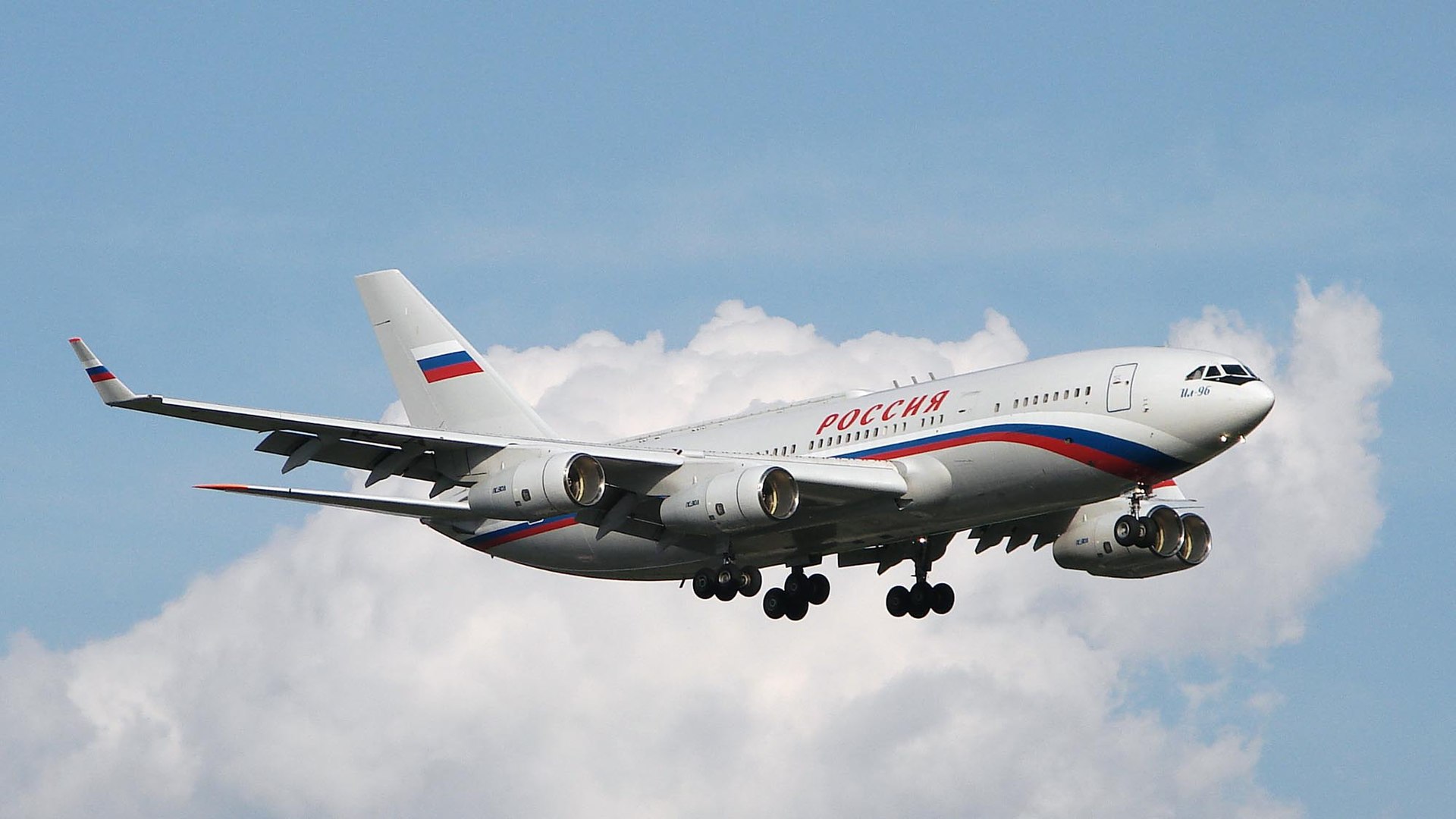
IL-96-400M Is Getting Ready For Take-Off.

Recall what I wrote 2 years ago about the program of return of the venerable IL-96 into operation. Well, it IS being brought back to life and three days old order of Russian government (in Russian) to issue additional (to already provided 6 billion Rubles) 1.3 billion rubles for retooling of Voronezh Aircraft Plant, getting it ready for series production, starting in 2020, is an extremely important event... geopolitically. How so, one may ask. Well, consider this:

1. While the US deep state goes apoplectic accusing Trump in being a Russian asset, truth is--no economic sanctions on Russia will ever be lifted and, in fact, new ones will be imposed. Russians know this damn well. So much for a "useful" Trump. 

2. Increasing economic sanctions apply to Russia all necessary pressures required for a domestic development primarily in real hi-tech sectors and no more so than in commercial aerospace. 

3. As was pointed out not for once--Russia's commercial aviation market is huge, as is the country itself, which necessitates (always did) an extraordinarily well developed commercial aviation sector. With SSJ-100 and MC-21s flying (MC-21 getting ready for series production) already, but those are regional and mid-range aircraft... 

4. Russia needs wide-body, long-range aircraft which is NOT A-3XX or B-747, 777 or 787 for its domestic flights. Il-96, granted, vastly upgraded, from avionics to aggregates, to some variant of Aviadvigatel PS-90 jet engine which will not have any Western parts in it, fits the bill perfectly while keeping Russia in the wide-body long-range commercial aviation business before CR-929 hits the market.  The same goes for PD-35 engine, albeit rumor has it that IL-96 may benefit from 4 PD-14 engines, with PD-14 being in the final stages of its certification. That makes Il-96-400M a thoroughly Russian airplane.

5. Il-96 is simply an awesome aircraft, it is beautiful, elegant and, in the end, Vladimir Putin himself uses its 300 version as a Russian variant of American Air Force One.

Special Version


6. Finally, it is the aircraft which is GOOD ENOUGH and exists now, as opposed to all future projects, not to speak of the Western wide-body aircraft which are a liability under economic and political war US wages against Russia. 

Resumption of the production of Il-96, which was sabotaged in 1990s by Yeltsin's cabal, is an excellent indicator of Russia doing what needs to be done under present conditions--making oneself independent from key Western technologies and this process was ongoing in earnest since 2014. Because in the end, it is finally being asked in Russia why should Russia support a hostile power by purchasing its technology when Russia can completely out of own resources produce it. It was symptomatic, however, that the largest delegation at the SPIEF 2018 was an American one, headed, as you all may have heard, by Boeing's CEO.    

Wednesday, June 27, 2018

And Who Said It Will Be Easy?

An interesting piece of news from India. India's government is setting up a special committee to deal with a rather peculiar situation with long-awaited (since mid-1980s) India's indigenous light fighter Tejas. It is not an impressive aircraft and its only remarkable feature is that it is designed and manufactured in India, mostly.
As you may have guessed already, the engine for this aircraft is not India's made. So, in some sense Tejas' saga is a very good example of an immense difficulty of inserting one into the field of aviation, both commercial and combat, without a school. 

Indian Air Force's (IAF) main fighter today is a Sukhoi-30 MKI. India operates almost 250 of those and it is an immensely powerful fighter, which also made a lot of noise and raised the international reputation of IAF very high. But here is a catch: how a mediocre light fighter of Tejas variety can cost 1.5 times more than Russian-built state-of-the-art fighter is a complete mystery. Or maybe it is not a mystery at all. In the end, much more advanced technologically and economically China still buys Russian jets and gets into the Joint Venture with Russia to produce long-range wide body CR 929. Much more than money and even engineering expertise is required for a creation of a state-of-the-art (military) technology. Technology is a cultural thing and this can not be bought, it has to be developed and even this is not just the matter of time. 
 
India today, if one discounts all kinds of cultural memes, is associated primarily with software field. It is an important field, but it is nowhere near in terms of human, scientific and industrial capital required for a viable competitive aerospace industry. That is on several orders of magnitude more complex task and that requires not just some elite strata of people, albeit it is a requirement, but overall cultural environment which creates appropriate "pressures" for a development of something like modern state-of-the-art fighter or a commercial jet. India is not there yet. But that is a whole other story which, for decades now, creates highly emotional discussions on a possibility of India becoming a true superpower.             

Wednesday, June 8, 2016

And The Bird Is Out.....

And she is a beauty!!

  
This is a major development not only for Russia, with MC-21 already having 175 firm orders and 100 options from Russia's airlines, but also for global market. This jet is a direct and powerful competitor at the most voluminous market of mid-range aircraft with anything out there available today. In this roll out, MC-21, named after legendary Soviet/Russian aircraft designer Alexander Yakovlev (initially, the plane was known as Yak-242), is equipped with Pratt & Whitney engines--this configuration will be used for promotion in the international markets. Russian versions will be equipped with newest PD-14, which will be in series production by 2018. 

MC-21 is a remarkably thoroughly Russian-made plane with a very high percentage of localization--from avionics to composites, which constitute 40% of aircraft air frame, including all-composite wings. A lot could be said about all that, but what must be said is that it is a milestone and a massive comeback of Russian civil (commercial) aviation which about 10 years ago was all but "buried" by all kinds of "experts".                 


This aircraft has a massive export potential but for now it must be oriented towards Russian  market.


Now, onto flight tests and certification. This aircraft is badly needed in Russia. As they say--Godspeed.
  

Thursday, June 2, 2016

IL-96 (and IL-114) Are Back.

This was in November 2015. But that was just an intention. A week ago an intention started to become practical steps. 

Russia Bets On Aircraft From Soviet Past (In Russian). 

This development is strategic, to put it mildly. Of course, the cabal of "experts", many of them, and you may have guessed it already, with financial degrees are "skeptical". One of those "experts" went as far as to complain that it is impossible to improve on the air frame developed  in 1980s. He is such an "expert" that he, of course, forgot that venerable and superbly modern Boeing-747-400, a plane currently still in production, goes back as far as...1968. Many object for a reason of 4 engines and economic issues which arise from that. The problem with this reasoning is that those who object they either can only see what is going on in the West or they have no idea that passenger aviation is a bit more important than production of espresso machines. In the end, one can make a decent living on the import of foreign-made espresso machines. For country such as Russia, which has an outstanding history and tradition of commercial aviation, and whose air frames are universally admired, it is a national shame to buy, especially as it was in 1990s-early 2000-s, Western second hand, some of it--dangerous junk. 

Currently Russia is producing a fairly successful Sukhoi Superjet-100, which is a regional jet, slow produces a number of other decent commercial jets and she also is getting ready to roll out Irkut MC-21. This plane is a wowser. This will be a first serious attack, initially primarily on the internal Russian market,  on the niche which currently is occupied by B-737 MAX and Airbus A321 NEO.  With firm orders for this aircraft topping 200 and PD-14 engine having very successful trials, the implications are obvious. MC-21 is a thoroughly Russian aircraft, albeit capable of being equipped with Pratt & Whitney engines for prospective foreign buyers, who are more used to P&W. As real experts point out:

The MC-21 has its own profile. It is not a copy of a Western aircraft. It has a wider cabin than the A320, a wing which allows a higher cruise speed and a higher capacity in its base variant, the MC-21-300.

And while MC-21 development is not without its share of problems and delays, it seems that 2016 should be the year when this jet will  make its maiden flight.
  

Russia is a country created by nature for commercial aviation--11 time zones, vast spaces, huge distances between major urban centers. And in late 1980s, early 1990s Russia had her own jumbo. The world knows it by its slightly shortened 300 version of President Of Russian Federation Ilyushin IL-96 300 Rossiya.


Its commercial version IL-96 400 is used by Aeroflot and Cubana. These are magnificent planes. 


The way Russian aerospace industry was being destroyed by the so called "reformers" in 1990s can only be described as economic state crime. It is nothing short of miracle that Russia's aerospace not only survived but is finally poised to break out into the vast Russian commercial flight market and it seems that this will be done with state-of-the-art jet aircraft, including, finally, a wide body ones. There is no doubt that new iteration of IL-96s will be updated with composites where it is needed, the older glass cockpit will be updated to the newest ones by KRET and, in foreseeable future, by newest engines. These aircraft have a very bright future in Russia and are genuine tough competitors to Boeing and Airbus on Russian market. It is a very healthy development for Russia, economic nationalism is the way to go for real recovery. In the end, none other than Donald Trump embodies this vision in the US and good for the US, I say, if this vision becomes a set of policies--it is certainly happening in Russia. 

No amount of financial manipulations or speculation ever produced anything of value, it only destroys. Building things is a completely different proposition and money must be in the subordinate position to these higher goals, not define them. Otherwise we will have what Russia was in 1990s or what US has become today--a market of office plankton and entry level service jobs. In the end, European people are in dire need of producing and building things, without that--the best in our culture is lost.