Showing posts with label STEM. Show all posts

Sunday, January 1, 2023

A Brick Wall.

I know, I often am blamed for my condescending attitude towards humanities and especially History, the way it is being written and taught in the Anglo-Saxon world. We all can recall Sir Anthony Beavor who, far from being real military historian, paraded himself as the man who has issues grasping force structure and basic math. And he is just one such "historian' who produced meme in Russia about gazillion "raped" German women.  Examples of such "history" and "historians" abound everywhere and in Russia too, be that Solzhenitsified caricature on 1930s-50s to Fomenko's famous "new chronology". History is no less about juxtaposition of the facts than it is about deliberate and highly responsible research. I was among many who applauded Kremlin's decision to close Russian archives to Western "historians" most of who basically "research" there for anti-Russian narratives, not for history.

But then there is another issue--by the year 2023 history as a scientific field ran, no smashed, full speed into the brick wall of technological and natural complexity of the world. And here is the piece in TAC, which I visit periodically, in which Sumantra Mairta makes a case for The End of (Academic) History. She reasonably complains that:

The academic discipline of history was always a courtly subject. One, it needs an emotionally detached and occasionally amoral temperament to be done right. There is a reason cardinals and monks were often great historians, as were adventurers and soldiers. Two, it needs patronization. History as a subject was never egalitarian, but in a paradoxical way it used to be a lot freer. Statesmen posted in far-off colonies during peak Victoriana were free to travel around and study a subject or a civilization. They did it as a hobby, were unbiased about their subjects, and were usually under no financial pressure to toe a political line, the human and social biases of those times notwithstanding. Those who were not in a position for that, but were still exceptionally talented or meritorious otherwise, were patronized individually or through an institution, yet with little scholarly pressure. That changed gradually after the Second World War, and especially with the rapid institutionalization and mass-democratization of the discipline in the 1980s and ’90s. 

The recent passing of one of the greatest, Corelli Barnett, symbolizes the completion of "democratization" of history, that is to say the destruction of it, and even in her short essay Maitra exposes a brick wall. 

I once wrote a short essay on the direction of historical and political research in which a couple of throwaway sentences caused some mild uproar. “One has only to look at the history departments in British Universities to see how seriously interdisciplinary research has diluted the discipline. Today, a historian of World War I studying fleet tactics is considered to be on an equal footing with someone exploring post-structural erotic subtexts in letters from the trenches.” The crisis in the discipline of history isn’t new and will only get worse...

Well, since the issue of WW I fleet tactics was touched, one has to point out immediately what researcher of said tactics can not do without, even for the primitive times of steam and steel. To REALLY study such a tactics one has to start with basic issues of navigation and maneuvering, which, even during WW I have been mechanized as much as possible but still required this:

And the mastery of operations with vectors and relative movement as was already a requirement for gunnery. Of course, issues of uncertainties are also nothing to be easily dismissed, and once one gets into the neck of the woods of WW I naval warfare, things become increasingly complex and have very little in common with Hollywood concept of war on the high seas. Yes, even for WW I. The issue of the combat control of fleets already then was horrendously complex, not least through developing Theory of Search and of what amounted to a primitive ISR. And then, of course, there is an issue of communications. Just see how Goeben escaped or what has transpired at Jutland. That is why they taught mathematics and physics in officer naval schools systematically already then. Precisely the subjects which are not taught in History programs and that is just WW I. 

You can have fun by reading on the evolution of gunnery for the US Navy since WW I--very light mathematical descriptions--here. And view those ever important errors:

And this is just scratching the surface, since one deciding to become a specialist in naval tactics even in WW I had to have a very good ability in Trigonometry and this thingy (spherical trigonometry is fun, not really;))

And all this is just scratching the surface. Once one gets into the history and fleet tactics of WW II, boy, this is where the shit hits the fan and one needs to have a good background in a lot of things, including, of course, ships automation and first electromechanical computers which ran ships and their weapons. 
Boy, this shit was fascinating. Not to mention courses in radar technology and, of course, ASW. So, you get my drift, right? And I am not even talking about war correlates which feed all those wonderful egg-headed Operations Research Groups in every military, with guys doing math, physics, electronics and mechanics non-stop. And it is already at this juncture where one must begin to understand WHY tactical level officers be them in the US, USSR/Russia or France, be them naval, army or air force have been and still are being fed a massive volume of a highly specialized STEM knowledge projected against the background of tactical and even operational realities of modern warfare, whose age unfolded fully in 1960s-70s.  

And then comes this--and this is where the brick wall becomes impenetrable and requires apart from extremely complex highly specialized knowledge training, also, very high level clearances.

All this is beyond the grasp of historians, and political "scientists", especially the ones who write and defend their Ph.D theses on the history of Queer movement and homo-eroticism. Two absolutely different animals, and things will not get better--they will get much worse for history as an academic field, because the history since 18th century is being written by engineers and people with natural science backgrounds. And those are very difficult degrees and research which goes into them. Hence, the brick wall and it is impenetrable. Just look at "reporting" on SMO by all those "voenkors" and Western media. Only real professionals know the real score and they ain't historians.

Friday, September 4, 2020

US Public "Education".

Quotation marks are on purpose and don't expect me to say anything new what hasn't been said before. James Kunstler wrote today a piece on the "decline" (it is actually an implosion) of US education. He writes, justifiably, sarcastically about the while scam of US university (higher that is) ed. 
Well, most modern "fields of study" in the humanities field are a complete scam and have a negative (not just zero) academic value which subtracts from already feeble set of skills of psychologically unstable but sanctimonious, nonetheless, legions of young people with applicable professional skills of a birthday party pony for a kindergarten girl, let's not go into the evaluating the number of prefabricated ass-holes among them who will never become anything but losers incapable of self-reflection. And here is THE issue: yes, one needs to be broadly educated and language and literature are an absolute must, but whatever one thinks on localism and getting back to roots, which I support wholeheartedly, let's be honest--one needs people who know how to build machines. No machines, no survival, period. 

I am not going to dwell too much on the "level" of STEM in American public schools. Unless we are talk about some fairly exclusive schools, real STEM education on the level of K-12 in the US is basically non-existent. I am not talking about Khan Academy which could be a good primer for kids who actually want to learn, but the issue is much deeper--it is the whole structure, approach to those crucial years, usually between 7th and 12th grades which lay down the foundation for any true talent to emerge and be ready to progress to become truly productive in the field which provides for true national competitiveness. One needs an environment saturated with sounds and symbols of classic math, physics and chemistry. US public school couldn't provide that for the last 40 years, now--it is over. Key interaction in those subjects both between students and competent teacher and students are already being removed, and this is just the tip of an iceberg.  

Here is an example from Khan Academy on simplest trig. identities. 

They are filthy simple and are not a nightmare for any student who actually, unknowingly, should have been ready for that in 7-8th grade when studying (that's the point--if they studied) basic forms of factoring which simply has to be, in the end, memorized, such as square of the difference/sum and difference of squares etc. But this is not how factoring is taught in the US. And then kids, even a well performing kids, encounter this (which is a regular fodder for entrance exams in Russia for any decent STEM) and implode:
These are really easy things, but they are easy when they are taught:
1) systematically with ramping up complexity;
2) when students constantly are reminded on WHY they need this both for:
  a) future professional activity;
  b) for development of synapses which are crucial. 
This has never been done on a systematic level in the US and instead of generation of people who know that knowledge is a hard labor and who want to create, we all have got the armies of "free thinkers" and poets, and Queer Studies majors, who constitute the core of (stealing from Kunstler) Maoist crowds attacking, on DNC buck and with its guidance, every single pillar on which civilization rests. You say trigonometric equations and ANTIFA debauchery are not connected? Think twice: differential equations or theoretical mechanics are hard, Queer Studies and Feminism are easy--hence the free time for rioting. Of course, Mohamed Atta example could be used as an exception, after all the dude was an excellent engineer, but we are talking about trends, not narrow particulars or separate data points. 
 
So, here is my point--what is happening in the US today is, of course, a manifestation of a critical phase of liberalism's collapse and, with it, of the economic and ideological structure on which it relied. But let's not forget, that the change is being moved by people and, in American case, very ignorant and badly educated people. Moreover, American BLM-ANTIFA cabal is an uprising of Kreakls. Recall who those are. It is a "revolution" of lumpen masses who are "not essential" and, in fact, dangerous. Looks like taking out of trash started, with federal agents disposing of an ass-hole who murdered Trump supporter in Portland. Bypassing corrupt DAs is also a great idea. Finally, something is being done. In related news, however, good public schools mean this: 
MOSCOW (Reuters) - Russia's "Sputnik-V" COVID-19 vaccine produced an antibody response in all participants in early-stage trials, according to results published on Friday by The Lancet medical journal that were hailed by Moscow as an answer to its critics. The results of the two trials, conducted in June-July this year and involving 76 participants, showed 100% of participants developing antibodies to the new coronavirus and no serious side effects, The Lancet said. Russia licensed the two-shot jab for domestic use in August, the first country to do so and before any data had been published or a large-scale trial begun.
You see, very simple--stay in school, study hard and Lancet will write about you. Develop your synapses and see the purpose in life. Just some thoughts for Friday evening. I will try to finish a large chapter for my new book tomorrow.

Thursday, August 6, 2020

Some Data.

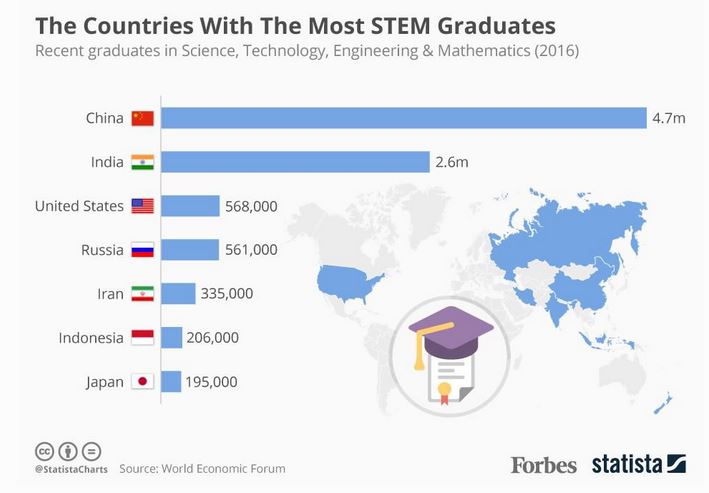
Which needs some elaboration. Because it explains one of the major factors behind geopolitical realignment taking place since the United States and EU unleashed a bloody mayhem in Ukraine. I warned already then that Russians are wrong people to fvck with. Well, here we are today with the US accelerating towards economic abyss while simultaneously destroying everything it prided itself on for couple of centuries, namely the rule of law, freedom of speech and whatever is understood under "democracy" in the US.  But behind all this massive geopolitical shift the "fundamentals" which define nations' real power one thing seems to be often forgotten and not brought up in the discussion often enough. Here is demonstration: this is 2017 statistics:
Well, I guess by now you can easily calculate that population of Russia being 2.2 times smaller than that of the United States and 9.9 times smaller than that of China (and 9.5 times smaller than that of India) per capita Russia produces the highest number of STEM graduates in the world. Here is another angle for 2018. 
China is not included in this count, neither is India, but this is not what matters here. What matters here is quality. Not only Russia produces, in absolute terms, twice as many engineers than the United States, but even if one considers that the United States has an access virtually for free to already educated engineering cadres from elsewhere, primarily India and China, through immigration programs, I can easily point out a number of Russia's engineering schools whose graduates will never move to the United States, thus providing the US with a top shelf engineering expertise. And I am not talking about programmers; in this field Russia does provide the US with an absolute top-notch software engineering talent. 

It goes without saying that the United States will never have access to the most graduates of industrial and weapons engineering schools such as Bauman MGTU. Especially those who went through classified courses, nor will Russian military academies, which are top engineering schools in their own right, provide any inflow to US engineering cadres. Don't count me, I am an old fart who completely forgot everything I ever knew (secrets wise), plus I have no ambitions to pursue specifically engineering career. And then, of course, comes this economic thingy which for many top notch Russian engineers stopped being a crucial factor in making their decision on where to employ themselves--top talent feels itself money-wise very well in Russia. As people who know, and are such talent, testify--Russia pretty much matches most of "economic" desires for such talents. No, really. Exchange Moscow, St. Petersburg or Novosibirsk for NYC or "silicon valley"? Really? Russians have an easy access to the internet, travel a lot and know about real state of the affairs in the US. The city on the hill doesn't shine anymore. 

Some, of course, still fall for the gimmick of American rivers of milk and honey, but increasingly even those begin to reconsider. Mind you, I am talking about STEM talent. The United States is free to remove from Russia most political "scientists", lawyers, journos, business "analysts" etc. Truth is, the demand for those basically evaporated in Russia, with the exception of good accountants--this profession will always be in demand. But, having said all that, one begins to understand how the country "with the economy the size of Texas"(c) continues to produce some mind-boggling technologies both in military and civilian fields. Very simple--by nurturing national STEM intellect, which is in the foundation of national security and survival. It is also in the foundation of making things. You know, cars, aircraft, buildings, railroads, medicine, submarines, computers and other things which are of low interest for Wall Street or Forbes' "analysts" who obviously never attended any school which gives a good handle on STEM.  

Please, don't misconstrue me as bragging. I am not bragging, I just state cold hard facts which are going into my third book which looks at issues of geoeconomics and how American "elites", most of who have no serious applicable productive skills, betrayed own people and doing so de facto demolished US standing in the world, granted many applaud such a development. Recall Lenin's sacramental from his "Can the Bolsheviks Retain State Power"  
Boy, how many in the West even today are able to grasp the fact that apart from own internal, and deadly, rot, modern degenerate West is being outplayed, outproduced, outgunned and outsmarted by the heirs of those very unskilled laborers and cooks (have anybody read Putin's biography, wink, wink) who instead of going to political "science" or journo school went into... well, you know. But I am sure American know-how in producing "elite" will be in a huge demand in the third world which is so desperate for oversupply of philosophers, political analysts, stock brokers, journalists, creative writers and Queer and ethnic studies majors. Meritocracy is so overrated...especially in the 21st century where iPhones grow on trees and Hollywood "stars" influence public opinion.

Friday, March 13, 2020

Chapeau.

To Russian Prime Minister Mishustin for confirming my (and many others) long time believe that in modern society...well, let Mishustin speak for himself when visiting today Kostroma State University and talking to the students there:
Translation: I know a large number of absolutely wonderful financiers, economists who used to be not very good engineers, but I don't know a single, even not a very good one, engineer who used to be good financier or economist.  

In other words, he advised students to get a STEM education, because, well, let's face it, in the 21st Century issues of real leadership and competent management start on the engineering level. How funny, let me quote myself from my second book:
No understanding of warfare is possible without understanding its most important tools, weapons and people, tactics and operational art. It is precisely the field in which American political class has zero competencies—they simply do not teach nor grant degrees in what amounts to military science in the United States. Obviously, rubbing shoulders with American military top brass and listening to rumors may create among some pundits and political figures an illusion that they know how the military operates or how wars are fought—but it is only an illusion. Truth to be told, regurgitation of the few, beaten to death, political talking points in the media sphere doesn’t require any serious background in anything of substance. On the other hand—writing a graduate thesis on Anti-Submarine Warfare operations in Arctic or on Fractionate Exchange Rates during air operations in the EW-dense environment—are the skills of a completely different level and backgrounds of which modern American pundits and an army of armchair “military analysts” cannot conceive. But precisely these skills and knowledge are the key to not only understanding of a modern warfare but to grasping geopolitical reality which is increasingly complex and rests on the foundation of the ever-evolving and revolutionary military technologies.
The Real Revolution in Military Affairs. A. Martyanov. Clarity Press, Atlanta, GA. 2019. pp 1-2. 

How timely is this Mishustin's admission. But the explanation to this statement is extremely simple: Russia's National Projects do not need yet another generation of marketing specialists, economists, bankers and MBAs, they need engineers, engineers, engineers....did I forget to mention engineers? They need CNC operators and programmers, they need construction and industrial engineering specialists, they need geologists, natural resources surveyors and the list is huge. Recall, yet again, what picture did Putin present to then PM Medvedev four years ago. 

It always was, is and will remain so that it is technological-scientific-industrial abilities of nation which define this nation's position in the world. Everything else follows. And that is, sad for some, truth. I will just remind you WHO most of Russia's liberal "reformers" were: with a notable exception of universally hated Anatoly Chubais, who is an electrical engineer by education, most of them came out of economic-law and other humanities fields. They "reformed" Russia in 1990s in such a way that they unleashed a demographic catastrophe and a hidden famine. Their defining feature, apart from greed and rabid anti-"communism" (in reality it is a variant of Russophobia), was their utter incompetence in any matter concerning real economic development of the country. I am not going to lie--it is gratifying reading second in line of command in Russia stating this. Incidentally,  Mishustin, an industrial system integration specialist by education, knows what he is talking about.

Monday, March 2, 2020

A Note-Worthy Admission.

An interesting piece on the US Navy's approach to education of personnel.  
I didn't see this document yet but the news is interesting and very symptomatic. As Kroeger comments on this approach he arrives to some notable conclusions, such as this:
“In a world where potential adversaries are peers economically and technologically, how do you win?" Kroger said in an interview. "We think we can out-fight potential opponents because we can out-think them. In order to do that, we must have, by far, the best military education program in the world."
But here is the catch, of which I write non-stop. Armed Forces in developed nations start from the student desk at the public schools--it is there where foundation for future personnel, be that lower rank or future officers is laid. But here one has to point out, again, that the key for the modern warfare, STEM that is, is non-existent in the American public schools as a well defined and rigorous physics-mathematics programs. To no service does this requirement applies more than to naval service, which operates the most complex technology there is embodied in modern state-of-the-art ships, submarines, their weapon systems and sensor suites. Running naval ship, as well as pretty much any modern military (air force, ground troops etc.) unit or formation requires more than just rigorous STEM training, which goes without saying, but a symbiosis of STEM and of military science (degrees not awarded in the United States) covering issues of not only operational art, strategy and history but, overall, military and general culture. As Kroger continues:
When the United States entered World War II, nearly all its admirals were Naval War College graduates. Now, less than a quarter of them are because the Navy hasn't stressed education as much, Kroger said.
Ah, that's warmer. In other words, it is more complex than just some, however brilliantly written, and implemented, manual but a requirement of having well-educated thinkers who lead modern militaries. Damn, I just betrayed foundations of military education and pedagogy as formulated in the Soviet Naval Academies in 1970-1980s, LOL. I am not kidding. But I can totally see where the US Navy is coming from, especially once one sees the world filled with peers. Anyhow, it is a note-worthy development as well as a admission--lacking the "edge". 

Tuesday, November 5, 2019

Total Recall-2.

Before I start--a disclaimer: this is to give an impression, not to gloat or be condescending. It is for educational purposes only. 

This is so funny how it all coincided with the whole vector of my series of posts about military education. Almost surreal.  I am on record that Bologna Process, all these Bachelor's and Master's Degrees are useless inventions in the world where something else is needed entirely for a serious and deep education. Now get this, today:
Translation: The President of Russia Vladimir Putin express doubts about separation of education for Bachelor and Master degrees. "Is this some kind of fad, does it make any sense?" Moreover, The Minister of Education Olga Vasilieva declared that Bachelor is not enough for humanities education. She (Vasilieva) thinks that Bachelor's Degree is merely incomplete higher education.  

Finally! This stupid and baneful European gradation of "degrees" came to post-Soviet Russia on the heels of devastating "reforms" of by a bunch of creeps in power in 1990s. It had a disastrous influence on Russia's always very impressive higher education. Yet, leading Russia's universities, such as the cradle of Russia's (and world's) space program, nuclear power and weapons, Bauman Moscow State Technical University (MGTU), among many others, still maintains the program of Specialitet (Specialist). Take a look:
Specialist Ed is highlighted in Yellow.
Now, let us define what Specilaist is: 
Специалитет — это традиционный для России уровень высшего образования, подразумевающий пятилетнее обучение. Выпускнику присваивается степень «специалист» и выдается государственный диплом о высшем профессиональном образовании. В связи с переходом в 2011 году на государственные образовательные стандарты III поколения и присоединении России к Болонской декларации осуществлен переход на двухуровневую систему образования: бакалавриат (1 уровень высшего профессионального образования) и магистратура (2 уровень высшего профессионального образования). В рамках специалитета были специальности и специализации, а в рамках бакалавриата — направления и профили.     
Translation: Specialist, is a traditional for Russia (and USSR, I may add) level of higher education implying 5 year long study. The graduate is granted degree of Specialist and receives diploma (degree) of Higher Professional Education. In 2011 due to the transfer to the educational standards of the III  generation and Russia joining Bologna declaration and transferring to two-tier system of education: Bachelor's (1st level of higher professional education) and Master's (2nd  level of higher professional education). Within the framework of Specialist type education, specialties and specializations do exist, within Bachelor's--only general directions and profiles. 

Confusing? Hell, yes. Now let me explain what five-year long higher education was in USSR. In reality it was 6 academic years long due to Soviet military academies studying full day on every Saturday, with the exception of holidays. Calculate the number  of the work weeks for each of the five years? Right--additional year of education. Here comes another thing in modern Russia, people with B.S. (Bachelor's) in engineering, as an example, are viewed in very many places as nedouchki (not fully educated people). I happen to agree with such harsh assessment. In STEM, to become a good level professional roughly 50 weeks x 4 years= 200 weeks, and 50 x 6 years= 300 weeks (all very roughly) in case of specialist or, for that matter, Master, compare very unfavorably. I am, of course, not talking about humanities. A remarkable comment to the news of Putin and Vasilieva effectively putting this stupid two tier system down as, pardon my French, complete crap and hinting on return to good ol' superb Soviet professional Specialist education reads like this:
          И кому-то понадобилось 25 лет, чтобы это понять...   
Translation:  It took somebody 25 years to finally figure this out...

Here comes second important notion--Russian and Western STEM higher educations are simply NOT-compatible on a fundamental level because even today, after disastrous "reforms" of 1990s, kids in Russia (I am not even talking about USSR) who aspire for STEM higher education receive in public school the volume of instruction in math, physics, chemistry or geography to name a few subjects, which is beyond the grasp of most Western schools, including elite private ones. This was even more true in Soviet times where average Soviet school graduate received three times more instruction in math, physics, chemistry and biology than it was stipulated for the entrance to MIT. Not to mention the fact that institutions of such level as Bauman's MGTU, Moscow State University, Novosibirsk SU etc. still retain own ENTRANCE exams beyond the required scores at standardized school exams known as EGE. Here is a typical problem in Physics (1 level of priority) at the entrance exams, that is upon graduation from public school, to MGTU. 
Translation: the bubble of gas  with the diameter d has occurred at the bottom of the pond. During ascent to the surface its diameter increased n-times. Find the depth of this pond in this place. Atmospheric pressure Po, coefficient of surface tension (lower case sigma) and water's density p (rho) to be considered known. During the expansion gas temperature remains constant. 

Here is the solution:
A typical problem for a school graduate. Requirements for entrance to MIT you can see here. While tests for Physics you may see here--as expected from College Board.  In fact, you are not even required to take Physics exam, you can take Biology instead. Wanna know what Math 1 stands for? Browse MIT site. Hell, while at it go to Math 2 also, and why not. The point? The point is that students who have to solve trigonometric equations like this by the 10th grade:
an extremely easy equation based on basic identities and quadratic substitutions, will have very little difficulty after going though hell of physics-math-language entrance exams getting to serious calculus and differential equations, not to mention mechanics and, eventually, weapons' and industrial design.  And that is the only thing that matters--HOW hard it is for future elite to go through this academic survival course. In my case add here nightmarish conditions of a brutal military regimen, especially the boot (and especially in Baku in Summer) and combination of simply unrelenting pressure of academics combined with an incessant sleep deprivation, hunger and necessity to carry out military duties ranging from duties in company quarters to actual guard duties of naval academy arsenal and classified facilities. If you survived the first year (many didn't), our company shrank in 1980 from 4 platoons and roughly 125 cadets to 3 platoons of about 90 cadets. The same trend was in other new companies--washouts numbered in many dozens. Symptomatically the first year of academy is called Guilty Without Guilt (Bez Viny Vinovatye) after Alexander Ostrovsky's famous play. As the senior (starshina) of our company in 1980, then himself a cadet of the 4th year (a normal practice of appointment of senior cadets to command 1st-2nd year companies, assistant to officers in charge. used to say--you will be like that until you stop shitting with home made pies, then, maybe something will come out of you....Damn he was right. It begins to dawn on you once you enter the world of serious military technology and weapons, and people who use them--that is a cultural shock. 

To Be Continued....

Sunday, November 3, 2019

Total Recall-1.

I, as promised earlier (you can find this exchange on education and professionalism in one of the recent threads), begin to address some issues related to military-political analysis as a function of fundamental education and experiences. I want to stress, as I think Tom Verso may have misconstrued my point (and I apologize if I came across as a jerk--in real life I am just an average run-of-the-mill ass-hole, but not a jerk) about humanities as a sweeping generalization about the filed and as me being totally against humanities field. I am not. In fact, as I stressed many times--no truly educated man or woman are possible without rigorous training in philosophy, political economy, history and classic arts. That goes without saying, what also goes without saying is this, I quote myself from my latest book:
It was Socrates, via Plato’s Republic, who came up with the prescription which would, in his mind, make life better for all:
Until, then, kings are philosophers, or philosophers are kings, cities will never cease from ill: no, nor the human race; nor will our ideal polity ever come into being.
Socrates’ idea, formed in the times of sail and wars fought with swords, shields and spears, seemed reasonable since philosophers and intellectuals of the era had little problem grasping the essence of warfare, the marketplace and industry as it existed 2,400 years back. Any inquisitive mind then could learn a great deal about different manifestations of human activity given that it was greatly limited by the primitive conditions of the time. Philosophers could build and lead armies then, they also could be kings or Caesars, such as Marcus Aurelius who definitely satisfied Socrates’ desire to see a philosopher as a king and vice-versa. Today things have changed dramatically—the modern world is filled with philosophers and their other contemporary iterations such as political scientists, sociologists or even economists, yet their grasp of the modern world is growing weaker and very few of them are capable to grasp all the complexity of the ongoing processes of this increasingly puzzling modern humanity. In fact, increasingly what used to be philosophy’s prerogative—finding the answers to life’s most complex questions by reasoning on the basis of abstractions and principles—cannot be done anymore. It was possible to assert this prerogative in the times of sword and sail, but in the times of space travel, neural networks, instant propagation of information and robots, something else entirely is needed and mere appeal to well-learned philosophical wisdom is not enough. Reasoning can no longer be based on broad generalizations only. In fact, uninformed reasoning can, and often does, lead to unexpected and not always benign results. In the modern world saturated, if not altogether overwhelmed with data, one has to have at least some rudimentary tools which allow one to filter, systematize and analyze this data. Philosophy and political science simply do not provide viable tools for that—the reason being rather simple: most modern philosophers, political scientists and other representatives of what came to be known as the field of humanities are not educated in the field of modern technology.
As you can see, I merely underscore the lack of tools which are required for sound analysis (and synthesis) of the issue central, even more than any time in the past, of global power balance as a function of  military, technological and economic potentials of geopolitical players. I would say even more--no one without good training in humanities field will be able to pass sound judgement on this crucial issue. But this is just a necessary condition, but it is not a sufficient one. Something else is required. This something else is a key to unlocking the secrets of this balance--what is generally known in the Wests as STEM (Science, Technology, Engineering, Math). One simply cannot pass a judgement on modern tactical and operational matters without having a profound background and training in STEM. Real modern military, starting from WW II, is literally driven by STEM in its every manifestation and that imposes an enormously high and rigid requirements on modern military professionals who see themselves slightly more than mere automatons designed for carrying out orders--this doesn't work like this, in fact, it never did. The requirements for a genuine military analysts are even higher.

Here is a simple example. This is how C4ISR looked in the times of Admiral Nelson and Trafalgar Battle:
 And this: 
This, however, is how things started to change by early to mid-20th century. This is how Mark 63 Fire Control System, among many other similar fire control systems around the globe, began to look like by 1950s. 
By the end of 1950s fundamentals in guided missiles looked like that. Granted this 1972 version is based on classic 1957 Guided Missiles Fundamentals by the Department of Air Force. I have an  paper version in immaculate conditions of this superb book (thanks for garage sales) which is a superb textbook on physics as applied to rocketry. And suddenly this:
And this: 
And this: 
Among very many things, become one and the same--a modern warfare. And that is whole other science rooted in complex physics, higher mathematics, dynamics, radio-electronics and the list goes on and on, and on. Now, here is the issue with me personally. As I already stated not for once, I was quite happy to forget all this military science staff, together with my specialty and experiences, if not for damn politics and a catastrophe which unfolded with the US foreign policy which was shaped by people so removed from the state's main power tool--its military--that we could at the end of 2014, after Crimea returning back to Russia, with real hot war. This catastrophic mistake would have been made by utterly incompetent people in Obama Administration, people who have zero understanding (it is expected from people with degrees in political "science" and law) of the warfare and how wars are fought. I was forced to enter my Total Recall phase, abandoning my passive posture with some trolling posts on different fanboys discussion boards. By 2014 it was clear to me that one cannot continue with playing preposterous game of American foreign policy and pseudo-military (largely Hollywood-driven) semantics and has to try to explain to lay people that what they know about real war through mostly American media and so called "experts" is a caricature totally removed from reality. 

I should start with pointing out some huge, dramatic really, differences in approaches to higher military education in the USSR/Russia and the United States. I do go over this somewhat in my first book, but often people in the West, and even Russia, still cannot grasp the intensity of the STEM training to which most command-engineering officer cadres were and are subjected in Russia. And I do propose that without serious precise sciences background, not to mention military one, any talk about contemporary geopolitical balance shift becomes absolutely useless since lacks professional understanding of the main factor which drives it--modern military power. It is one thing to know force structure, totally another knowing or predicting how this force will perform. And that is how I began my total recall.  

To Be Continued....      

Thursday, May 25, 2017

Some Introspective Per ACM-ICPC World 2017 Finals.

Some people abroad sometimes ask: how come that Russia whose population is hovering slightly above 146 million mark still remains in a race in many truly hi-tech fields globally. Well, there is no secret here. Admiral Hyman Rickover knew it all along with his "Russian educational menace" as early as 1960.   
Obviously, many things go into the competitiveness, but one of the pillars of this competitiveness remains national educational level in STEM--Science, Technology, Engineering And Math. Mind you, not in journalism, music or political science. One of subdivisions of this STEM is the field of programming languages and software engineering. So, yesterday, the results of World Finals in International Collegiate Programming Contest 2017 have been published. Here is a screenshot of first 10 places.


Out of 10 first places, 4, that is 40%, are taken by Russia's colleges. Out of first 20, 7, that is 35%, are taken by Russians. This is what is called a preponderance. This absolutely doesn't mean that while traveling somewhere in Irkutsk (a lovely city, very sophisticated) or in Magadan (former capital of GULAG) and seeing Russian gopniks,    
This is a basic Russian model
 
These are Czech gopniks at their convention in Prague
you would expect them discussing peculiarities of formal logic going into program languages or methods of OOP (Object Oriented Programming). Not at all. But you may expect a very tough STEM curriculum in any Russian institution of higher learning in appropriate field and, also, in many public schools, including those in Magadan. Russians simply know how to prepare own elite. It is really very simple, basic statistics. As Clausewitz' dictum goes: the more nation is involved in war, the more numerous are the instances of military genius. The same applies pretty much to any field and it just happened so that it is STEM--always was, is and will remain so--that happens to be the most important of them. Humanities follow, in the end--the best philosophers are very often produced in the field of precise sciences. Be it Rene Descartes or one of the fathers of Russian Cosmism (and the father, one of, of spaceflight) Constantin Tsiolkovsky. So, technical nerds do have this knack for serious generalizations which transcend the world of pure numbers. Many of them wax philosophical and do it very often better than some Ph.Ds in philosophy. Indeed, who knows them other then some pretentious nerds, yet Doctor Michio Kaku is known globally and the whole world (yours truly included) reads his books and find them compelling not only in scientific but in a larger philosophical sense. 

So, there you go--some of the "secret" to Russians still being around in military, science, technology, economy, high art, what have you--teach them well, they will later pay it back by becoming excellent engineers, scientists, teachers, designers of technology....you name it.